



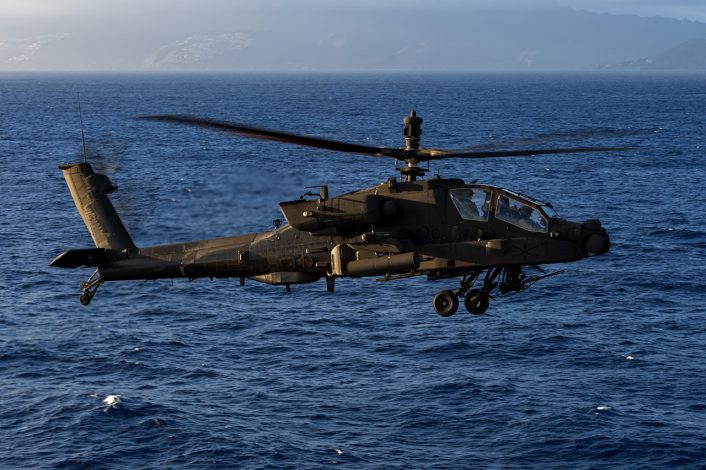
President Trump said the U.S. Army AH-64 Apache fighter jet crashed near the Strait of Hormuz for unknown reasons and the crew was rescued safely.
A U.S. Army AH-64 Apache attack helicopter crashed near the Strait of Hormuz on June 8, 2026. This news was first reported on June 8, 2026. new york timesCiting two people who reported the incident, it noted that two sailors were rescued.
When asked about the incident before boarding Air Force One, U.S. President Donald Trump responded that the two crew members were “okay” and “no one was hurt,” the Associated Press reported. Reuters. There is no statement from the Department of Defense or U.S. Central Command (CENTCOM).
The cause of the incident has not yet been revealed, now The incident is said to be already under investigation. Reuters President Trump was asked about this by reporters and responded that the report would be released soon.
This is the first AH-64 Apache helicopter lost in the Middle East since the start of hostilities with Iran. Notably, this incident occurred just a day after Israel and Iran halted new attacks following a new escalation.
Updated 10:16 UTC
CENTCOM has now released a statement on the incident, providing further details about the rescue.
At 7:33 PM ET on June 8, two crew members of a U.S. Army AH-64 Apache were rescued by U.S. forces after their helicopter crashed near the coast of Oman while patrolling local waters.
The soldiers were safely rescued in about two hours and are in stable condition. The cause of the incident is under investigation.
The rescue effort was led by U.S. Naval Central Command and the 82nd Airborne Division, with support from U.S. Air Force and Navy units, including U.S. 5th Fleet Task Force 59.
https://t.co/k6NzVz3G5t
— U.S. Central Command (@CENTCOM) June 9, 2026
Apache in the Strait of Hormuz
American Apache helicopters have been operating in the area for several months now. CENTCOM also released several photos in April showing AH-64s flying patrols, “providing a visible presence in support of freedom of navigation.” Earlier, Joint Chiefs of Staff Chairman Dan Kane said Apaches were hunting one-way attack drones in the same area.
Last May, U.S. Navy MH-60 Seahawks and U.S. Army AH-64 Apache helicopters were used to sink six Iranian small attack boats. The boats are reportedly threatening commercial shipping in the Strait of Hormuz, according to CENTCOM’s Admiral Brad Cooper.
No other details were provided about the U.S. attack, and it is unclear whether the MH-60 and AH-64 operated together or were involved in separate incidents. Navy and Army helicopters are conducting armed patrols in the area, and both helicopters have been seen carrying AGM-114 Hellfire missiles.
Together with fast jets, the AH-64 is well suited for maritime patrol missions. In fact, this platform combines a combination of persistence, precision sensors and flexible weapons to counter OWA drones that can be launched against fast ships as well as tankers and ships in crowded coastal environments.
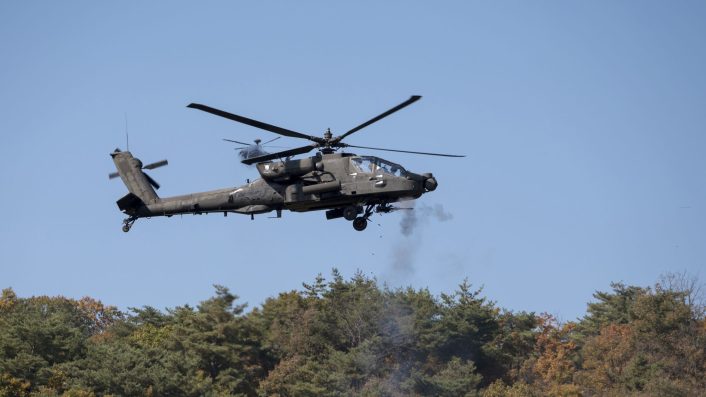
As shown by the U.S. Army’s recent counter-UAS demonstration, the AH-64E is capable of detecting, tracking, and defeating drones using a variety of weapons, including 30mm M230 chain guns, APKWS-guided 70mm rockets, HELLFIRE variants, and JAGMs. This provides the crew with scalable options depending on range, target size, and collateral risk considerations.
The sensor side of the helicopter features a combination of electro-optical and infrared sighting devices and a mast-mounted AN/APG-78 Longbow radar, designed to quickly detect, classify and prioritize large numbers of contacts. In the Strait of Hormuz, where threats can include small one-way attack drones, high-speed attack aircraft and other transient and difficult-to-classify targets, this combination makes the Apache a reliable hunter-killer platform.







