



The Air Force seeks to bring back the AGM-183 ARRW with $1 billion in funding through FY2030 while also beginning work on the ARRW-derived air-launched ballistics program (ALBM).
The U.S. Air Force is reviving the AGM-183A Air-Launched Rapid Response Weapon (ARRW) hypersonic missile program by requesting $345.7 million in the FY2027 budget, which will be used for Phase 2 of the weapons increment. The Navy also wants to begin design activities on a new air-launched ballistic missile (ALBM) derived from ARRW, which will receive $50 million in ARRW funding.
The budget request also notes that ARRW will be integrated with the B-1B Lancer bomber, which has been in the works for several years now. So far, test missions have only used the ARRW on the B-52H Stratofortress.
The Department of Defense formally told lawmakers in March 2023 that it did not intend to continue the program after three test failures in 2021 and one test failure on March 13, 2023. The 2022 and 2023 budget requests decided to focus on the Hypersonic Attack Cruise Missile (HACM) program, after eliminating spending plans and allocating the purchase of just one missile to complete planned test campaigns and collect critical data.

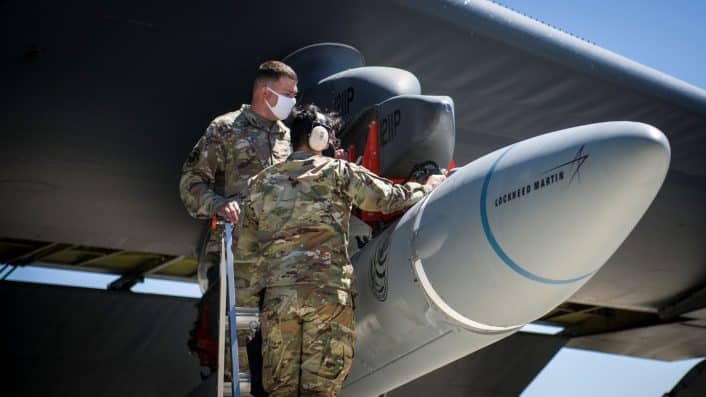
But moves to revive the ARRW have already begun in 2024, after the U.S. Department of Defense reported on September 26, 2024 that it had awarded Lockheed Martin $13.4 million in additional Research, Development, Test, and Evaluation (RDT&E) funding for the ARRW. This award therefore brings the total value of ARRW to $1.3 billion.
According to the current budget request document, two acquisition decision memorandums (ADMs) were signed on March 18, 2025 and March 5, 2026 for the mid-tier acquisition (MTA) pathway for ARRW. Prior to this, in June 2025, then-US Air Force Commander Gen. David Allvin hinted at a possible return of the ARRW to the House Armed Services Committee (HASC) while detailing a budget proposal for hypersonic weapons.
“I would say we are developing. You will see two different programs as we laid out in the budget submission,” Allvin said. “One is a more strategic, longer-range, larger form factor that we have already tested several times: ARRW.”
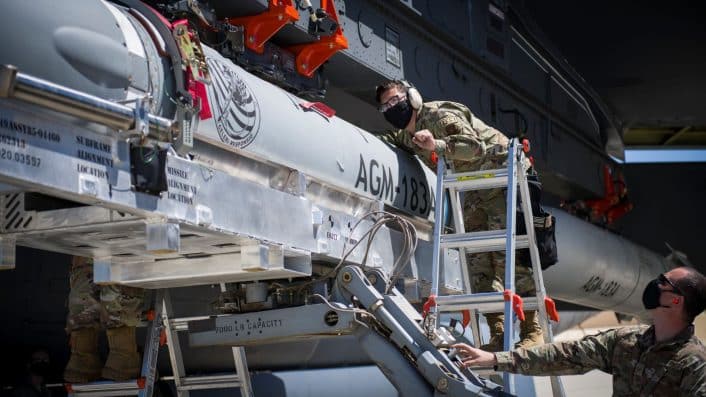
AGM-183 Seeking new financing for ARRW
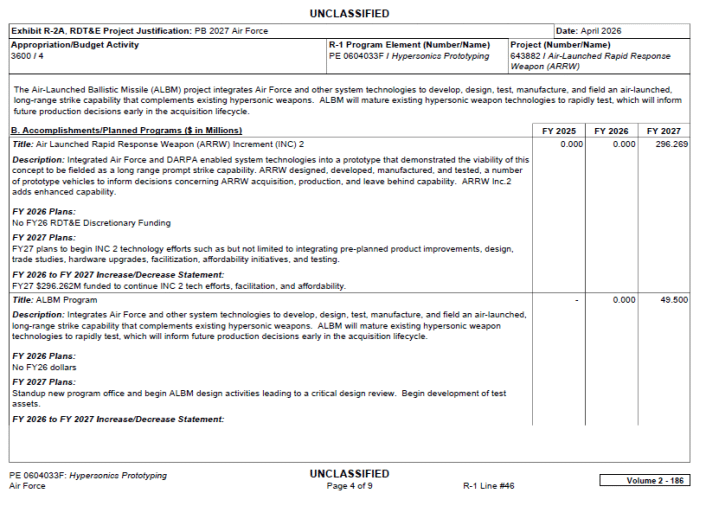
As previously noted, RDT&E Volume 2 seeks $345.7 million for ARRW in FY2027, followed by $548 million in FY2028, $620 million in FY2029, and $242 million in FY30, for a total of $1.7 billion. Of the $345 million requested for FY2027, the Air Force said in its budget request that it plans to spend $296 million on Incremental Phase 2 of the program.
“INC 2 technical efforts, including but not limited to pre-planned product enhancements, design, trade studies, hardware upgrades, facilitation, economics initiatives and test integration,” the service says.
Justifying the creation of the ARRW’s RDT&E prototype, the Air Force stated:
“Prototyping enables a key link between research and development in the laboratory and the application of advanced technologies to the warfighter. ARRW accelerates the transfer of new hypersonic technologies that integrate technologies into hypersonic systems and enable responsive, long-range strike capabilities. Hypersonic development occurs throughout this program element, which includes but is not limited to infrastructure improvements, digital engineering, open systems architecture, modeling and simulation, and new technologies, processes and demonstrations for the development and demonstration of hypersonic technologies. Incubate and mature resources for analytics and high-performance computing environments.”

The Pentagon then emphasized the need for continued testing to collect data to improve the technology and lay the engineering and scientific foundation for future weapons development.
“The Air Launched Rapid Response Weapon (ARRW) Project Integrating Air Force and DARPA support systems technologies have enabled us to leverage this concept as a long-range rapid strike capability. ARRW has designed, developed, manufactured, and tested a number of prototype vehicles to inform decisions regarding ARRW acquisition and production. Future developments will also seek to mature and integrate existing technologies to enhance the performance of hypersonic weapons (…). Investing in hypersonic development will allow us to collect valuable data (…) Let hypersonic programs leverage and build on each other.”
For the ALBM, which the language implies will be derived from ARRW, the Department of Defense will spend $49 million in FY2027 to “establish a new program office and initiate ALBM design activities leading to a critical design review.”
“The Air-Launched Ballistic Missile (ALBM) project integrates Air Force and other systems technologies to develop, design, test, manufacture, and field an air-launched long-range strike capability that complements existing hypersonic weapons. The ALBM will mature and rapidly test existing hypersonic weapon technologies, which will inform future production decisions early in the acquisition life cycle,” the document says.
At the HASC hearing, @RepJimBanks asked Deputy Secretary LaPlante why there are no plans to move America’s only prototype hypersonic missile, the AGM-183 ARRW, moving forward.
Answer: There is a plan, but the briefing will need to be held in SCIF (in a confidential setting). 🙌 pic.twitter.com/F4vq7Wv3nX
— Colby Badhwar (@ColbyBadhwar) February 15, 2024
ARRW is an aeroballistic hypersonic missile that operates on the boost glide vehicle principle. Dropped from a solid rocket motor (SRM) booster on the ground or a high-flying aircraft, an ARRW ‘boosts’ a hypersonic glide vehicle (HGV) and releases it just outside the atmosphere. Once supersonic speeds are reached, the HGVs separate and glide toward their target at speeds of up to Mach 15.
B-1B and ARRW
Integrating the B-1B with the ARRW is part of the B-1B Modernization Program, of which external Heavy Stories Pylon and hypersonic integration efforts are key components. “The Hypersonic Integration Program successfully demonstrated the B-1B’s ability to carry a 5,000-pound storage cannon and launched a proven weapon form in Load Adaptable Modular (LAM) pylons,” the Navy previously said.
The B-1B has already been tested with Boeing’s Load Adaptable Modular (LAM) pylons in 2024, for which Boeing was awarded an Air Force contract in the fiscal 2026 budget request. Additionally, looking at the latest budget documents, we can infer that LAM is part of hypersonic weapons integration efforts.
America’s next-generation hypersonic missile AGM-183A ARRW (Air Launched Rapid Response Weapon) was captured under the wing of a B-52H bomber at Andersen Air Force Base in Guam.
Despite rumors that ARRW will be canceled in March 2023, testing appears to be underway.
“AGM-183 ARRW is currently… pic.twitter.com/HYxLfpjLkp
— Venik (@venik44) March 3, 2024
Boeing previously said the idea was to use the new pylons to shift hypersonic weapons testing from the B-52 to the B-1 and increase BONE’s payload by 50 percent. “The Air Force plans to use the B-1 and pylons to test hypersonic weapons in the near term,” the company said.
Boeing added that the B-1 can accommodate six pylons, each capable of carrying two 2,000-pound weapons or a future 5,000-pound weapon. The pylons were initially installed on external hardpoints on the B-1B and later removed to meet post-Cold War nuclear arms reduction treaties.


