



Grace Eliza Goodwin,
Cristobal Vasquezand
Tom Bateman,State Department Correspondent

 getty images
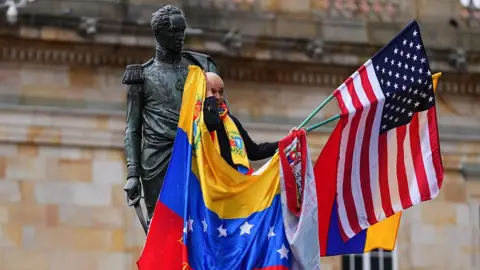
As the situation calms down in Caracas, Venezuelans are reacting with hope, fear and uncertainty to the news that the United States has arrested President Nicolas Maduro.
After a night of explosions in the Caracas Valley on Saturday, people began taking to the streets in moods ranging from celebration to condemnation.
Local resident Dina told the BBC she was now grateful to the US for “getting Maduro out of here”. Because now she “at least can see the light at the end of the tunnel again.”
But the political climate remains tense, which is one of the reasons she did not reveal her real name to the BBC.
Jorge, another Venezuelan living near Caracas, told the BBC: “I’m grateful that I have the support of Trump and the rest of the country, but I’m worried that the days ahead won’t be easy.”
“Now what’s going to happen when we take this person away?” Jorge told the BBC. “It doesn’t guarantee us anything. So there’s some uncertainty. We don’t know what’s going to happen.”
Supporters of the Maduro government are also rallying on the streets of Caracas and demanding the United States release their leader. Caracas Mayor Carmen Meléndez, a staunch government loyalist, joined the rally to protest Maduro’s ‘kidnapping’.
Early Saturday morning, U.S. forces under President Donald Trump launched a series of targeted attacks in the Venezuelan capital that eventually led to the Venezuelan leader being taken into U.S. custody.
The United States accuses Maduro of running a ‘narco-terrorist’ regime. He is widely seen by his opponents at home and foreign governments as having illegitimately won Venezuela’s 2024 elections.
Maduro, who leads the United Socialist Party and has been in power since 2013, has often been accused of using violence to repress opposition groups and silence dissent in Venezuela.
Venezuela’s future is uncertain as Maduro and his wife are extradited to New York to face drug trafficking and weapons charges. Trump said the United States would run the country and manage its oil reserves until a permanent successor to Maduro is established.
Maduro has previously denied U.S. claims that he was directly involved in drug trafficking.
But even among those grateful to see Maduro gone, there is still great fear and uncertainty, several Venezuelans told the BBC.
Dina doesn’t really trust Trump.
“He says something now and changes his mind tomorrow,” Dina said of Trump. “I mean, I’m not used to taking what he says seriously.”
“The only good thing” Trump said after Maduro’s arrest was that the United States would invest in Venezuela, which she said she hoped would lead to a “better economic situation” for the struggling country.
The risk of speaking out against Maduro remains very real in Venezuela, as the National Assembly, controlled by Maduro loyalists, passed a law several weeks ago declaring anyone who supports a U.S. naval blockade a “traitor.”
Jorge said yesterday he saw motorcyclists from Venezuela’s pro-government paramilitary group Colectivos roaming the streets carrying weapons.
“I’m a little scared to even go out and buy bread right now,” he said. “We’ll just have to do our best and be patient.”
Jorge added that he was worried about the influence of Maduro’s ally, Venezuelan Minister of Interior, Justice and Peace Diosdado Cabello.
“He’s a very bad person, a very malicious person,” Jorge said of Cabello. “I don’t know how many are on his side. I hope the military will stand with the people and he will lose some control.”
Sandra echoed Jorge and Dina’s relief at Maduro’s ouster. But she, too, is skeptical about the future and what it means for Venezuelans in exile.
Nearly 8 million Venezuelans have fled the country since Maduro took power, and many of them have publicly celebrated his arrest on the streets of the cities where they have settled.
In addition to the millions in exile, others are “disappeared, imprisoned, dead or simply alive.” This is “a true tragedy that has not been talked about in any country,” Sandra said.
Sandra added: “This is just the beginning. We know there is still a long way to go.” “No country has ever before heard the cries of the Venezuelan people in the face of this tragedy.”
Tom Bateman and Kristina Volk contributed to this report.





