



Manuela Peña Giraldo co-authored this article with Angie Acosta M.
Medellin and Bogotá, Colombia – Álvaro Uribe Vélez is one of the few Colombians to have served two terms as president and has served as a political kingmaker since leaving office in 2010.
Onetime Defense Minister Juan Manuel Santos served two terms, and his handpicked candidate, Iván Duque, won the 2018 election.
This joins Uribe’s party, the Centro Democratic Party, which has won an average of about 21 parliamentary seats and 17 Senate seats in the past four elections, and has been on the rise in 2018, riding a wave of discontent after Santo signed a 2016 peace deal with FARC rebels.
So when the Centro Democratico held a primary in March and Senator Paloma Valencia, who once said, “I am a Urivista and I will die a Urivista,” entered the race, it seemed as if she could offer a real challenge to Abelardo de la Espriella, a far-right candidate who ran on a social media-savvy, strong-crime platform. It was visible.
But that wasn’t true. Ahead of last Sunday’s election, opinion polls predicted Valencia would secure about 20% of the vote. She reached much lower, at 7%.
With that loss, she joined Federico Gutierrez, another candidate supported by Uribe. Federico Gutierrez lost in the first round of the 2022 election to former Bucaramanga mayor Rodolfo Hernández, another political outsider and firebrand. Hernández was later defeated by incumbent President Gustavo Petro.
Could a string of defeats in these key elections mean the end of 73-year-old Uribe’s political dominance?
a series of miscalculations
In a cross-party presidential primary last March, Valencia secured more than 3 million votes, defeating another center-right coalition. She chose economist Juan Daniel Oviedo, who received more than 1 million votes in the primary, as her running mate.
The choice was seen as an attempt to attract more moderate voters, a move some analysts say may have alienated her right-wing base.
“Paloma’s campaign made a tactical miscalculation by trying to win over centrist voters through Oviedo,” said Gabriel Clavizo, a political scientist and international relations expert at the University of Javeriana in Bogotá. “This ultimately alienated her traditional right-wing base, which did not view the alliance favorably.”
The choice of Oviedo, who is gay, shook the more conservative bloc of the Centro Democratico.
After the first round of elections on May 31, Valencia supported de la Espriella, who had publicly ridiculed Oviedo for his sexual orientation.
“It’s incredible that Colombia is debating its future based on homophobia and sexism,” Oviedo said.
Valencia’s campaign made other errors as well. Rodrigo Pombo Cajiao, professor of constitutional law at the University of Javeriana, said: Latin America Report Unlike de la Espriella’s campaign, Valencia lacked a vital component.
“(Valencia’s campaign) had no logo. Abelardo, by contrast, had a tiger. There was no slogan, while his opponent insisted on ‘firmes por la patria’ (‘firm for the homeland’). And most importantly, Abelardo’s campaign captured the banner of security.”
Some see Valencia’s traditional campaign style as a weakness amid populist outsider rhetoric.
“The Colombian right is moving away from Uribe and aligning itself with new global trends,” Clavijo said. “Uribe’s vote could not win over the entire electorate, as many voters were drawn to more direct, anti-establishment and reactionary proposals of the kind perfectly represented by the ‘outsider’ phenomenon.”
Uribe’s fading hidden politics
Uribe was elected president in 2002 during one of the bloodiest periods of Colombia’s half-century of internal armed conflict involving left-wing guerrillas, right-wing paramilitaries and state security forces.
He is credited with his ruthless tactics in defeating the FARC and other rebel groups and increasing security for ordinary Colombians, especially in urban areas such as Medellín. In 2013, he was voted ‘the greatest Colombian of all time’ in a poll hosted by the History Channel.
But his legacy has since been tarnished as revelations revealed his illegal spying on judges and journalists, human rights abuses, links to paramilitaries and drug cartels, and so-called misdiagnosis of killing civilians and increasing the number of murders by those dressed as guerrillas.
Last year, Uribe was found guilty of bribing a witness and committing procedural fraud in a case involving leftist senator Iván Cepeda, de la Espriella’s opponent in the June 21 runoff election. A court later overturned his conviction.
Read more: Former Colombian President Alvaro Uribe found guilty of bribery and procedural fraud in ‘trial of the century’
The 73-year-old politician regularly shouts at opponents in the streets, and a video circulating on social media days before the election showed the commotion outside his rural estate in Antioquia, where local graffiti artists painted messages about false positives on a nearby wall.
All this has contributed to the politician’s star fading even from his base.
“What we saw was a kind of grassroots revolt of ‘Uri Vista’ voters against Uribe himself.” said Vladimir Ramirez, a sociology professor and analyst at the University of Antioquia. “Faced with his apparent support of Paloma Valencia, many of his supporters were unhappy with the way Uribe made political decisions.”
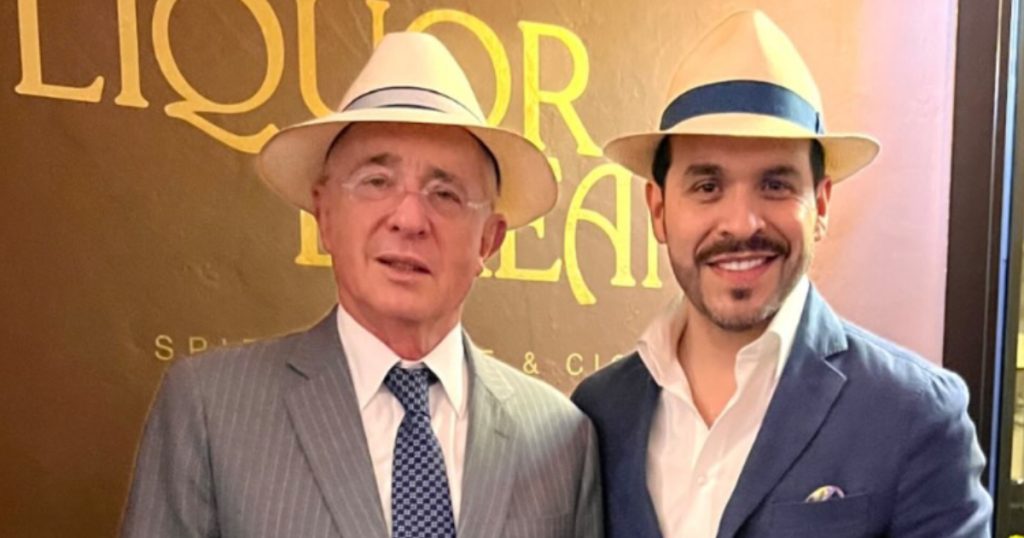
Uribe certainly had no enemies in Abelardo de la Espriella.
Uribe’s defeat does not necessarily mean that de la Espriella will have no allies in the presidency if he wins on June 21.
De la Espriella, who comes from a cattle ranching family in Córdoba, on Colombia’s northern coast, said he had known Uribe (who also runs a large cattle ranch in the area) “since I was a kid.”
De la Espriella, a lawyer, said he advised and represented the former president in a lawsuit against journalist and lawyer Daniel Mendoza over a miniseries he made about Uribe’s ties to drug paramilitary forces.
Regarding La Espriella’s victory, Uribe said, “Abelardo won. We keep our promise. We will vote for him and we hope you will vote for him and Colombia. We cannot allow our country to continue on the path of becoming a satellite of Chavismo, referencing the political ideology of former Venezuelan President Hugo Chávez.”
Given the intense hatred between Uribe and Cepeda, the former president aimed to defeat the leftist in a runoff, even if it meant giving up some of his political dominance.
“Uribe is no longer the central figure unifying the entire Colombian right. He is now fighting for political survival and this has led him to sympathize with La Espriella’s project rather than lead it,” Professor Clavizo said.
“This alliance will not be easy or harmonious. Both men are dominant figures with an authoritarian style, and both are used to setting the rules in their own parties. It will be interesting to see how they adapt to working together.”
Featured image: Paloma Valencia and Álvaro Uribe on the campaign trail.
Image credit: Álvaro Uribe (via Facebook)
This article originally appeared in The Bogotá Post and is republished with permission.







