




 getty images
US lawmakers have released more than 20,000 pages of documents from the estate of disgraced financier and convicted sex offender Jeffrey Epstein, including some that reference President Donald Trump.
On Wednesday morning, Democrats on the House Oversight Committee released three email exchanges, including correspondence between Epstein, who died in prison in 2019, and his longtime associate Ghislaine Maxwell, who is currently serving a 20-year prison sentence for sex trafficking.
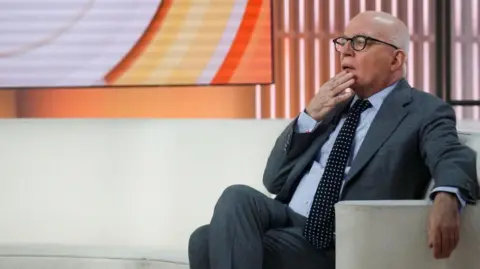
They also released emails between Epstein and author Michael Wolff, who has written numerous books about Trump.
Within hours, House Republicans released a massive document to counter Democratic efforts to “cherry-pick” the documents. They also said it was “an attempt to create a fake narrative to defame President Trump.”
“House Democrats selectively leaked emails to the free press to create a fake story to smear President Trump,” White House press secretary Carolyn Levitt said.
“The fact remains that President Trump kicked Jeffrey Epstein out of his club decades ago for his appalling behavior toward his female employees, including Giuffre,” she said.
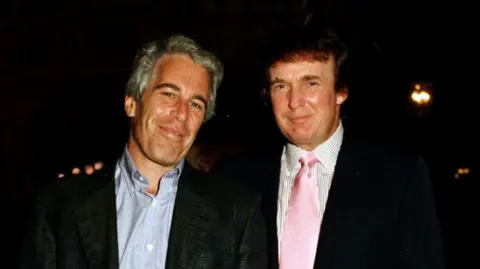
Trump has been a friend of Epstein’s for years, but the president said the two had a falling out in the early 2000s, two years before Epstein’s first arrest. Trump has consistently denied any wrongdoing regarding Epstein.
Epstein-Maxwell email content
The first emails released by Democrats were between Epstein and Maxwell in 2011.
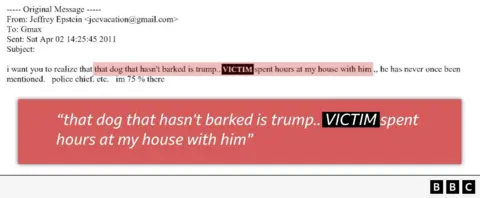
In it, Epstein wrote to Maxwell: “I want you to know that the dog that didn’t bark was Trump. (The victim) spent hours at my house with him.”
Epstein went on to write that Trump was “never mentioned,” including “police chief.”
Maxwell responded, “I’ve been thinking about it…”
The victim’s name was redacted in the email released by Democrats, but the tranche released by the committee included an unredacted version. The name “Virginia” appears.
The White House said this was a reference to Virginia Giuffre, a prominent Epstein accuser who died by suicide earlier this year. The White House said in a statement that Giuffre “repeatedly told her that President Trump had not been implicated in any wrongdoing and that he ‘couldn’t have been nicer’ to her in their limited interaction.”
Giuffre said in a 2016 deposition that she never saw Trump engage in abuse. And in a memoir released this year, she did not accuse the president of any wrongdoing.
Asked why the names were originally redacted, U.S. Rep. Robert Garcia, the Democratic leader on the House Oversight Committee, said the party would never release the victim’s name in compliance with the family’s wishes.
What the Epstein-Wolff Email Says
In a conversation with author Wolff, Epstein discusses his relationship with Trump. – At the time – he was campaigning for the presidency ahead of his first term.
In a second email exchange released by Democrats, Wolf wrote to Epstein in 2015 informing him that CNN planned to ask him questions about his relationship with Trump “either on air or later in a scrum.”
Epstein responds: “If we could come up with an answer to that, what do you think it should be?”
Wolff wrote: “I think we should let him hang himself. If he says he’s never been on a plane or home, it provides valuable PR and political currency. You can potentially hang him in a way that generates positive profits for you. Or, if he really looks like he’s going to win, you can save him and generate debt.”
“Of course, when asked, he is likely to say that Jeffrey is a great guy, has made great deals, and is a victim of political correctness that would be banned under Trump,” he added.
 Reuters
In a separate email from October 2016, days before the U.S. presidential election, Wolff offered Epstein the opportunity to participate in an interview that could “finish” Trump.
“You have an opportunity this week to talk about Trump to gain a lot of sympathy and help put an end to him. Are you interested,” Wolff wrote to Epstein.
The third email released by the Democratic Party was issued in January 2019, during President Trump’s first term.
Epstein told Wolff that “President Trump has asked me to resign,” adding, “I believe he was referring to my membership in the president’s Mar-a-Lago club.” He added: “I have never been a member.”
“Of course he knew about the girls, asking Ghislaine to stop,” Epstein added.
“Some of the emails were between Epstein and me, and Epstein discussed his relationship with Donald Trump,” Wolff said in a video posted to his Instagram account.
“I’ve been trying to tell this story for a very long time,” he added.
Andrew sent an email to Epstein in 2011.
The released document mentions not only Trump but also former Prince Andrew Mountbatten-Windsor.
He responded to an email forwarded by Ghislaine Maxwell through Jeffrey Epstein in March 2011 alleging sexual activity with a masseuse working for Epstein.
Here is Andrew’s answer: “Hello! What is this all about? I don’t know anything about this! I need to tell you, so please. This has nothing to do with me. I can’t take it anymore.”
Maxwell forwarded a “right to reply” email to the Mail on Sunday March 4, making numerous claims against Maxwell, Epstein and then-Prince Andrew.
The reply email states that a woman, whose name has been redacted from the published documents, was introduced to Andrew by the disgraced financier at Maxwell’s home in London in 2001 and had a sexual relationship with him.
On March 6, 2011, the Mail on Sunday published an article containing a photo of Prince Andrew and Virginia Guiffre.
Andrew has always denied any wrongdoing and has not faced any charges.
Peter Mandelson contacted Epstein in 2016.
Lord Peter Mandelson, who was sacked as British ambassador to the US in September over his links to Epstein, is also mentioned in the new document.
The documents show he was in contact with Epstein until late 2016.
The most recent contact previously reported between the two was when the then-business secretary was advised by Epstein on a banking deal in March 2010, just months after the US businessman was released from prison for child sex offences, as reported by the Daily Telegraph.
An email from Epstein to Lord Mandelson on November 6, 2015, shortly after his colleague’s birthday, read: “63 years old. You did it.”
Lord Mandelson responded less than 90 minutes later: “Just so. I have decided to extend my life by spending more time in America.”
Epstein then replies, “At the Donald White House,” referring to the U.S. presidential election scheduled for later that week.
Epstein goes on to say, “It was right to stay away from Andrew. It was right to stay with Rinaldo (sic),” referring to Lord Mandelson’s current husband, Reinaldo Avilda da Silva.
Lord Mandelson has repeatedly said he regrets his relationship with Epstein. He declined to comment on the emails when approached by the BBC.
What the survivors said
Annie Farmer, one of Epstein’s accusers and a key witness in Maxwell’s sex trafficking trial, shared a statement after the emails were made public.
“The more information that comes out about Jeffrey Epstein, the more questions we are left with. Survivors deserve more than a little information,” she said.
Palmer called for “full disclosure” of the so-called Epstein files, saying “the nearly 1,000 women and girls harmed by Epstein and his associates deserve full transparency.”







