



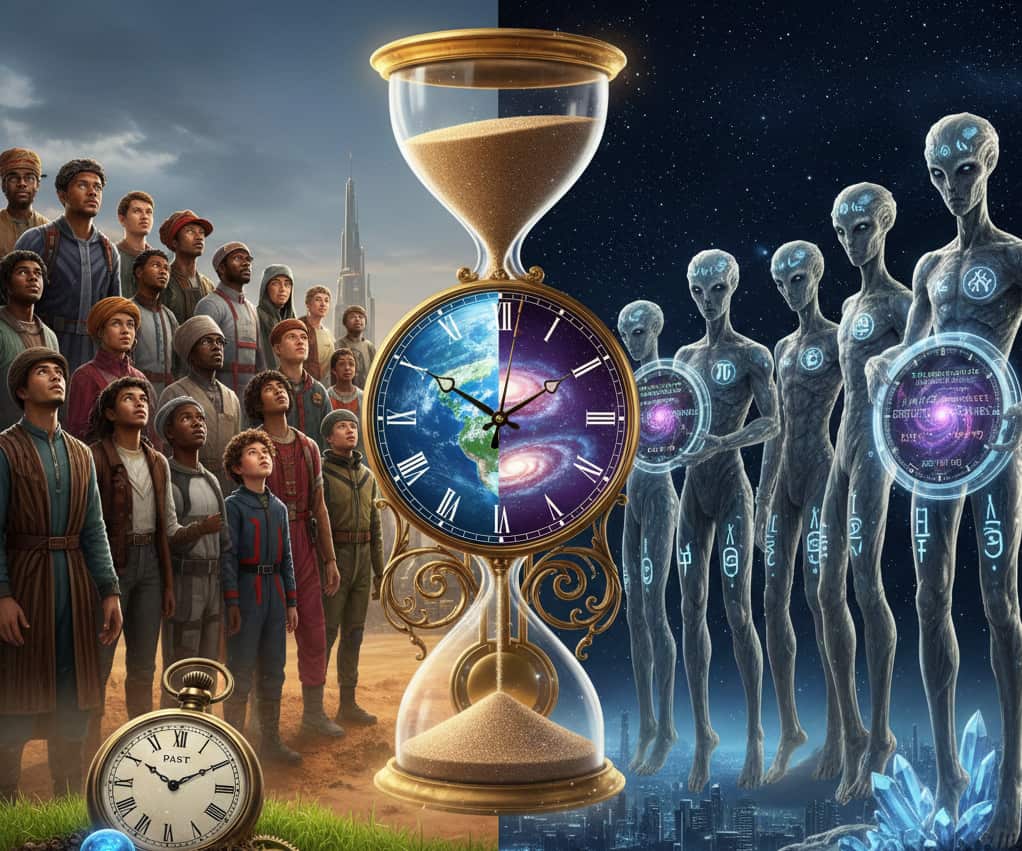
We humans have always lived tied to the hands of a clock. We define a day as 24 hours, a minute as 60 seconds, and have always believed that ‘time’ is a constant that flows equally for everyone. It doesn’t matter what corner of the world you are in. But in the reality of the universe “Time is relative” And it doesn’t always flow at the same speed.
If you’ve ever seen the movie interstellar You might remember the scene where the main character lands on a planet near a black hole for just a few hours. But when he returns to the spaceship, his friend is decades older. This is not just the director’s imagination. But this is a physical phenomenon. “Time Dilation”
Starting point of the idea: When ‘time’ is not a constant value
In the past, Sir Isaac Newton believed that time was a steady stream flowing throughout the universe. But in 1905 and 1915, Albert Einstein also brought about major changes in science. Theory of Relativity (Theory of Relativity) He proved that time is not separate from space. But it is combined into one substance “Space-Time”
The difference between Earth time and space time is largely caused by two factors. speed and gravitation
First element: speed (special relativity)
According to special relativity, the faster an object moves, the closer it is to the speed of light. Time is passing faster for that object. “slowly” Compared to a fixed observer
Imagine a “light clock” made up of two mirrors that reflect light particles up and down. One cycle is calculated as 1 second.
- If stopped: Light travels up and down in a straight line.
- When moving at high speed: People looking out can see the light moving diagonally. (Longer distances) But because the speed of light must always remain constant. Therefore, light takes a “longer” time to complete one complete cycle.
This phenomenon speed time dilation This is why astronauts on the International Space Station (ISS), which orbits the Earth at a speed of about 27,600 km per hour, live ‘slightly’ younger (about 0.01 seconds after 6 months) than people living on Earth.
Second Element: Gravity (General Relativity)
This factor affects more than just speed in the context of Earth and space. Einstein explained that the mass of a large object (e.g. the Earth or the Sun) bends “space-time” like a steel pendulum placed on a stretched canvas.
The closer we get to massive gravitational sources, the more time will move. “slowly”
- On Earth: We are close to the Earth’s core. Because gravity is higher, time passes more slowly.
- Outside the atmosphere: Gravity becomes weaker and time passes faster.
This is it gravitational time dilation The two most accurate atomic clocks would be a house at sea level and a house at the top of Mount Everest. Clocks on mountaintops always run faster than clocks at sea level. Even if it’s only for a brief moment.
Competition between ‘speed’ and ‘gravity’
Astronauts aboard the ISS face two factors simultaneously.
- High speeds on the ISS: Make your time well spent slowly (about 28 microseconds per day)
- Distance from Earth (reduced gravity): Make your time well spent faster (about 33 microseconds per day)
When taken together, the result is that the clocks on the ISS work. “Faster” On Earth, that’s about 5 microseconds per day. This means that astronauts returning from long-duration missions will be slightly ahead of their counterparts on Earth. (They (technically “time travelers” into the future)
Why should we care? (For GPS systems)
This may sound absurd. However, the time difference between Earth and space directly affects our daily lives, especially our systems. GPS (Global Positioning System)
GPS satellites orbit the Earth at high speeds at altitudes where gravity is much lower than that of Earth. If the engineer does not compute Einstein’s theory of relativity into the system:
- Satellite clocks run roughly faster than Earth’s. 38 microseconds per day
- It seems small, right? However, at the speed of light, these distortions make GPS positions inaccurate. 10 km per day
So every time you open Google Maps for navigation, it uses physics equations to compensate. There is always a ‘time difference’ between Earth and space.
Ultimate Time Distortion: Black Hole (Ultimate Time Distortion)
To see the clearest time differences, you should go to: “Black Hole” A black hole is an object whose gravity is so strong that not even light can escape.
If you travel near the edge of a black hole (the event horizon), the gravitational pull there is so strong that time becomes incredibly distorted. For you out there, only 10 minutes may have passed, but for those watching you from far away on Earth, thousands of years may have passed. And if you fall into a black hole, they will gradually see you from an outsider’s point of view. It moves slowly until it appears to “stand still” forever at the edge of the black hole.
Conclusion: Why is time on Earth different from time outside of this world?
The most surprising thing about this story is “There is no standard time in space.” Everything has its own time. It depends on where you are and how fast you are moving.
that Time on Earth and time outside the world are different. It teaches us how complex and amazing the universe is. It changes our perspective on reality. What was once thought to be stable and certain becomes flexible and relevant to the surrounding context.
“Time is just an illusion, even if it is a very stubborn illusion.” — Albert Einstein
Do we live in a world where time moves regularly, or are we floating in a space where time is warped? One thing is true: time is your most precious resource. And physics has proven that moments for all of us may not actually have the same value.
If you’ve read this far and want to find something fun to do during the day, be sure to stop by.Play Lottery Onlinewith Global Lotto You can do it. The website is easy to use, the system is reliable, there are a variety of number types to choose from, deposits and withdrawals are convenient, and there is a team that always looks after you. Someone who likes to take chances or set their own numbers. I know this is a great answer. Click here >>
Post Why is time on Earth different from time outside of this world? It first appeared in Space Stories.






