




 getty images
Copenhagen’s gloomy January weather matches the mood of Danish politicians and business leaders.
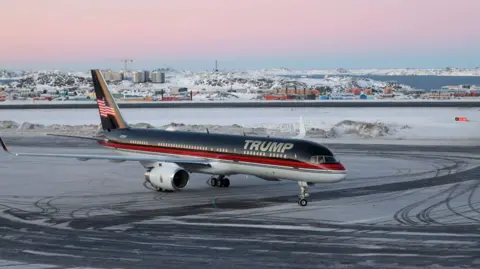
Foreign Minister Lars Løkke Rasmussen responded to Donald Trump’s threat to acquire Greenland and punish Denmark with high tariffs if it stands in the way: “We take this situation very seriously,” Foreign Minister Lars Løkke Rasmussen said.
But he added the government had “no ambition to escalate the spat”.
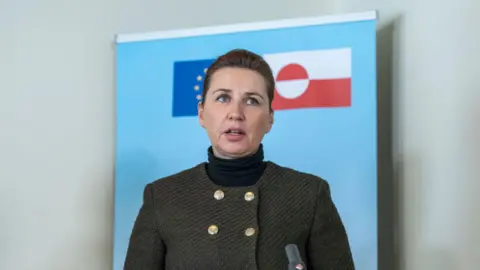
Prime Minister Mette Frederiksen dismissed President Trump’s suggestion that the United States could use military force to occupy Greenland. “I have no illusions that that will happen,” she said in an interview with Danish TV.
“There are plenty of reasons to be calm,” said Lars Sandahl Sorensen, CEO of Danish Industry. “No one is interested in a trade war.”
But behind the scenes, hastily organized high-level meetings have been taking place in Copenhagen all week, reflecting the shock of Trump’s remarks.
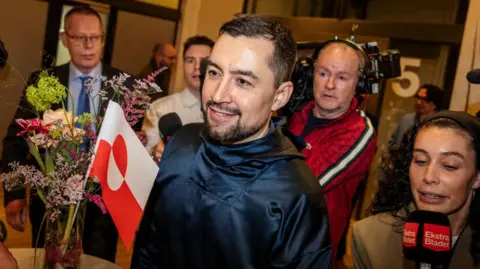
Greenland’s Prime Minister Mute Egede flew out to meet the Prime Minister and King Frederik X on Wednesday.
And on Thursday night, party leaders from across the political spectrum gathered for a special meeting on the crisis with Mette Frederiksen in the Danish parliament.
In the face of what many in Denmark called Trump’s “provocations,” Frederiksen attempted a broadly conciliatory tone, repeatedly referring to the United States as “Denmark’s closest partner.”
 AFP
AFPShe added that it was “natural” that the United States was preoccupied with the Arctic and Greenland.
But she also said any decisions about Greenland’s future should rest with its people. “Greenland belongs to the Greenlanders, and it is the Greenlanders themselves who must define their future.”
Her cautious approach is two-fold.
On the one hand, Frederiksen wants to avoid escalating the situation. She was burned in 2019 when President Trump canceled a trip to Denmark after calling a proposal to buy Greenland “absurd.”
“At the time, there was only a year left in office, but everything was back to normal,” veteran political journalist Erik Holstein told the BBC. “But maybe this is the new normal.”
But Frederiksen’s comments also speak to Denmark’s determination not to interfere in Greenland’s internal affairs. Greenland is an autonomous region with its own parliament and a population increasingly leaning toward independence.
“She should have rejected this idea much more clearly,” said opposition lawmaker Rasmus Jarlov.
He told the BBC: “This level of disrespect from the next president of the United States towards a very loyal ally and friend is record-breaking,” and acknowledged that “everyone was surprised” by Trump’s strength.
The conservative lawmaker believed that Frederiksen’s claim that “only Greenland… can determine and define Greenland’s future” was putting too much pressure on the island’s residents. “It would have been wise and clever to side with Greenland and make it clear that Denmark did not want an American takeover.”
 AFP
AFPThe Greenland issue is a sensitive issue for Denmark. Denmark’s prime minister recently publicly apologized for leading a social experiment in the 1950s that forced Inuit children to be taken from their families and reeducated as “model Danes.”
Last week, Greenland’s leader said the country must break free from the “shackles of colonialism.”
In doing so, he capitalized on the growing nationalist sentiment fueled by the interest of young Greenlanders in the indigenous culture and history of the Inuit.
Most commentators now expect a successful independence referendum to be held in the near future. While this is seen by many as a victory, it could also create new problems since 60% of Greenland’s economy depends on Denmark.
An independent Greenland “will have to make choices,” Karsten Honge said. The Social Democrat now fears that a new Commonwealth-style deal he prefers “based on equality and democracy” is unlikely to materialise.
Sitting in a parliamentary office decorated with poems and paintings depicting scenes from Inuit life, Honge said Greenland must decide “how much it values its independence.” Hongge said he could cut ties with Denmark and turn to the United States, but that doesn’t make sense if he values independence.
Opposition lawmaker Jarlov argues that forcing Greenland to be part of Denmark makes no sense, but that it is “already very close to becoming an independent state.”
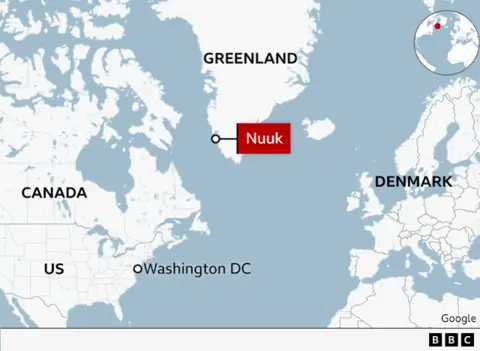
The capital, Nuuk, is an autonomous city but relies on Copenhagen for currency, diplomatic and defense administration and significant subsidies.
“Greenland today has more independence than Denmark has from the EU,” Jarlov added. “So I hope they think it through.”
The most robust rebuttal to Trump’s comments so far has come from outside Denmark, as Mette Frederiksen has the awkward task of responding decisively without offending Greenland or the United States.
German Chancellor Olaf Scholz warned that “the principle of inviolability of borders applies to all countries,” while French Foreign Minister Jean-Noël Barro said the European Union would not allow this. Other countries “attack their own sovereign borders.”
Their comments raised deep concerns within the EU about how to handle the upcoming election of President Trump. “This is not just a serious problem for Greenland and Denmark. It is a serious problem for the whole world and for Europe,” said lawmaker Karsten Honge.
“Imagine the world we will face in just a few weeks, where there are no international agreements. That would shake everything up and Denmark would be just one part of it.”
Denmark’s trade sector was also deeply shaken after President Trump said he would impose “very high tariffs on Denmark” if it did not give up Greenland to the United States.
A 2024 Danish Industry Study found that if the US imposed a 10% tariff on imports from the EU to the US as part of a global trade war, Denmark’s GDP would fall by 3 points.
Sorting out Danish products from the influx of EU goods would be nearly impossible for the United States and would almost certainly lead to retaliatory action from the EU. But trade industry experts are taking few risks, and in Denmark, as elsewhere on the continent, vast amounts of resources are being expended internally to plan for the potential consequences of Donald Trump’s second term in the White House.
As the inauguration approaches, Danes are doing their best to prepare to weather the storm. There are hopes that the next president will soon shift his focus to grievances against other EU member states and that the Greenland issue may be temporarily put on hold.
But the anxiety caused by President Trump’s refusal to rule out military intervention to occupy Greenland remains.
Karsten Honge said that no matter what decision the United States makes, Denmark will suffer.
“All they have to do is send a small warship to travel along the Greenland coast and send a polite letter to Denmark,” he said, partly in jest.
“The last sentence is: Denmark, what are you going to do?
“That’s the new reality about Trump.”







