



The United States and Australia have signed an agreement to increase supplies of rare earths and other critical minerals, as the Trump administration seeks ways to counter China’s market power.
Australian Prime Minister Anthony Albanese said the deal would support a pipeline of $8.5 billion (A$13 billion, 6.3 billion pounds) “ready-to-use” projects that would expand the country’s mining and processing capacity.
This includes $1 billion for both countries to invest in projects in the United States and Australia over the next six months, the primary document says.
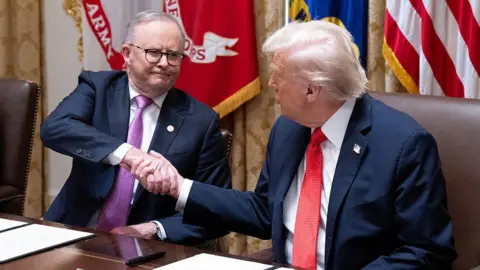
The United States and Australia have been working to resolve the issue since Trump’s first term, but Albanese said the latest agreement would take their partnership to the “next level.”

 AFP via Getty Images
On Monday, US President Donald Trump also spoke about Aukus, Australia’s multibillion-dollar submarine deal with the US and UK, saying it was “going full steam ahead”.
The deal came into the spotlight earlier this year after the Trump administration said it would review the details to ensure it fits with its “America First” agenda, raising concerns that Australia may not be able to buy American submarines to replace its aging fleet.
When asked if Australia would acquire submarines, President Trump responded, “No, they are.”
China now controls about 70% of rare earth mining and 90% of the processing of rare earths, which are used in everything from defense equipment to computer chips and cars.
U.S. companies rely heavily on raw materials, making them vulnerable this year as China took steps to limit access to supplies in response to new U.S. tariffs and other tensions.
Albanese said the agreement aims to accelerate investments in three types of projects, including U.S. investments in Australian processing facilities.
The two countries also agreed to cooperate on issues such as pricing, licensing and government review rules for the sale of companies and projects in the sector.
The United States separately said it would invest in the construction of an advanced 100-tonne-per-year gallium refinery in Western Australia and was preparing to provide about $2.2 billion in financing to advance critical minerals projects through the Export-Import Bank.
In recent months, the Trump administration has announced a series of investments in companies such as U.S. rare earths miner MP Materials, Canada’s Trilogy Metals and Lithium America’s, which already have projects underway in the United States.
In return for their support, they received an ownership stake in the company.
Ahead of the meeting, shares of Australian companies such as Lynas Rare Earths jumped on the prospect of increased support. Lynas is working on a project in Texas under contract with the U.S. Department of Defense several years ago.
The framework released by the White House did not reveal details and reflected the ongoing and sensitive issue.
Australia is a major source of critical minerals, but like the United States, it relies on its largest trading partner, China, for the processing needed to turn those materials into something companies can use.







