




 Reuters
Ukrainian Foreign Minister Andriy Sibikha accused President Vladimir Putin of “wasting the world’s time” a day after high-level talks between the United States and Russia over ending the war in Ukraine failed to produce tangible results.
“Russia must end the bloodshed that has started. If this does not happen and President Putin once again spits in the face of the world, there will be consequences,” Sybiha said.
Nonetheless, the U.S. delegation told its colleagues that the talks had “positive implications for the peace process” and added that it had invited Ukrainian officials to continue talks in the United States in the near future.
President Donald Trump’s special envoy Steve Witkoff and his son-in-law Jared Kushner spent nearly five hours with Putin in the Kremlin on Tuesday, and the White House said they briefed Trump on Wednesday after a “thorough and productive meeting.”
The talks between the United States and Russia come after days of talks by the United States with Ukrainian and European leaders, who expressed concerns that a deal was being struck that was too biased toward Russian demands.
Little concrete progress appears to have been made during Kremlin talks reconciling Moscow and Kiev’s positions.
 Reuters/Pool/Sputnik
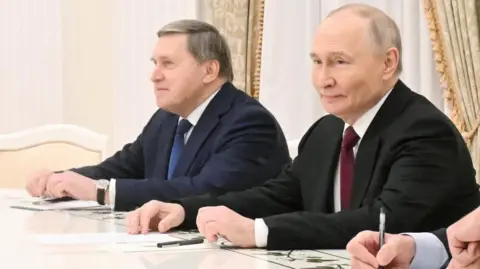
Yuri Ushakov, Putin’s senior policy adviser, said “no compromise was found” on ending the war. “Some of the U.S. proposals seem somewhat acceptable but require further discussion,” he said. Meanwhile, other proposals have drawn public criticism from Russian leaders, he added.
Ushakov did not elaborate further, but at least two major points of contention remain between Moscow and Kiev. It is the fate of Ukrainian territory occupied by Russian forces and security guarantees for Ukraine.
Kiev and its European partners believe that even if a peace deal is reached, the most effective way to deter future Russian aggression would be to grant Ukraine NATO membership.
Russia is vehemently opposed to such a proposal, and Trump has repeatedly said he has no intention of allowing Kiev to join the alliance.
The Kremlin said Wednesday that Ukraine’s possible accession to NATO was a “key question” that had been addressed in Moscow.
Ushakov hinted that Russia’s negotiating position has been strengthened thanks to recent battlefield successes.
He said Russian soldiers “helped make the assessment of foreign partners more relevant regarding the path toward a peace settlement.”
Ahead of his visit to the Kremlin in the United States, President Putin was filmed at a Russian command post in military uniform receiving a briefing from commanders who called for the conquest of Pokrovsk, a key strategic city in eastern Ukraine, and nearby settlements.
Fighting in Pokrovsk continues, with Russian forces losing control of the entire city. But Russian officials clearly believe their message of military gains has been conveyed to the United States.
Russian forces have made gradual advances in the east and appear to have stepped up their operations in recent weeks. They seized about 701 square kilometers (270 square miles) of Ukrainian territory last November and now control 19.3% of Ukraine’s territory, according to an AFP analysis of data from the Institute of War Studies (ISW).
The Kremlin said Wednesday that Putin was prepared to continue meeting with the United States “as long as necessary.”
But as relations between Russia and the United States appear to be developing more cordially, the gap between Moscow and Europe has widened.
Putin accused Europe of interfering with relations between Russia and the United States, making demands that Moscow cannot accept and obstructing the peace process. Speaking at a forum in Moscow shortly before meeting Witkoff and Kushner, Putin said he did not want conflict with Europe but was “ready for war.”
 Reuters
British government officials dismissed Putin’s message as “Kremlin ramblings from a president who is not serious about peace.”
NATO foreign ministers met in Brussels on Wednesday and Secretary-General Mark Rutte said it was positive that peace talks were progressing, but that Ukraine needed to be in “the strongest position to continue the fight.”
Meanwhile, EU member states have reached an agreement with MEPs to make Europe fully independent of Russian gas before the end of 2027.
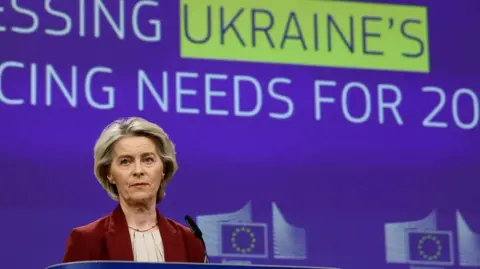
European Commission President Ursula von der Leyen welcomed the “beginning of a new era” following an agreement that would see long-term gas pipeline contracts with Russia banned from September 2027 and long-term liquefied natural gas contracts from January 2027.
“We chose energy security and independence for Europe. No more blackmail, no more market manipulation by Putin. We will stand firm against Ukraine,” EU Energy Commissioner Dan Jorgensen said Wednesday.
The committee is also proposing that Ukraine raise 90 billion euros to fund its military and basic services while Russia’s war continues.
The plan would require Belgium to agree to a “compensatory loan” using frozen Russian assets held in financial institutions in Brussels or would be financed through international borrowing.
Ukrainian Prime Minister Yulia Svyrydenko welcomed the proposal, which would cover two-thirds of Ukraine’s financial needs over the next two years.
Belgium has rejected plans to utilize frozen assets stored on its territory, fearing legal repercussions from Moscow. The European Central Bank (ECB) also opposed the idea, saying it would not act as a backstop for compensation loans.
The proposed loan is less than the 140 billion euros originally planned, and German Foreign Minister Johan Waddepuhl said: “We support this and of course we take Belgium’s concerns seriously.”







