



Various anti-Cuban groups, including Cuban Freedom March, Steps for Change and Cuban resistance rally (ARC) gathered at the Ermita de la Caridad del Cobre, Miami’s Roman Catholic church and shrine dedicated to Cuba’s patron saint, to sign the ‘Liberation Agreement’.
Rosa María Paya, a prominent Cuban opposition activist and one of the main signatories of the agreement along with ARC Secretary-General Orlando Gutiérrez-Boronat, defined the agreement as “a coordinated transition framework approved by a unified coalition of Cuban opposition forces on the island and in exile.”
John Suarez, director of the Anti-Cuban Regime Center for a Free Cuba, said: Latin America Report On the meaning of unifying the Cuban opposition. He described the liberation agreement as “a step toward unifying the opposition movement in Cuba with the vision of returning sovereignty to the Cuban people after 67 years of communist dictatorship.”
The signing of such a document appears to indicate that the Cuban opposition anticipates some kind of regime change and subsequent democratic transition on the island in the near future.
Suárez confirmed that the Cuban opposition “believes change is imminent” due to the “exhaustion of Cuba’s communist model, which most Cubans reject” and the White House’s decision to pressure “the existing regime to make fundamental changes.”
The Liberation Agreement plans what this transition will look like. In addition to condemning the regime, the document lays out a three-step plan for change in Cuba. In other words, it proposes the ‘liberation’, ‘stabilization’, and ‘democratization’ of the island.
The process will include “dismantling the criminal enterprise of the Cuban Communist Party and dismantling all repressive organizational mechanisms.” Specifically, the document proposes that the Cuban opposition movement establish an interim government to address the deepening humanitarian crisis, release political prisoners, rebuild democratic institutions, and ensure a stable transition to free multi-party elections on the island.
Suárez explained that unity between the diaspora and the Cuban population will be a key part of the process laid out in the opposition’s plan. The opposition reportedly called for “all Cubans who have not committed serious human rights violations to join this effort.”
Once the transition to democracy is achieved, Suarez expects the end of “the United States embargo on Cuba by the law enacted in the Cuban Freedom and Democratic Solidarity Act of March 12, 1996.” Popularly known as the Helms-Burton Act, the law makes the establishment of a democratic transitional government a legal prerequisite for lifting the embargo.
The proposed democratic transition will need U.S. support to succeed. The signatories of the Emancipation Agreement reside primarily in South Florida. The U.S. government, which has recently repeatedly threatened regime change on the island and strengthened anti-Cuban economic sanctions, may well be able to support the ambitions of the newly unified Cuban opposition movement.
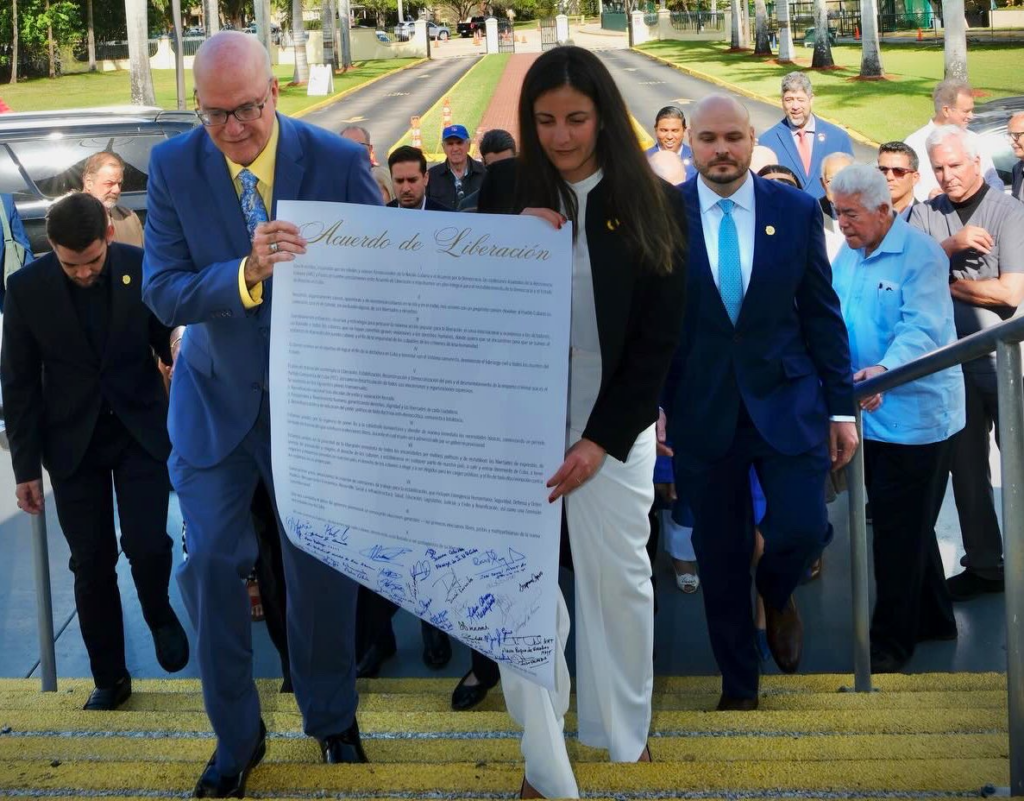
Image source: Rosa María Paya A. via X
US Secretary of State Marco Rubio has long been a staunch critic of the Cuban regime and is an ally of Maria Falla, having previously nominated her to the Inter-American Commission on Human Rights. In a statement supporting her nomination, he described her as a “principled, courageous and deeply committed defender of human rights and democracy.”
Sebastián Arcos Cazabón, associate director of the Cuban Institute at Florida International University and a member of the research committee of the Center for a Free Cuba, said: Latin America Report Cazabón explained the unique nature of the current political situation: “There are many active Cuban political (opposition) groups both on and off the island, and a unifying umbrella … has always seemed out of reach,” Cazabón explained.
The Cuban opposition activist, who was born in Havana and was imprisoned on the island in the early 1980s for attempting to defect, expressed hope that this declaration by various Cuban opposition groups would “achieve what seemed impossible” and that this unification, combined with US support, would lead to “a complete transition to full democracy… (and) free elections within a relatively short period of two to three years at most.”
However, some Cubans questioned the intentions of the ‘liberation agreement’. A Cuban Foreign Ministry official, who requested anonymity, said: Latin America Report “These organizations do not represent the Cuban people, have no legal status, and their members put personal and economic interests first. Waging counterrevolution in Miami is a lucrative business.”
The Cuban government has not yet issued an official statement regarding the ‘liberation agreement’, but some left-wing figures have expressed skepticism about the plan’s intentions.
María Teresa Felipe Sosa, a Cuban journalist writing for the left-leaning Diario Red, questioned the legitimacy of Paya, Boronat and other signatories. Felipe Sosa noted that the “moral and political authority of those who seek to decide the future of Cubans in a territory that has served as a base for organizing terrorist acts against our people” is questionable.
In fact, there has been a history of clandestine and violent incursions into Cuban territory by Cuban exiles for the purpose of forcing regime change. Last week, Cuban authorities reportedly intercepted and attacked a Florida-registered speedboat carrying 10 Cuban nationals living in the United States.
According to Cuban authorities, the group planned to “infiltrate (the island) for terrorist purposes.” Cuban Deputy Foreign Minister Carlos Fernández de Cosio also criticized anti-Cuban groups operating in the United States in a statement sent to the media last week, saying, “They are resorting to terrorism as an expression of their hatred of Cuba and the impunity they believe it enjoys.” However, there is absolutely no possibility that the signatory countries of the ‘Liberation Agreement’ were involved in this incident.
Featured image: Rosa María Paya and U.S. Secretary of State Marco Rubio at the State Department
Image source: U.S. Department of State via Wikimedia Commons
patent: Creative Commons License







