



For the second day in a row, Swedish, Romanian and French fighter jets intercepted a Russian Tu-22M3 ‘Backfire’ strategic bomber carrying Kh-22N/Kh-32 supersonic cruise missiles over the Baltic Sea.
The Russian Aerospace Forces’ (RuAF) Tupolev Tu-22M3 ‘Backfire’ strategic bomber, carrying Kh-32/Kh-22N supersonic cruise missiles, was intercepted in two episodes over the Baltic Sea for the third time in two years. The bomber was intercepted by Swedish Air Force (Flygvapnet) jets on April 20, 2026, and by Romanian and French fighter jets as part of the Baltic Air Policing (BAP) mission at Šiauliai Air Base, Lithuania, on April 21.
As in previous cases, the weapon appears to be an inactive variant used for training, according to military aviation analyst Guy Plopsky’s assessment based on markings visible in the images. Training variants of Russian weapons are often painted with a black band around the warhead area.
Shown here is a VKS Tu-22M3 escorted by a Su-30SM2. The former appears to be equipped with a single Kh-22N anti-ship missile or a variant thereof (judging by the black band around the warhead area, it is the latter). https://t.co/h7IA7Rc3JJ pic.twitter.com/DgjDRVAn9j
— Guy Plopsky (@GuyPlopsky) April 20, 2026
Previously, on December 17, 2024, Finnish, Swedish and Dutch fighter jets scrambled to monitor and escort Russian aircraft over the Baltic Sea. Among their targets was a Tu-23M ‘Backfire’ carrying a single Kh-22 or Kh-32 (NATO-designated AS-4 Kitchen) under its wings.
Busy day for NATO air security ✈️
The Romanian Air Force 🇷🇴 Lithuanian Baltic Air Security Detachment 🇱🇹 conducted its first NATO air security sortie last week, intercepting an Il-20M “Coot-A”.
Yesterday French Rafale 🇫🇷 fighter jets and Romanian F-16 🇷🇴 intercepted several… pic.twitter.com/DE3uqDFQFq
— NATO Air Command (@NATO_AIRCOM) April 21, 2026
A year later, on November 27, 2025, Flygvapnet Saab JAS39 Gripens again intercepted a Tu-22 carrying a Kh-22/32 under the port (left) wing. However, images released by NATO Air Command and Flygvapnet from two recent intercepts showed a Tu-22 carrying a single Kh-22/32 in a weapons station halfway into the centreline.
The Russian Ministry of Defense, which frequently promotes flights over the Baltic Sea and the East Sea, released a video of a ‘scheduled flight over the neutral waters of the Baltic Sea’. As the bomber takes off, its weapons are clearly visible.
Official RU MoD video on the latest flashback patrols in the Baltic Sea region. https://t.co/SZMGcKFQcF pic.twitter.com/PbSZjPfBzv
— Dmitry Stepanovich (@KomissarWhipla) April 21, 2026
NATO and Sweden intercept Tu-22
A Flygvapnet post published on April 20, 2026, shows the RuAF’s Su-30SM2 and Tu-22M3, with Kh-22/32 missiles visible on the center line. The Air Force said, “We intercepted two Russian Tu-22M3 strategic bombers,” but only one is visible in the image.
“The bombers were escorted by two Russian fighter jets and the intercept was carried out in cooperation with our NATO allies,” he added. The Su-30SM2 appears to be carrying at least one R-73/R-74 short-range AAM on its starboard wing.
Information released by NATO Air Command on April 21 included intercepts conducted by Romanian F-16s and French Rafale fighter jets as part of the Baltic Air Policing (BAP) mission in Lithuania last week. Romanian F-16s made the first intercept when they encountered an Ilyushin Il-20 Coot-A signals/electronic intelligence (SIGINT/ELINT) aircraft.
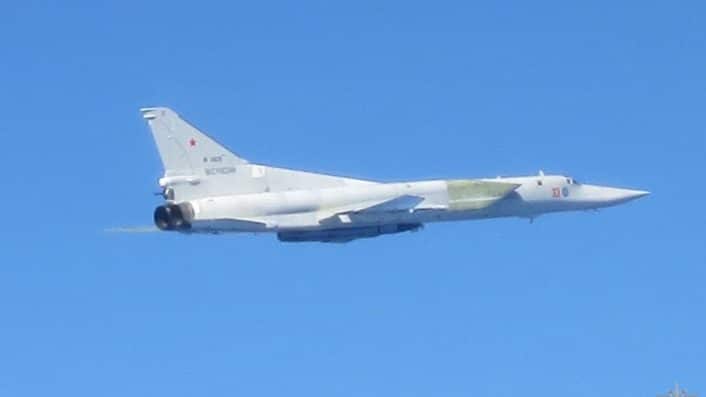
Another set of photos next to the Il-20 shows the Su-35S and Tu-22M3, the latter again carrying the Kh-22/32 with a black nose cone on the centerline. “Yesterday (April 20) French Rafale fighter jets and Romanian F-16s intercepted several Russian reconnaissance aircraft, bombers and fighter jets. NATO air security in the Baltic Sea region, commanded by the Eastern Sentry, ensures continuous vigilance, deterrence and protection of NATO airspace,” the NATO post said.
Information and video released by the French Joint Chiefs of Staff on April 21 shed more light on these intercepts, saying there were two intercepts on the same day. The first attack involved Il-20s while the Rafales relieved Romanian F-16s that were escorting a squadron of Tu-22, Su-30 and Su-35s.
The second intercept involved another Su-30 and Su-35 pair. The French Joint Chiefs of Staff also released footage of the Rafale’s TALIOS targeting pod capturing Tu-22s and Su-35Ss.
🇷🇺Russian Tu-22 M3M bomber with kh-32 supersonic anti-ship missiles and Su-30/35 heavy fighter aircraft 🇫🇷 French Strategic Air Force (FAS) ☢️ Seen through optical sensors of Rafale B – currently deployed in Lithuania for NATO’s air policy mission in the region. https://t.co/ebJ9Bf1uu1 pic.twitter.com/gqYs9u5XdZ
— Etienne Marcus (@Etienne_Marcuz) April 21, 2026
The Romanian Ministry of Defense also released images of an F-16 interception. In the high-resolution image, the Tu-22M3 and its missiles are clearly visible.
As part of the NATO Enhanced Air Policing mission, the “Carpathian Vipers” detachment 🇷🇴 deployed to 🇱🇹 was tasked with identifying and monitoring a formation of Tu-22M3 bombers escorted by Su-35S aircraft. https://t.co/k91M5wb8CR pic.twitter.com/pvXRjq1w77
– MApN (@MApNRomania) April 22, 2026
The missiles visible on both interceptors have black nose cones. Regarding the Tu-22 intercepted by Sweden, nuclear weapons and policy expert Hans Kristensen identified it as a “nuclear-capable” Kh-32, but Russian military aviation analyst Guy Plopsky disagreed and stated that it was a Kh-22N anti-ship missile.
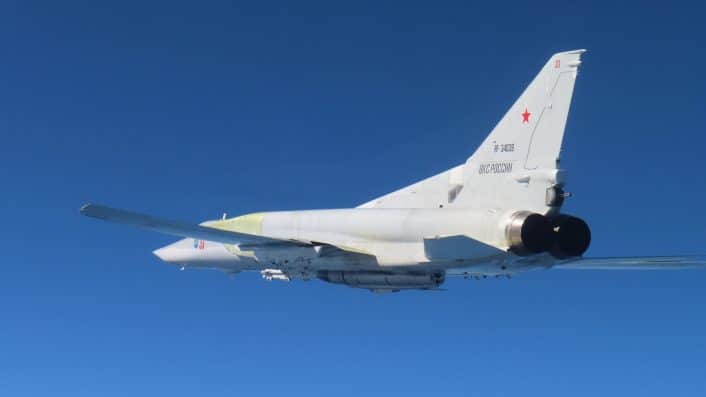
It is unclear whether the April 20 and April 21 intercepts involved the same Tu-22. The image released by NATO shows Bort number 33 on the fuselage, but the Bort number in the Swedish image appears to be different, although it cannot be clearly identified due to image quality issues.
Judging by the black belt, it appears to be a training variant of the Kh-22. https://t.co/jX4esgDGdN
— Guy Plopsky (@GuyPlopsky) April 20, 2026
Consistent with NATO intelligence about the interception of the Russian aircraft, the alliance did not claim a violation of sovereign territory, suggesting the Russian aircraft remained in international airspace.
Kh-22/32 air-launched cruise missile
The Kh-22 missile was developed in the early 1960s as a high-speed missile with a speed of just over 4,000 kilometers per hour to bypass regular air defenses and destroy large stationary or slow-moving targets such as ships (e.g. aircraft carriers), military bases, power plants, and bridges.
If you’re not sure which band I’m referring to, add them here: https://t.co/CvXNl1R00g
— Guy Plopsky (@GuyPlopsky) September 12, 2023
Introduced in 2016, the Kh-32 looks strikingly similar to the Kh-22, but has few notable differences. The upgraded weapon is primarily designed to be mounted on Tu-22M3 bombers.
According to an unofficial Russian-affiliated Telegram channel, the Kh-32 has a smaller warhead, improved rocket motors, and a new radar imaging seeker for terminal guidance that operates at multiple frequencies, making it less susceptible to radar/radio frequency jamming.
yesterday @fap_pt 🇵🇹 F-16s scrambled to identify 🇷🇺 Ilyushin Il-76 Candids flying close to NATO airspace.
This is the first alpha scramble for the 🇵🇹 detachment since taking over the NATO enhanced air security mission at Émari Air Force Base in 🇪🇪. @Italian Air Force 🇮🇹 pic.twitter.com/C0xTSrZ8e7
— NATO Air Command (@NATO_AIRCOM) April 7, 2026
Another recent interception of a Russian aircraft over the Baltic Sea
On 8 April, NATO Air Command reported that the Portuguese Air Force (Força Aérea Portuguesa – FAP), deployed to Emari Air Base in Estonia for the Baltic Air Policing (BAP) mission, intercepted a Russian Ilyushin Il-76 tanker on 7 April. FAP sent F-16s in Alpha-scramble (as opposed to Tango-scramble) to intercept the Il-76. “Flying close to NATO airspace”, “after capturing Amari” in the service’s first intercept.
📍Lithuania | Intervention within a very short period of time against Rafale 🇫🇷 deployed as part of Baltic air security
🎯 Maximum responsiveness to protect alliance territory
⚡️ Support and escort of Russian IL-20 reconnaissance aircraft in the south… https://t.co/fIfvIbkPcI pic.twitter.com/bThGVZSriy
— French Army – Military Operations (@EtatMajorFR) April 9, 2026
On the same day, the Allies reported that an Il-20 Coot-A was intercepted by two French Aerospace Forces (FASF) Rafale Bs deployed at Šiauliai, Lithuania. The French Joint Command also released additional images of the Il-20, one of which was possibly an infrared capture from the Rafale’s TALIOS targeting pod.
📍Lithuania | Baltic air security mission continues 🛡️
✅ Four Rafale interventions in cooperation with allies within a week 🇫🇷
⚔️ Identification and support of 6 aircraft 🇷🇺 🇱🇹, 🇱🇻 🇪🇪 as part of the protection of the Baltic countries’ airspace
— French Army – Military Operations (@EtatMajorFR) April 15, 2026
A week later, on April 15, the French Joint Command posted a short 19-second promotional video for the FASF’s BAP detachment in Siauliai, showing the Rafales intercepting six Russian aircraft the previous week. In addition to TALIOS capturing the Il-20, the clip also showed infrared footage of a Sukhoi jet, possibly a Su-30 or Su-35, recorded from behind.







