



Raytheon confirmed that Australia received its first next-generation Jammer pods last year, which will replace the ALQ-99 pods currently used by the RAAF’s EA-18G Growlers.
Raytheon has confirmed that on April 20, 2026, the Royal Australian Air Force (RAAF) received its first Next Generation Jammer (NGJ) pods to be fitted to its EA-18G Growler fleet. The announcement follows photos of the Australian Growler carrying ALQ-249 NGJ-MB (mid-band) in December 2025.
“The first delivery took place in September 2025, ahead of schedule, and future deliveries will continue until 2026,” the company said. Australia has already considered producing four pairs of pods for the RAAF in a pod production contract signed in December 2024.
The company describes the pod as “an airborne electronic attack system containing an active electronically scanned array that radiates in the mid-band frequency range.” Although not explicitly stated, this provides further confirmation that the delivered pod is NGJ-MB.
“This delivery is an important milestone in our collaborative efforts with the U.S. Navy and RAAF on the NGJ,” said Barbara Borgonovi, president of Naval Power at Raytheon. “This advanced technology will significantly enhance the RAAF’s electronic warfare capabilities, protecting the aircraft’s critical assets and more effectively neutralizing enemy technology across a wide range of missions.”
Raytheon noted that NGJ is a collaborative development and production program with the RAAF. In fact, Australia has been collaborating with the US Navy on the development and production of the NGJ-MB and NGJ-LB (Next Generation Jammer – Low Band) pods since 2017, and further expanded cooperation in 2020.
The service is also the only foreign operator of the EA-18G, although unlike the U.S. Navy it only uses land bases. The RAAF is based at RAAF Base Amberley. Operates 12 Growlers assigned to 6 Squadron.
NGJ Program
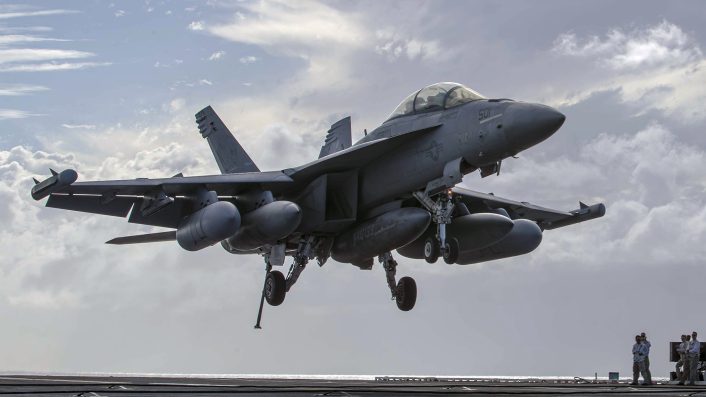
The U.S. Naval Air Systems Command (NAVAIR) describes NGJ as the next step in airborne electronic attack (AEA). The NGJ project is developing a replacement for the AN/ALQ-99 Tactical Jamming System (TJS) currently equipped by the EA-18G Growler, a specialized electronic warfare variant of the Super Hornet.
The AN/ALQ-99 is a very old platform, first deployed in 1972 on the now-retired EA-6B Prowler, so it may not cover the full spectrum of EW needed to neutralize today’s threats, especially in today’s network-centric warfare. The pods also have some drawbacks, including interfering with friendly radar, placing a significant strain on the airframe, and imposing a high workload on the Growler’s two-man crew.
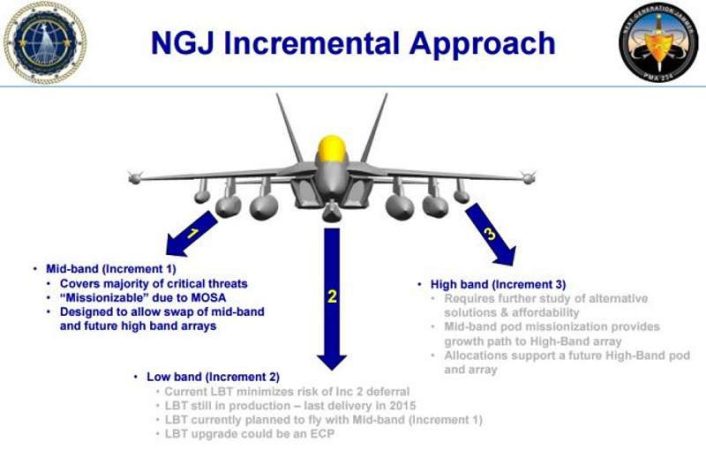
The full NGJ family includes three different pods designated as NGJ-MB (Middle Band), also known as Capability Block/Increment 1. NGJ-LB (low band), aka Block/Increment 2; and NGJ-HB (high band), aka Block/Increment 3; It specifically targets the low-band (100 MHz to 2 GHz wavelength band), mid-band (2 GHz to 6 GHz), and high-band (6 GHz to 18 GHz) sections of the overall threat spectrum.
AN/ALQ-249 NGJ-MB
The AN/ALQ-249 Next Generation Jammer Midband (NGJ-MB) is a state-of-the-art electronic warfare (EW) pod that rejects, disrupts and degrades advanced radar threats, communications, data links and non-traditional radio frequency threats. According to Raytheon, the system reduces enemy targeting range, disrupts enemy kill chains, and supports kinetic weapons until they reach their target.
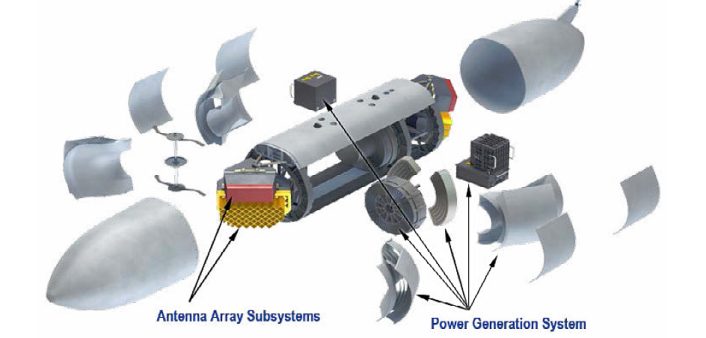
NGJ-MB utilizes a fully digital, software-defined design, allowing the system to rapidly adapt to new threats. Additionally, its modular architecture simplifies maintenance and allows for future upgrades, ensuring the system remains relevant throughout its service life.
The jammer uses AESA antennas, allowing for a highly focused and dynamic jamming beam. This precision improves efficiency while minimizing interference with friendly systems. In addition to jamming, NGJ-MB also supports electronic intelligence gathering, battlefield network disruption, and suppression of enemy air defenses.
In the 2024 DOT&E (Operations Test and Evaluation) report, it was mentioned that NGJ-MB has four EA mission profiles: Deadlock, Modified Escort, Penetrating Escort, and Atmospheric Jammer. Navy aircrews will primarily fly deadlock and modified escort profiles, according to the document.
The system reached initial operational capability (IOC) in December 2024 with the U.S. Navy. On that occasion, the Navy stated that NGJ-MB brings “a quantum leap in performance over existing systems with a dramatic increase in power, targeting flexibility and jamming technology for global naval air operations.”
Electronic Attack Squadron (VAQ) 133, assigned to Carrier Air Wing Nine (CVW) 9 on the USS Abraham Lincoln, was the Navy’s first to deploy and use the new pod in combat. At the time, the U.S. Air Force said Wizards had proven the future of airborne electronic attack (AEA) by developing new tactics, achieving the first NGJ arrest landing and tactical application of the system.







