



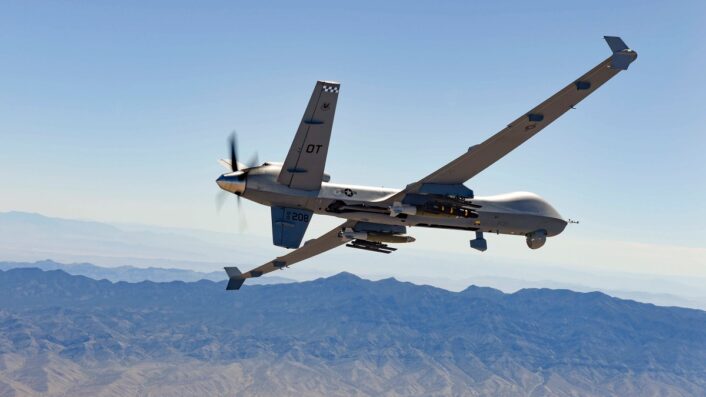
GA-ASI and the U.S. Air Force tested the MQ-9A Reaper using the APKWS laser-guided rocket, launching it against both air and ground targets at the Nevada Test and Training Range.
General Atomics Aeronautical Systems, in collaboration with the U.S. Air Force, announced testing of the MQ-9A Reaper remotely piloted aircraft (RPA) employing the Advanced Precision Kill Weapon System (APKWS) laser-guided rocket. The company said testing recently took place at the Nevada Test and Training Range (NTTR).
According to the statement, over an unspecified number of test flights, the test team demonstrated “a variety of types and variants of shot profiles, including against aerial targets.” “The MQ-9A crew performed all shots flawlessly using laser-guided rockets and special launchers,” the company says.
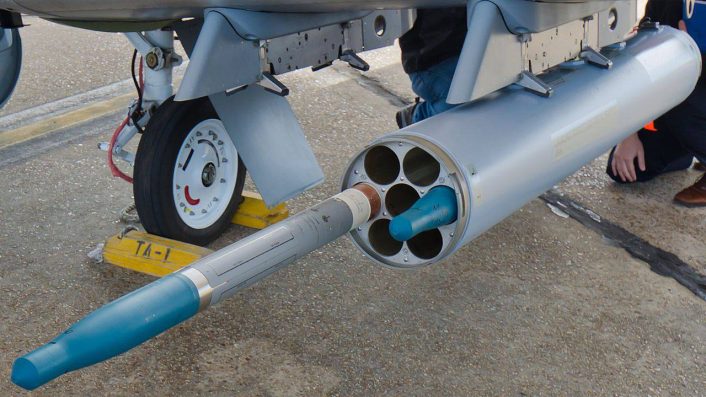
The photo accompanying the statement shows an MQ-9A equipped with a LAU-131 A/A pod equipped with an inert AGR-20 rocket, as APKWS is designated by the military. However, the statement did not mention whether the AGR-20F fixed-wing, air-launched, anti-unmanned aircraft system weapon (FALCO) was also used.
The company also said, “This effort has moved quickly from planning to integration and flight testing in support of real-time technology adaptation requirements.” It is currently unclear whether this integration of APKWS into the MQ-9A is a response to an Urgent Operational Need (UON).
In an effort to rapidly test and deliver new capabilities to the warfighter, the U.S. Air Force and GA-ASI are collaborating to demonstrate advanced precision lethal weapons systems using: #MQ9A Ripper®.
Read the news: https://t.co/izLaZilq8X #APKWS pic.twitter.com/lm2Us4mdEi
— General Atomics Aeronautical Systems, Inc (GA-ASI) (@GenAtomics_ASI) May 11, 2026
“We recognize the value that systems like APKWS bring to the MQ-9 aircraft as a tool to counter one-way attack drones,” said David R. Alexander, GA-ASI President. “APKWS not only increases the number of weapons the MQ-9A can carry, but also enables it to carry new, lower-cost weapons. Most importantly, this integration effort highlights how government and industry can work together to rapidly test and deliver new capabilities to the warfighter.”
Last year, GA-ASI disclosed that the Gray Eagle Short Takeoff and Landing (STOL) conducted a test flight with APKWS, successfully engaging a target drone. The test was intended to demonstrate a new Counter-UAS (C-UAS) capability for unmanned aerial vehicles.
The Importance of Testing
The introduction of APKWS on the MQ-9A Reaper will allow the U.S. Air Force to provide persistent airborne C-UAS capabilities at a lower cost compared to fighter aircraft. Additionally, the MQ-9A can stay on base for much longer than fighter jets without needing aerial refueling.
To date, the U.S. Air Force has flown Combat Air Patrol (CAP) with F-16 Fighting Falcons, F-15E Strike Eagles, and A-10C Thunderbolt IIs equipped with APKWS rockets that can be used against drones. However, this poses a major logistical and economic burden, as evidenced by the urgent combat command requirements that led to the creation of the Probe Refueling Adapter for the A-10 to address tanker shortages.
The Reaper is also much cheaper to fly, with an estimated cost of $3,000 to $4,000 per flight hour, compared to the aforementioned fighters, which cost $20,000 to $30,000 per flight hour. Add this to the low cost of APWKS, and it’s easy to see why the Air Force is involved in this project.
The MQ-9A used in the C-UAS role would bring additional benefits as it would relieve the fighters of the burden and allow them to focus on other missions. The downside is speed, as with a cruising speed of around 200 knots, the Reaper will need time to intercept farther targets.
It is currently unclear how many LAU-131 A/A rocket pods the MQ-9A can use. However, some MQ-9 variants have six hardpoints, so you could see a capacity of 42 rockets, and even more if you could fit more pods on each hardpoint.
APKWS
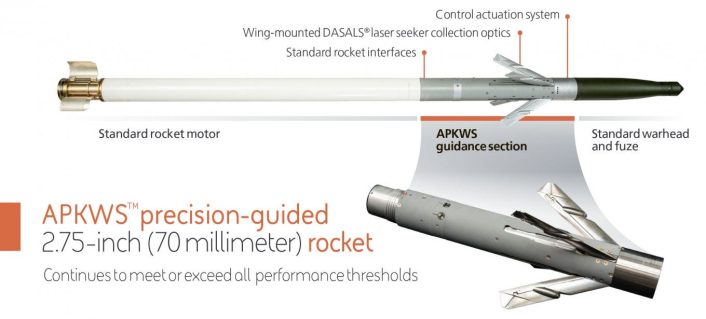
The AGR-20 APKWS II (Advanced Precision Kill Weapon System II) is a conversion of the Hydra 70 unguided rocket that adds a laser guidance kit to the base weapon, converting it into a precision guided munition (PGM). The Hydra 70 itself was derived from an earlier weapon, the 2.75 in (70 mm) Mk 4/Mk 40 Folding Fin Aerial Rocket (FFAR), a system widely used in the Korean and Vietnam Wars in the late 1940s.
Thus, by adding a guidance section to a cheap rocket (inserted in the center of the rocket, between the 10-pound high-explosive warhead at the front and the Mk66 Mod 4 rocket motor at the rear), the U.S. Air Force was able to obtain a low-cost smart munition that could be used in the air-to-ground role. This is particularly useful when the full warheads of larger bombs (e.g. JDAMs) and missiles (e.g. AGM-65 Maverick or AGM-114 Hellfire anti-tank missiles) are not needed to achieve the desired effect or are not suitable due to the risk of collateral damage.
The guidance section of the APKWS includes four folding wings with wing-mounted laser seeker collection optics with a wide field of view capable of attacking both moving and stationary targets. BAE Systems, which produces the weapon, said “no modifications are required to the rocket, launch platform or fire control system.” The only known modification is a longer variant of the LAU-131/A seven-rocket launcher commonly used by the U.S. Air Force, called the LAU-131 A/A (the Navy uses the AGR-20 with the similar LAU-68 F/A).
Further developing air-to-air capabilities in these older rockets is another impressive achievement for the U.S. Air Force, which now has the potential to engage targets at a fraction of the cost of other conventional missiles. Currently, the beyond-visual-range radar-guided AIM-120 Advanced Medium Range Air-to-Air Missile (AMRAAM) costs more than $1 million each, while the AIM-9X Sidewinder Block II costs about $420,000.
The high cost of interceptors against these cheap targets and the magazine size of the launch platforms were two major concerns highlighted by the military responding to these attacks. On the other hand, the guided portion of the APKWS II costs only about $15,000, while the entire APKWS II round costs only a few thousand dollars more, including the warhead and motor.
The low cost of the APKWS II has some limitations, as the weapon has a shorter range and smaller warhead than current USAF missiles. But against slow, cheap targets like drones, the AGR-20 could provide the Air Force with a cost-effective weapon.
Moreover, the APKWS II can be carried in a seven-rocket pod on a single hardpoint capable of firing only AIM-9X or AIM-120 missiles, giving U.S. jets deeper magazines for air-to-air munitions. This feature can be useful when facing a swarm or saturation attack from enemy drones. This tactic has already been used by Russia in its attacks on Ukraine, Iran in its attacks on Israel, and sometimes on a smaller scale by the Houthis.







