



Buenos Aires, Argentina – On Thursday, June 3, signs in downtown Buenos Aires bore the slogan: “We are the voice of those who have nothing anymore.”
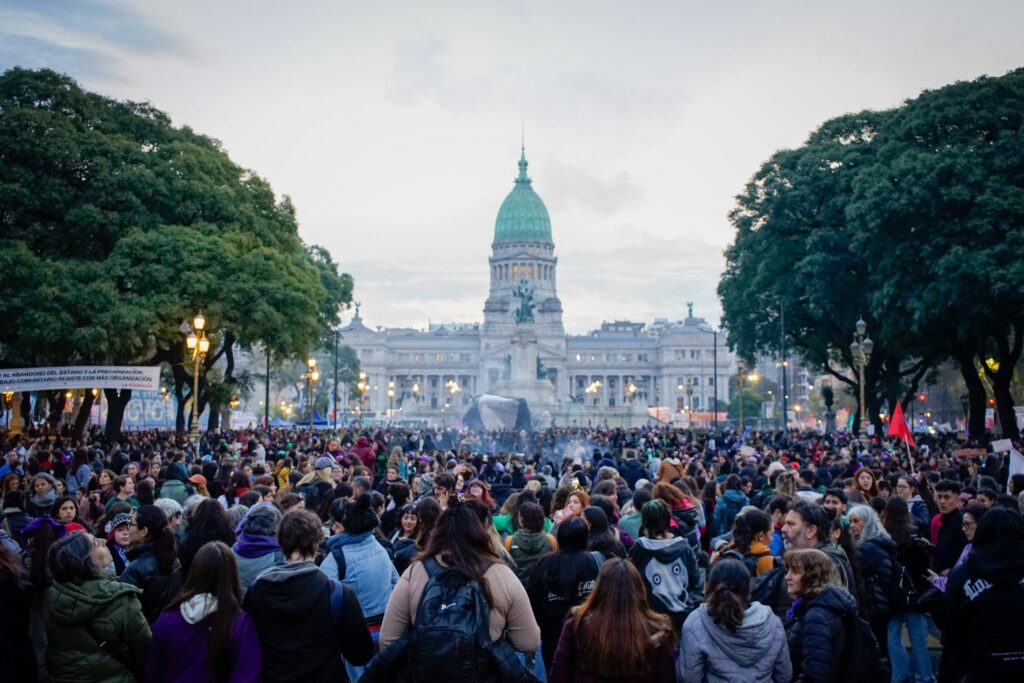
Thousands gathered outside the National Assembly to mark the 11th anniversary of Ni Una Menos. Ni Una Menos is a movement that emerged in the wake of the 2015 murder of 14-year-old Chiara Páez, inspiring similar mobilizations across Latin America while reshaping Argentina’s debate on gender violence.
Purple scarves, green handkerchiefs and photos of victims filled the streets Wednesday as protesters demanded justice for women who died in acts of sexual violence. This year’s march was largely shaped by the femicide of Agostina Vega, a 14-year-old girl in Córdoba. The incident made national headlines and became a symbol of public anger in the days leading up to the protests.
The case sparked criticism of Argentina’s judicial system and calls for the resignation of judiciary and government officials for failing to protect the teenager.
Protesters also highlighted the recent murder of 17-year-old Dulce Candia in the northern province of Misiones. And the name of Noelia Romero, 30, who lives on the outskirts of Buenos Aires, echoed throughout the protests.
“This incident encapsulates the institutional violence inflicted on us by the state,” organizers of Ni Una Menos said in a statement issued during the rally.
The statement was read by actress and sexual rights activist Thelma Fardin, marking a landmark moment in Argentina’s MeToo movement. “Don’t talk about me. Stop killing us,” she told the crowd, which included women of all ages, political leaders and relatives of femicide victims. Earlier this year, Brazil’s Supreme Court upheld the conviction of Argentine actor Juan Darthés for sexually abusing Fardin during a 2009 trip to Nicaragua, ending one of the country’s most followed sexual assault cases.
As the protesters marched through the city center, messages such as “Every woman must learn how to survive where she belongs,” “May freedom be a reality, not a promise,” and “Feminist revolt against fascism” were posted on banners.
Debate surrounding cuts to gender programs
Along with their demands for justice, many protesters linked sexual violence to Argentina’s economic situation. One of the most prominent slogans is “We want to be alive and free… without debt” (“Vivas, libres y desendeudadas nos queremos”), a variation of the movement’s traditional slogan “Vivas y libres nos queremos” (“We want to be alive and free”). Organizers said the additional measures reflected concerns about the impact of President Javier Millay’s austerity policies on women and vulnerable communities.
This mobilization came as feminist groups and the Millais government gave very different assessments of the situation facing Argentine women.
According to Ahora Que Sí Nos Ven, an Argentine feminist observatory that monitors femicide and gender-based violence, one woman is murdered every 31 hours in Argentina. The group recorded 99 victims of gender-related murders between January and May this year and has recorded more than 3,200 such incidents since the first Ni Una Menos march in 2015.
For organizers, the anniversary was not only a call to action against femicide, but also a protest against the dismantling of gender policies under the Mailay administration.
Activists have pointed to declining funding for gender-based violence programs. Inflation-adjusted spending on eight gender-related programs fell by nearly 95% between 2023 and 2025, according to an analysis by Argentine fact-checker Chequeado. Among those most impacted were a national hotline for victims of sexual violence and programs that provide financial assistance to at-risk women. Both saw their actual budgets decline by almost 100% during that period.
According to Chequeado, six of the eight programs analyzed were eliminated or absorbed into broader initiatives under the Human Capital and Justice Department.
But Mylay’s administration has defended the restructuring, arguing that some programs were ineffective or redundant.
Government officials also disputed activists’ interpretation of the data. Senator Patricia Bullrich of Milei’s La Libertad Avanza explained that femicide has decreased since Milei took office.
“I know that behind every statistic there is a family, and for that family, numbers mean everything,” Bullrich wrote on social media during the mobilization. “But the data reflects reality: Since Javier Milei took office, we have reduced femicide by 25%, strengthened our prison system, and created a DNA registry for convicted rapists.”
Bullrich added, “The feminism I advocate is a feminism that protects women.” This reflects the administration’s argument that public security measures, rather than gender-focused institutions, have driven the improvements in statistics.
According to a report released by the Argentine Supreme Court, the number of direct victims of femicide in 2025 will be 200, a 12.3% decrease from the previous year, recording the lowest annual figure since 2017. The Justice Department’s National Femicide Registry estimated that one woman died every 44 hours last year.
As the protest ended, participants held up photos of the victims towards parliament while organizers read aloud the names of women who had been killed over the past year. Eleven years after the first Ni Una Menos march, protesters insist their core demand remains unchanged: to ensure no women are added to the next list.
Featured Image Description: Protesters commemorate the anniversary of Ni Una Menos.
Featured Image Source: @FundHuesped via X







