



A new report released by the International Crisis Group (ICG) says organized crime is a major obstacle to protecting the Amazon.
Criminal gangs have expanded their territorial control in Brazil, Colombia, Venezuela, Ecuador and Peru, with drug trafficking and illegal gold mining becoming major causes of violence and deforestation across the region.
At the forefront of this expansion are indigenous communities living in the Amazon, who are particularly vulnerable to lethal reprisals from criminal groups.
Below, Latin America Report We analyze three main points of the report:
Global economic patterns are causing criminal groups to expand.
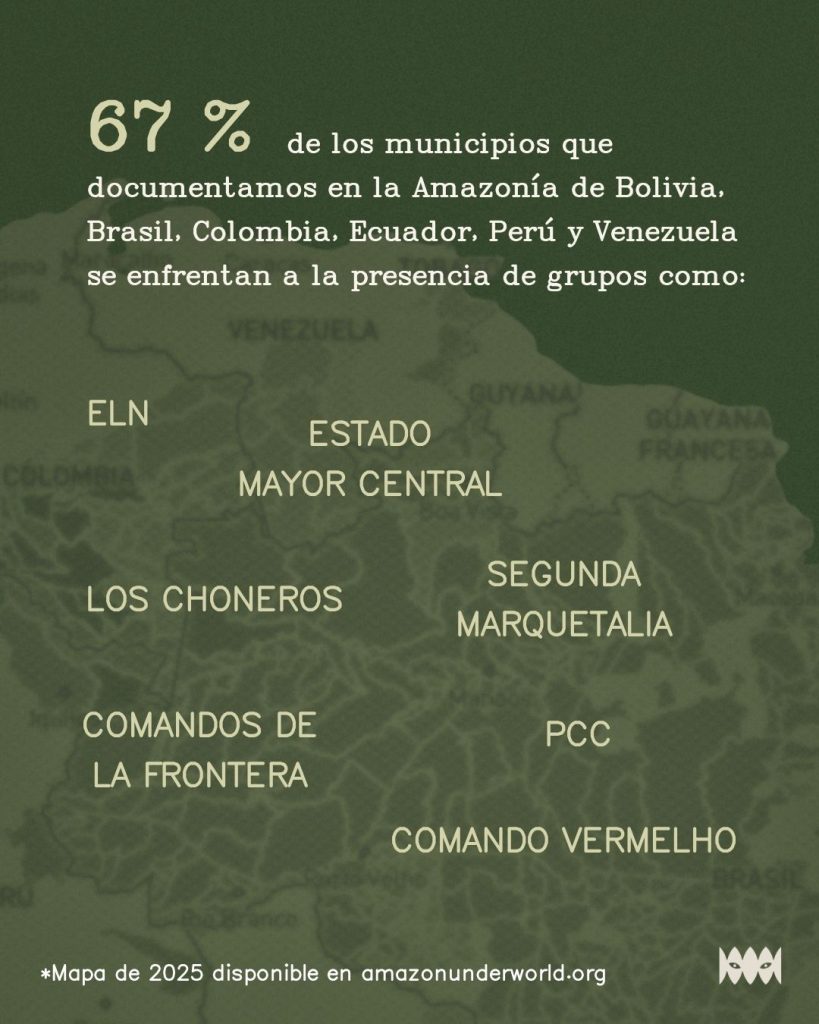
Organized crime groups currently exist in at least 67% of Amazonian municipalities in Colombia, Brazil, Venezuela, Peru, Ecuador and Bolivia.
The report listed two key illicit activities behind this crime escalation: changes in global drug consumption trends and increased demand for gold and other minerals.
In recent years, countries such as Colombia, Bolivia and Peru have reached record levels of cocaine production, making Europe the world’s largest consumer market. The growing importance of Brazilian ports such as Santos and Barcarena and the port of Guayaquil in Ecuador as outlets for cocaine bound for Europe made the Amazon a central hub on drug trafficking routes.
Soaring gold prices have made illegal mining increasingly attractive to criminal groups, with the trade now more profitable than drug trafficking.
Major criminal organizations operating in the Amazon include Brazil’s Primeiro Comando da Capital (PCC) and Comando Vermelho (Red Command), the Colombian National Liberation Army (ELN) and Comandos de la Frontera, and the Ecuadorian gangs Los Lobos and Los Choneros.
The growing influence of these groups is now prompting a policy response. The Brazilian government recently announced $40 million in funding to combat criminal groups in the Amazon and border regions.
Both cocaine production and illegal gold mining have a devastating impact on the environment by relying on deforestation and using substances such as mercury, cyanide, and hydrochloric acid to produce hazardous chemical waste.
Organized crime also reinvests profits into activities such as industrial agriculture, land clearing and livestock grazing, further contributing to environmental destruction.
“It’s attractive because cocaine can’t be legalized, but meat and gold can be. Drug profits are reinvested in buying physical gold, mining equipment, land grabs and livestock,” said Bram Ebus, a consultant at the International Crisis Group and founder of the journalism project Amazon Underworld. Latin America Report.
“Armed and criminal groups routinely use scarecrows to control cattle herds, gold pawn shops or mining operations. The end game is always to infiltrate the business world and exploit political authorities,” added Ebus.

Indigenous communities are on the front lines
ICG research highlights that indigenous communities in the Amazon are among the most exposed to criminal incursions and violence.
For many of these countries, they constitute the front line of territorial defense and surveillance. However, lack of coordination with state authorities and distrust of national authorities made the role of the Native Guard particularly dangerous.
Moreover, armed groups force community members to join their ranks, either by force or through promises of greater profits from illegal activities.
“Rather than protecting the most vulnerable, state forces in some cases attacked communities, which were too often seen as involved in the illicit economy rather than perceived as victims,” Ebus said.
Ebus explained that the results also have profound implications for indigenous culture. This is because local people often have no viable alternative to gold mining, which destroys and pollutes their ancestral lands. Indigenous youth abandoned traditional practices such as hunting and fishing and became increasingly dependent on income from illegal mining, their only economic activity, to purchase food.
Violence can be fatal. Criminal groups do not hesitate to take lethal revenge against those suspected of opposing environmental exploitation or collaborating with the authorities.
Latin America has the highest murder rate in the world, and this statistic is even higher in the Amazon. Between 2012 and 2024, a significant proportion of the world’s killings of environmental and land defenders occurred in this region. Colombia and Brazil alone account for 40% of the total global death toll, with members of indigenous and African-descended communities disproportionately affected by the violence.
Coordination is urgent
The most urgent recommendations emerging from the study are to improve cross-border cooperation among Amazonian states and harmonize environmental laws.
“Amazon cooperation will largely depend on the results of this year’s elections in Brazil, Colombia and Peru. The UNTOC General Assembly in October is another opportunity for Brazil and Colombia in particular to push for formal recognition of environmental crimes,” Ebus said.
The enormous profits generated from illicit activities allow organized crime to corrupt authorities and take over state institutions, making information sharing even more important.
Uneven regulation of environmental crime allows criminals to exploit loopholes and weaknesses in different jurisdictions, especially those where cross-border enforcement is lacking.
One example is the smuggling of mercury, a toxic substance used in the gold extraction process. All countries in the Amazon have signed the Minamata Convention, which limits the sale and use of mercury, and Ecuador, Peru and Colombia have banned mercury imports altogether. In contrast, the import and export of mercury is legal in Bolivia, and weak border controls have made the country a hub for the mercury trade in South America.
Featured image: Destroyed equipment at an illegal gold mine near the border between Brazil and Colombia.
Image credit: Brazilian Federal Police.


