



Anduril will deliver at least 3,000 water-launched Barracuda-500Ms to the U.S. Army, starting in 2027 with an initial 1,000 units with associated containerized launch systems.
Anduril announced on May 13, 2026 that it has signed a framework contract with the U.S. Department of War to provide at least 3,000 surface-launched Barracuda-500M (SLB-500M) autonomous aircraft to the U.S. Army. Meeting the DoW’s current needs for affordable, simple, and mass-producible modular weapons, the SLB-500M is a “cruise missile solution to long-range precision fires and standoff strike problems” for the Army Program Acquisition Officer FIRES (PAE FIRES), the company said.
The contract amount is unknown, but Anduril said the base contract with the Office of the Secretary of War for Research and Engineering (OSWR&E) includes at least 1,000 full-round units per year, with the first tranche expected to be delivered by mid-2027. Anduril also plans to deliver 60 SLB-500M related containerized launch systems in 2027.
PAE FIRES is purchasing missiles for the Army’s ground-launched low-cost containerized munitions program. The SLB-500M can also be optionally integrated with Lattice, Anduril’s self-flight autonomy software, to improve “survivability and effectiveness against large target sets in contested environments.”
Anduril signed a production agreement with . @DeptofWar Delivering the Surface-Launched Barracuda-500M quickly and at scale.
It is an inexpensive missile designed for long-range precision strikes.
We plan to deliver at least 1,000 rounds per year for three years, with the first round being… https://t.co/j9nlNOE1XR pic.twitter.com/G2Lj6GiemS
— Anduril Industries (@anduriltech) May 13, 2026
Anduril first unveiled the Barracuda family of weapons in September 2024, and the Barracuda-500M has been tested several times since then. The Barracuda-500M also announced that Anduril is one of the contenders for the Air Force’s Enterprise Test Vehicle (ETV) program on March 4, 2025, and has been selected by the Air Force Armaments Directorate and Defense Innovation Unit (DIU) to move the program to the next phase.
Anduril said production affinity to meet DoW’s mass production potential is achieved by manufacturing the Barracuda and all other weapons from commercially readily available, non-sophisticated spares, parts and electronics, while ensuring the design and materials ensure the weapons are not over-engineered. This will enable the company to produce “ultra-scale” at its nearly $1 billion Arsenal-1 plant in Columbus, Ohio, capable of “meeting additional surges in demand.”
SLB-500M
According to Anduril, the “highly capable and affordable” SLB-500M is “effective against a wide range of land and sea targets” with a 100-pound ammunition payload and a range of more than 500 nautical miles, “enabling massive, coordinated long-range strikes.”
Today is official. Yes, this is just a contract that PGZ has already signed in the dozens, but this time it may have concrete results.
▶️https://t.co/sPTsvOOKGa@PGZ_pl 🇺🇸 At work @anduriltech An agreement on joint development and production cooperation was signed. pic.twitter.com/Yin1A0qqKY— Thomas Dmitruk (@goltarr) October 27, 2025
The weapon can be fired from a “standard 20-foot ISO container” capable of carrying up to 16 bullet units, eliminating the need for “additional infrastructure to support large-scale defenses.” Operators can select Lattice or other existing software, select a target, then select the “right combination” of SLB-500M ammunition to fire.
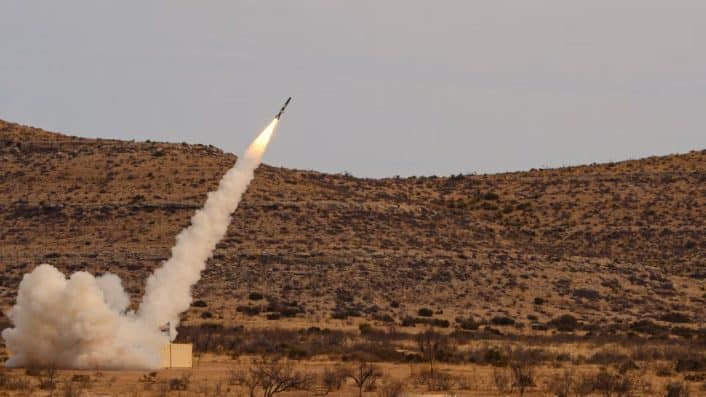
A video released by Anduril also shows the SLB-500M being launched vertically and diagonally from the ground. A containerized launch would see the solid rocket motor (SRM) booster drop, the main air-breathing jet engine taking over and the top-mounted wings deploying later in the cruise phase.
Barracuda family of expandable cruise missiles and AAVs
The other two missiles in the Barracuda family are the Barracuda-100 and Barracuda-250, each with its ‘M’ variant indicating kinetic effect. A similar approach can be seen in the Copperhead series of autonomous underwater vehicles, where vehicles without the ‘M’ designation are detection and/or ISR platforms.
Anduril describes the Barracuda-250 as a low-cost AAV that can be used flexibly on a variety of air, ground or sea platforms, including in the internal weapons bays of fifth-generation fighter aircraft.
🇺🇸 From the sensor (@anduriltech) announced a contract with the U.S. Department of War to produce the surface-launched Barracuda-500M.@DeptofWar).
“Under this agreement, Anduril will scale up production to deliver at least 1,000 full rounds per year through the first tranche. pic.twitter.com/V4fNSYiK7c
— Counter Unmanned Systems (@CUAS_NEWS) May 13, 2026
Anduril’s product information page lists the Barracuda-500M as having a range of less than 500 nautical miles (926 km) and a speed of 190 to 500 knots (350 to 926 km/h). Speed depends on the type and weight of the warhead and other payloads.
Likewise, the smaller Barracuda-100 and Barracuda-100M have a range of 120 NM (222 km). The platforms expected to operate the Barracuda are either the F-35 and front-line bombers with internal weapons bays, or externally mounted bombers by the F-15, F-16 and F/A-18 Super Hornets.
If the Air Force decides to have a wider variety of combat-ready, mass-produced and technically simple cruise missiles, separate from the FAMM/ERAM class of weapons, it could adopt these weapons for pallet launches from C-130 and C-17 cargo aircraft.
In a September 2024 test of the Barracuda-500M supervised by the DIU, the missile was launched vertically from a ground-based cell “to mimic the palletized use of airborne aircraft.” The missile “performed autonomous navigation and flight for more than 30 minutes, successfully acquired a GPS-coordinated target identified in the lattice, and performed autonomous terminal guidance to the target.”
A low-cost cruise missile, the Barracuda-500 is the big brother of the Barracuda family.
Air- and ground-launched cruise missile developed by 🇺🇸#us Manufacturer Anduril Costing <$200,000, maximum range 925km, speed Mach 0.75, warhead weight 45kg⬇️ https://t.co/NVnh25S1CE pic.twitter.com/clg6aiNdx1
— 🇺🇸 🇺🇸 🇺🇸Midobecker 🇺🇸 🇺🇸 🇺🇸 (@midobecker_1) October 13, 2025
scalability
Anduril has long differentiated itself from traditional defense companies by infusing scalability and logistical simplicity into its Barracuda family of weapons, Copperhead naval weapons and the YFQ-44A Fury Cooperative Combat Aircraft (CCA). This is achieved by selecting readily available and proven components, electronics, assemblies, simple designs and reconfigurable factories and assembly lines equipped with the necessary machinery to dynamically respond to production demands.
The Barracuda also represents a trend toward blurring the distinction between long-range one-way attack (OWA) drones and stand-off attack cruise missiles that are mass-produced and simultaneously launched at enemy targets. Anduril also described the Barracudas as a family of air-breathing cruise missiles that support Modular Open Systems Architecture (MOSA) and are software defined for rapid upgrades.
@anduriltech Barracuda-M cruise missile family unveiled
The Barracuda AAV family consists of the Barracuda-100, Barracuda-250 and Barracuda-500. Each increment provides increasing size, range and payload capacity, but every Barracuda is compatible with a variety of payloads… pic.twitter.com/NW1RvpUI6W
— Global Defense Insights (@Defense_Talks) September 12, 2024
In its latest press release, Anduril said, “Existing solutions are too expensive, too sophisticated, and too difficult to produce at scale.” Barracuda weapons are also supported by simple tools and manufacturing machines.
When first unveiling the weapon in September 2024, Anduril said, “The Barracuda AAV family requires no more than 10 tools to assemble. The Barracuda (…) can be produced by a broad commercial automotive and consumer electronics workforce rather than a much smaller, over-extended, highly specialized defense-related manufacturing workforce pool.”
In the latest release, Anduril said 70% of the components of the entire Barracuda family, including the SLB-500, are publicly available, and “the remaining 30% has been de-risked through open architecture design competition between multiple vendors.” This allows the SLB-500M to prevent supply chain disruptions.







