



RAF Typhoon FGR4s deployed to the Middle East have begun carrying APKWS guided rockets, just weeks after completing a rapid testing and certification process.
In early March 2026, we reported sighting an RAF Typhoon equipped with two rocket pods at BAE Systems’ Warton airfield. Although not confirmed at the time, this was widely expected to be intended to deploy Hydra 70 rockets equipped with BAE Systems’ Advanced Precision Kill Weapon System (APKWS) guidance kit.
Initially developed for surface targets, APKWS has taken on an important new role with its ability to shoot down small unmanned aircraft systems (UAS) at a fraction of the cost of conventional air-to-air munitions. It also significantly expands the fighter’s ammunition load with up to seven rounds per rocket pod, making it ideal for drone swarms.
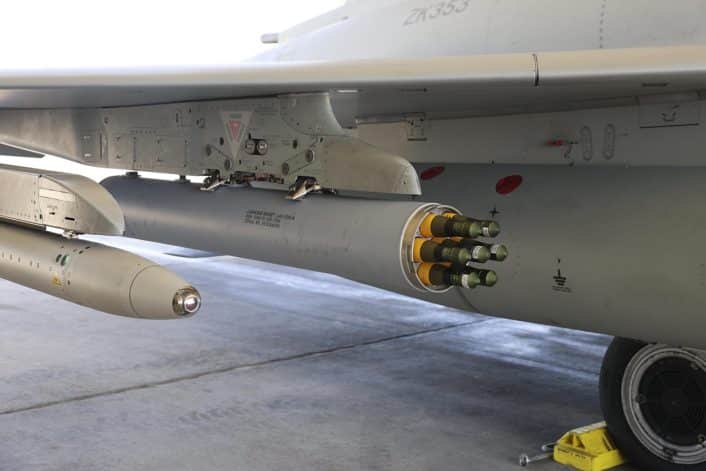
Expectations for tests involving APKWS were confirmed by an official statement from BAE Systems in April, when it announced that the Typhoon had successfully used the weapon against ground targets. Counter-UAS (C-UAS) was specifically mentioned as a key feature of the system, and air-to-air testing was scheduled to begin in the next testing phase.
First MoD (Crown Copyright) images and videos @Eurofighter Typhoon and #APKWS The combo is now on the op counter.#drone used with @RoyalAirForceRAF’s 9th Squadron #Akrotiri In Cyprus and across the wider Middle East… pic.twitter.com/TcyshWplQm
— Gareth Jennings (@GarethJennings3) May 16, 2026
These air-to-air tests have now been completed and, in a pace rarely seen integrating a weapon into a modern fighter aircraft, the weapon has entered operational service with No. 9 Squadron RAF. 9 Squadron, also designated IX (Bomber) Squadron in Roman numerals, is currently stationed at RAF Akrotiri, a British forward sovereign base on the island of Cyprus, and has been actively involved in defensive anti-aircraft missions to defend the base, Cyprus and British interests in the region.
RAF Typhoon and F-35B aircraft conducted long-range defensive air patrols in support of HMS Dragon in the Red Sea.
These missions were made possible by Voyager air-to-air refueling aircraft operated from RAF Akrotiri.#Defend and block #typhoon #F35 pic.twitter.com/DPSEKRiHcc
— Royal Air Force (@RoyalAirForce) May 15, 2026
Defense Industry Secretary Luke Pollard said: “It has been a great effort working with industry to test and deploy this system in a matter of months, which will help the RAF shoot down more drones at a much lower cost.”
He added: “Our Typhoon fleet is the backbone of UK and NATO air defence, while the RAF protects Europe’s eastern flank against incursions by Russian drones and protects our partners across the Middle East.”
APKWS will not only enhance the Typhoon’s C-UAS capabilities, but also provide a welcome option for precision strikes against small, soft targets such as those encountered in Iraq and Syria during Operation Shader. Although the compact warhead of the Hydra 70 rocket platform is not always sufficient to destroy a target, availability of the more expensive Brimstone or the much larger and more destructive Paveway IV in stock is possible on suitable targets.
🇮🇶🇬🇧 | #Iraq: The British Ministry of Defense has released footage of a recent airstrike showing RAF Eurofighter Typhoon fighter jets loading Paveway IV guided bombs onto rocket launchers somewhere in Iraq.
The rocket launchers, most likely operated by Iranian-backed militias, were used to: pic.twitter.com/hJ7zMMXHhi
— Status-6 (War & Military News) (@Archer83Able) April 26, 2024
“We welcome the pace of development and meticulous testing of the fielding of these missile systems for use against the Typhoons. They are a valuable addition to the air defense package we are already adopting with alacrity across the Middle East,” said Air Commodore Donal McGurk, Deputy Director of Air 11 Group Operations.
The testing and evaluation phase with BAE Systems was supported by Qinetiq. Steve Wadey, Qinetiq Group CEO, said: “From engineering expertise to real-world testing, our team is providing the foundational support the military needs to deliver emergency capabilities that keep the UK and its allies safe and combat-ready.” The company operates the MOD Aberporth range on the west coast of Wales, where weapons have been tested on behalf of the Ministry of Defence.
Additional images of the recent Martlet test launch from the Aberporth Range.
Proven against stationary or fast-moving floating targets, the Martlet missile now assumes an aerial role and destroys Banshee targeting drones. pic.twitter.com/52R8fky9TP
— Navy Lookout (@NavyLookout) July 28, 2023
Simon Barnes, Group Managing Director, Aviation, BAE Systems, said: “Our priority is to ensure the RAF and its allies have the advanced technology they need now and in the future to stay ahead of evolving threats. This capability demonstrates the Typhoon’s exceptional versatility and highlights its continued role as the backbone of combat aviation across Europe and the Middle East.”







