



Boeing has delivered a briefing update on the MQ-28 Ghost Bat Cooperative Fighter (CCA) currently on display at the Farnborough International Airshow, confirming the addition of Leonardo as an official European partner.
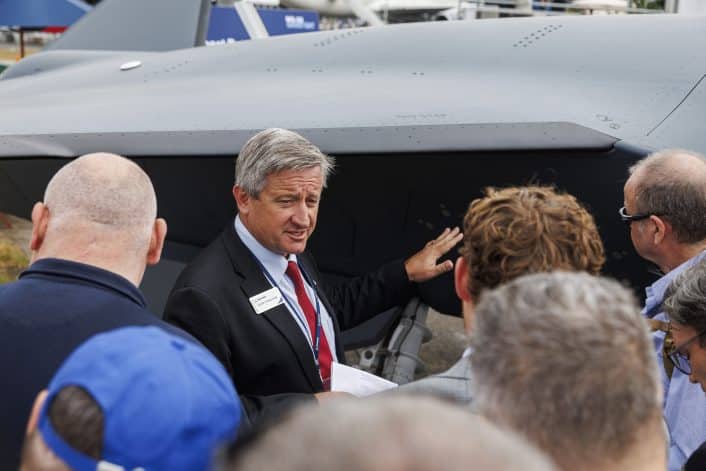
MQ-28 Program Global Director Glen Ferguson announced at the Farnborough International Airshow July 21, 2026 that Leonardo, Eton and Hensoldt have joined as international partners as Boeing introduces the Ghost Bat to a growing number of customers. Eton manufactures the payload launch system and offers both ITAR and non-ITAR variants. Leonardo has been working with the Ghost Bat team for eight years, contributing to electronic systems, but is now officially a program partner.
Hensoldt will work on the MQ-28 specifically for the German market. Although the exact contribution has not been confirmed, Ferguson says the goal is to build a library of knowledge from partners so customers can always use features rather than targeting them directly.
Interesting: @LDO_Aeronautics among European companies partnering with @BoeingDefense on MQ-28 Ghost Bat pic.twitter.com/sdmC3WOB6K
— The Aviationist (@TheAviationist) July 21, 2026
The Ghost Bat on display at Farnborough first flew five years ago and was only the second aircraft built. It is now out of service as the focus shifts to newer aircraft with iterative improvements. Compared to the latest design, the MQ-28 on display has a 25 percent smaller wing. The aircraft’s additional 3.3 meters wingspan is designed to maximize the aircraft’s adaptability to a variety of mission sets and extend its operating range with larger fuel loads.
New developments have been made for the Boeing MQ-28 Ghost Bat CCA, internal weapons bays (2 AMRAAM or 4 SBD) modular nose, BVLOS communications and larger wings. #avgeek #FIA2026 pic.twitter.com/CzEhOsujK9
— Tim Robinson (@RAeSTimR) July 21, 2026
Shown with MBDA Meteor missiles. Ferguson confirmed that they are working with MBDA to integrate a wide range of additional weapon capabilities, although a specific timeline for test launches has not yet been confirmed. He suggested that test launches may not be necessary due to the advanced nature of the simulation software and that all tests could be conducted virtually.
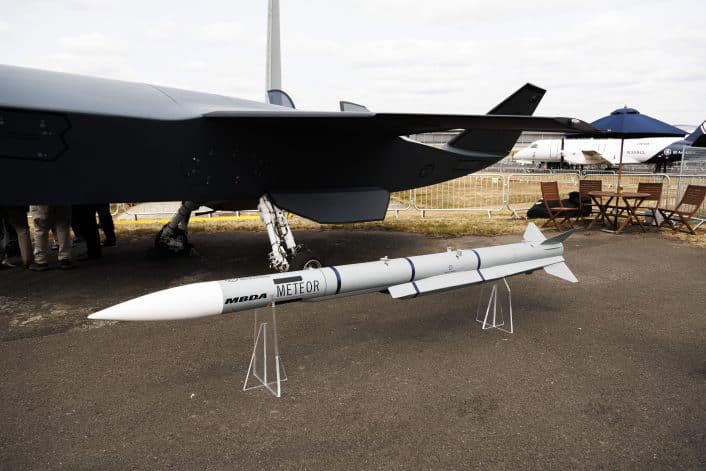
The MQ-28 is in discussions with several countries, but there are no concrete public plans to showcase the aircraft anywhere other than Germany. As customers become increasingly focused on CCA sites, discussions are flowing naturally. Once a customer orders the appropriate number of aircraft, Boeing is prepared to provide in-house manufacturing whenever needed. The company doesn’t expect to follow a ‘megafactory’ style manufacturing process for the Ghost Bat.
Sovereignty over the aircraft is also strengthened through modularization. Replaceable with just a few bolts, the nose section can be quickly swapped out for different configurations, allowing you to carry a variety of sensor packages depending on mission requirements. Maintenance was simplified as much as possible, and it is noteworthy that the Ghostbat was able to switch between training sorties in up to 19 minutes.
When participating in the US Valiant Shield exercise, the MQ-28 flew nine sorties over six to seven days with no infrastructure required. It is reported that more overseas training is also taking place.
Ghost Bat exceeded 200 hours of flight time last month, but recorded several times more flight time in a virtual environment. The company says that while the physical aircraft may have flown more than 1,000 hours by now, the maturity of the available virtual environments means this is not necessary. They “fly out for verification”.
🇺🇲🇦🇺 A U.S. Air Force F-15EX Eagle II and Boeing Defense Australia MQ-28 Ghost Bat assigned to the 85th Test and Evaluation Squadron are seen over the Philippine Sea during exercise Valiant Shield 26.
(📸/USAF) pic.twitter.com/GPadTugBIB
— Guy Plopsky (@GuyPlopsky) July 2, 2026
The jet’s protracted development over several years has drawn criticism, but the company has said its priority is to ensure the aircraft is mature and ready for operation rather than to achieve incremental goals. Most of this time was spent developing mission systems.
The current focus is on providing a ‘loyal wingman’ for the fighter, but supporting other platforms such as the E-7 Wedgetail and P-8 Poseidon is also vital. When the MQ-28 achieved the first live test launch of the AIM-120 AMRAAM (an event that usually did not pass due to multiple simulations), the target was transferred to the MQ-28 by the E-7.
The Ghost Bat is specifically designed to complement, rather than replace, crewed aircraft. This is not simply an unmanned fighter, but an additional capability that expands mission capabilities and diversifies risk, the company said.
Ferguson said the CCA was “critical to the future” of warfare.







