



The US President told reporters that the new VC-25B bridge aircraft will soon undergo further modifications to introduce new capabilities.
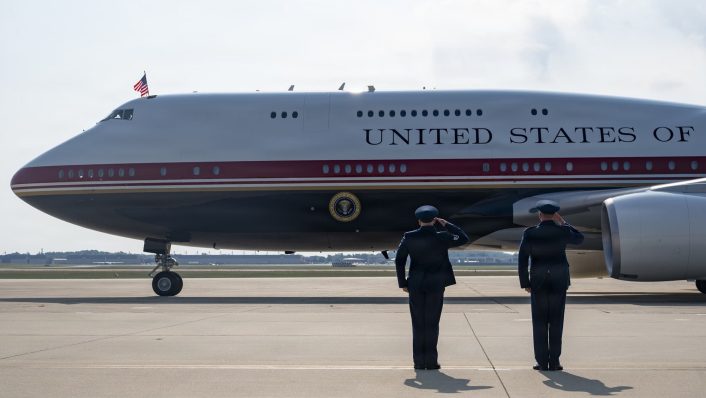
US President Donald Trump recently announced that the VC-25B Bridge aircraft, which was recently introduced to the US Air Force as a new presidential aircraft, will soon receive a new modification. This information was disclosed to reporters by President Trump as he was returning from the FIFA World Cup final held in New Jersey on July 19, 2026.
This was in response to questions from reporters asking whether the new aircraft would be equipped with defensive capabilities after it had to switch to the older VC-25A when returning from the NATO summit in Turkey. “It has a lot of capability, but from what I understand, we will send it to full capacity in about a month or so,” Trump said.
The president did not elaborate on the nature of the planned modifications. Likewise, the U.S. Air Force has not commented publicly on this announcement as of this writing.
Questions about your defense system after traveling abroad
The announcement follows several weeks of investigation into the aircraft’s defensive capabilities and overall security configuration. The U.S. Air Force previously confirmed that the fighter jets are equipped with at least some level of advanced communications and self-defense capabilities, without providing further details.

The U.S. Air Force aircraft, commonly designated Air Force One, receives extensive upgrades, including enhanced defenses, secure and redundant communications systems, and survivability enhancements to support the President’s command and control in the event of a national emergency or nuclear conflict.
Given the rapid timeline, it is unclear which requirements were met during the transition. However, some features that require more extensive modifications may be excluded.
Unconfirmed rumors suggest the aircraft may be limited to flights within the United States due to its lack of defensive capabilities. However, as previously mentioned, the VC-25B was used to fly Trump to Türkiye.
While President Trump flew to Ankara aboard the VC-25B Bridge, as usual, a VC-25A accompanied him as a spare aircraft. But on the way back, Trump changed planes.
According to new york timesThis decision follows security precautions related to the recent breakdown of the ceasefire with Iran and the resumption of hostilities. The president later denied this, saying he did so so that VC-25B would depart early and give personnel assigned to U.S. military bases in Europe a chance to see it.
At RAF Mildenhall, England, the President once again swapped aircraft. He also told reporters that while aboard the VC-25A, he was “put on a dangerous plane” due to Iranian threats and that he was “Iran’s No. 1 target.”
VC-25B bridge aircraft
The VC-25B bridge aircraft conducted its first presidential flight as Air Force One on July 1, 2026, after arriving at Joint Base Andrews, Maryland, in early June 2026. The aircraft arrived there after a secret night flight to avoid revealing the new livery before the official ceremony held on June 19.
After its unveiling, the VC-25B bridge began a series of certification flights ahead of its official service with the Presidential Air Corps of the 89th Airlift Wing. The controversial aircraft, a modified 747-8i donated by Qatar, underwent a rapid conversion process with minimal changes to serve as a “bridge” until the full-scale VC-25B entered service.

Critics have highlighted the security risks that could arise from using aircraft transferred from other countries to fly the US president. However, the Air Force explained that “elite experts from multiple government agencies have developed advanced protocols to detect and, if necessary, neutralize potential technical hazards in previously owned aircraft.”
“The safety and security of the Commander-in-Chief is our top priority,” said Air Force Secretary Troy Maink. “From the beginning, we have meticulously evaluated all requirements to accelerate delivery while maintaining the high standards expected of the President’s mission. These efforts demonstrate that the U.S. Air Force can move quickly without sacrificing quality, security or reliability.”
Fielding the VC-25B bridge aircraft could be considered a “forced decision” because the Air Force needed an option to avoid a capability gap in the presidential transport mission. In fact, the service explains, interim capabilities have become absolutely critical as Boeing VC-25B deliveries fall behind their initial 2024 target and the VC-25A major maintenance cycle extends.
Despite the unusual public controversy surrounding the aircraft, details about its modifications are still scarce. The Air Force has so far declined to discuss specific fixes or whether requirements have been adjusted to speed delivery.







