



La Paz, Bolivia – Bolivia has been paralyzed for three weeks by the worst social unrest since President Rodrigo Paz took office in November. Bolivian highway authorities reported dozens of road blockade points across the country, blocking major arteries on the Peru-Chile border, Sucre, Oruro, Potosi and Santa Cruz. In La Paz, there are severe food and diesel shortages, inflation is rising rapidly and hospitals are in crisis due to a shortage of medical supplies.
The tens of thousands of protesters include the Central Workers of Bolivia (COB) union, rural teachers’ unions, mining cooperatives, coca growers’ federations and members of indigenous Amazonian communities who walked hundreds of kilometers to La Paz. This also includes the Red Ponchos, a radical Aymara militia and social movement for indigenous rights most active in the highlands (Altiplano), which rose to prominence in the 2003 gas war. They are known to take direct action, including blockades and clashes with state forces.
What is the root cause of anxiety?
The crisis did not appear suddenly. Recurring fuel shortages – the same chronic problem that caused the collapse of the socialist Arce government – along with deep economic cuts, including fuel and food subsidies, have begun to shake the already weak economy.
But the bigger trigger was Law 17-20, legislation authorizing reforms to indigenous land tenure systems, which many communities interpreted as opening the door to privatization of public lands.
Many of the protesters voted for President Paz, and the most affected regions – La Paz, El Alto and Cochabamba – are the same areas that gave him electoral majorities.
“We voted for change, for capitalism for all, but we are in the same position as before, maybe even worse,” said one protester named Patricia. Latin America Report In El Alto.
“They promised us social rights and economic development and then acted as if they forgot we existed,” said Fernando, a member of the Cochabamba Peasant Federation. Latin America Report.

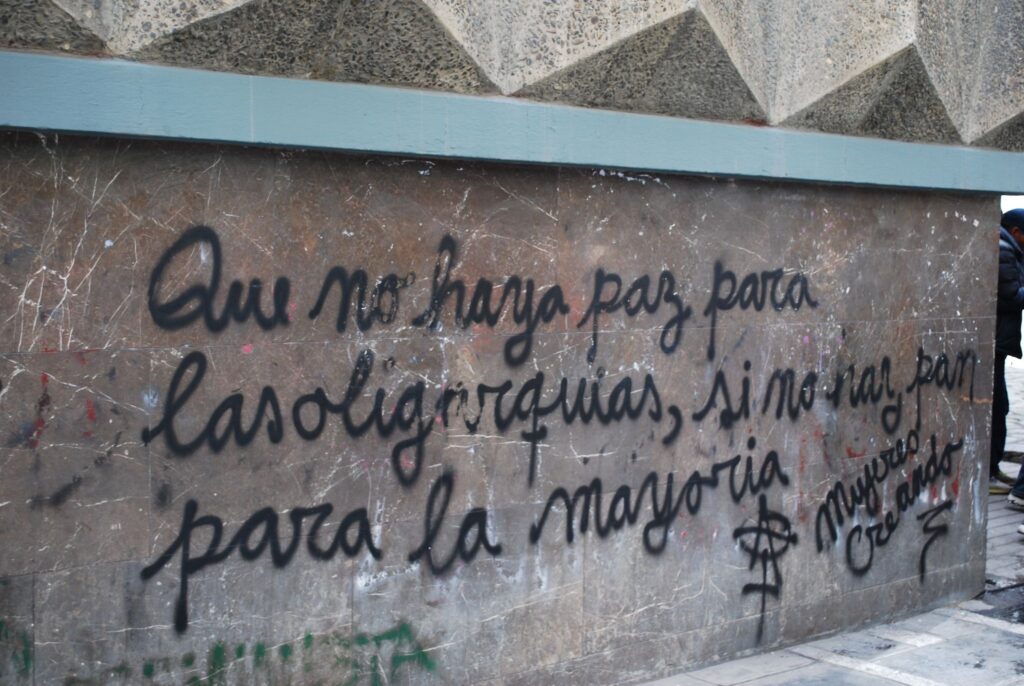
Protesters wrote: “No bread for the many, no peace for the oligarchy.” Image Credit: Joseph Bouchard
They have a range of grievances, including a cabinet with little meaningful indigenous, women or movement representation, a lack of consultation with social groups on key legislative decisions, cuts to fuel subsidies and social services whose effects are immediately felt in communities already weakened by years of economic crisis, and a failure to address the structural commercial and energy crises that predated Paz’s election.
At a more structural level, many syndicalist and indigenous movements long associated with the Movement for Socialism (MAS) made a deliberate and politically costly decision last year to support Paz over the party led by former Socialist President Evo Morales. They feel betrayed and left out.

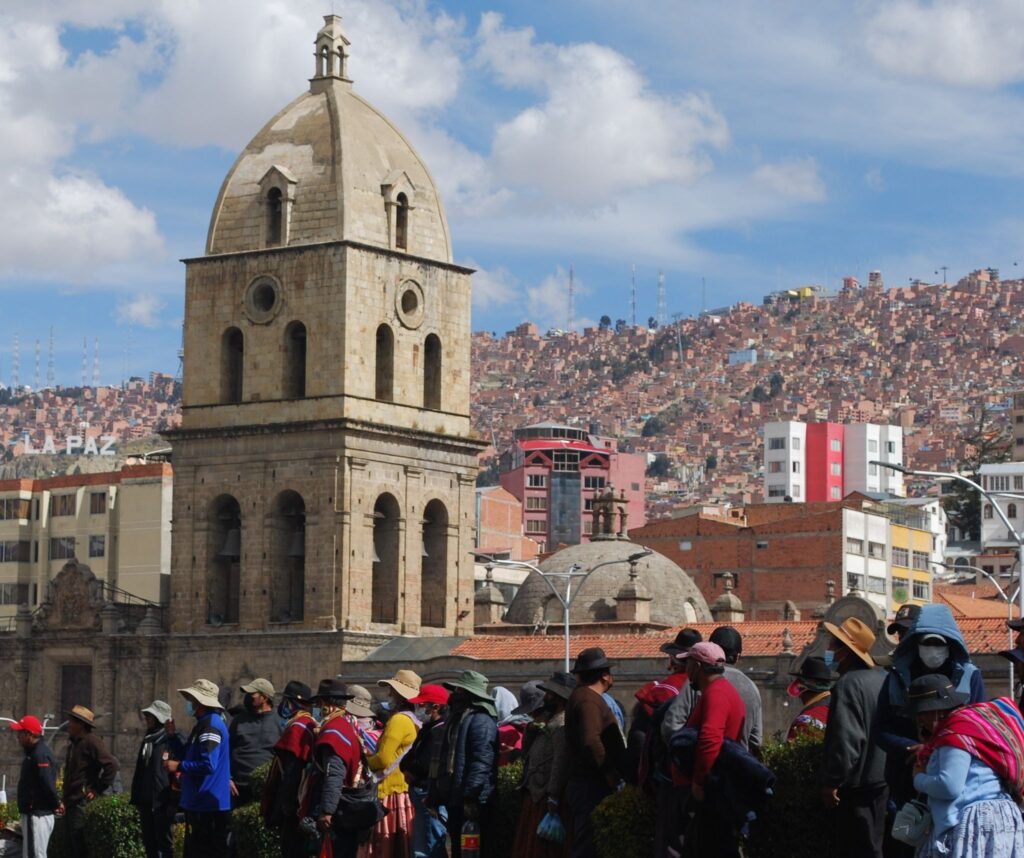
Protesters lined up at San Francisco Square in downtown La Paz. Image Credit: Joseph Bouchard
government response
Paz’s government has pursued a selective negotiation strategy while increasing pressure on those who refuse to leave the streets. Agreements were reached with certain teachers’ unions and local COB affiliates, and decrees were issued guaranteeing health, education, and other rights to indigenous communities.
Some factions accepted these terms, but others accused them of surrendering or being co-opted by the government. A COB leader claimed in La Paz: “They are carrying out the same strategy as MAS under the previous regime, co-opting social movements to delegitimize our demands and concerns and portray us as disobedient and ungrateful.”
Paz promised a cabinet reshuffle along with the Economic and Social Council to “listen to the voice of the people” and provide additional representation for affected sectors of society.
The Paz government has deployed thousands of police in La Paz and El Alto, using tear gas, riot gear and rubber bullets to resist and break up the blockade, and has arrested at least 100 people, including journalists, according to the People’s Ombudsman. So far, three people have died and many more are injured.
Senior officials, including cabinet members, have publicly accused the blockade leaders of being funded by Evo Morales and of having links to drug trafficking and terrorism.
Paz himself still called those protesting in the streets ‘vandals’ and warned that state security agencies would use ‘progressive and proportional force’ amid ongoing rumors that the government had refused to authorize live ammunition.
Human rights groups and COB leaders have condemned the targeting of union leaders and harassment of media and activists. Former President Evo Morales claimed that Paz’s government was working with the DEA and U.S. Southern Command to plan an operation to detain or kill him.
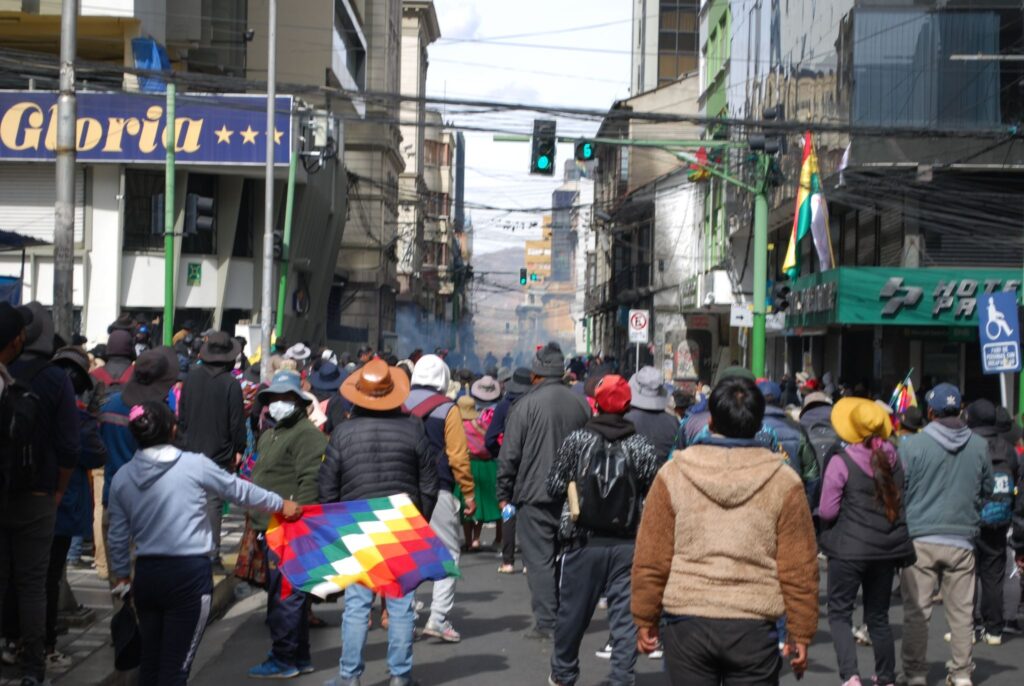
As tear gas piles up near the multiracial parliament, protesters wait to join the front lines. Image Credit: Joseph Bouchard
Influence on Paz’s Presidency
The crisis is exposing deep tensions within Paz’s own Christian Democratic Party (PDC) marquee coalition, which brings together an ideologically eclectic mix of figures, from nativist tendencies and populist actors previously linked to MAS to more traditionally conservative actors such as former president Tuto Quiroga, multi-millionaire former minister Samuel Doria Medina and prominent figures from the right-wing stronghold of Santa Cruz. The coalition is tense.
Vice President Edmand Lara, a populist anti-corruption figure and former police officer embraced by social movements and who gave crucial support to Paz’s election victory, issued several statements opposing the president’s handling of the crisis.
Lara condemned the use of chemicals against the elderly, pregnant women and children, urged security forces to respect proportionality protocols, condemned intimidation of journalists and asked the Inter-American Commission on Human Rights to monitor the situation. Political analysts in La Paz are openly speculating that Lara will position himself as the social movement’s presidential candidate if the Paz government falls.
On the more conservative side, Paz’s allies are calling for a tougher line. Proposals include a state of emergency, tighter controls on what are characterized as violent paid agitators, and a continued carrot-and-stick approach to willing and unwilling sectors. Which trend wins in the internal debate will likely determine the future nature of the Paz government’s survival.
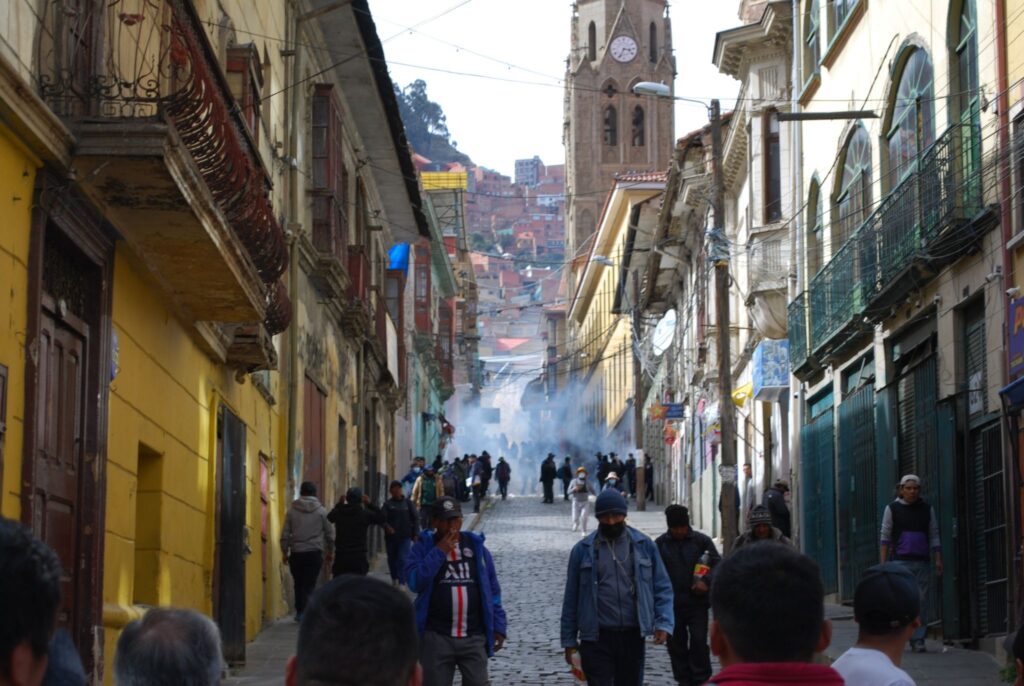
Protesters retreated as tear gas landed on a commercial street in downtown La Paz. Image Credit: Joseph Bouchard
International reaction to protests
Internationally, this crisis has also created further divisions. In a series of posts on social media, Colombia’s leftist President Gustavo Petro described the protests as a “people’s uprising” against “geopolitical arrogance” and declared that “Bolivia is at the forefront of the struggle for Latin America’s dignity.” He also suggested Colombian mediation in the crisis.
Bolivian Foreign Minister Fernando Aramayo expelled Colombian Ambassador Elizabeth García and declared her persona persona non grata for what he called “continuous and public declarations of interference in Bolivian internal affairs.” Paz called it “an attack on democracy.”
Read more: Bolivia fires Colombian ambassador after Petro’s comments
Latin America’s conservative bloc has lined up firmly behind Paz. In El Salvador, Argentina, Chile, Peru, and the United States, among others, protests were characterized as destabilizing and linked to drug trafficking. U.S. Secretary of State Marco Rubio described the unrest as a “coup attempt” and added, “We will not allow criminals and drug traffickers to overthrow our democratically elected government.”
Meanwhile, Argentina was officially reported to have sent a military aircraft carrying food and medicine, which protest groups claimed also included tear gas and crowd control equipment, a claim Buenos Aires denied. The OAS Security Council has convened an emergency meeting on Bolivia.
protesters’ demands
Protesters’ demands range from sector-specific issues, such as improving conditions for teachers and guaranteeing the rights of indigenous communities, to demands for Paz’s resignation and, in the case of Evo Morales, new democratic elections within 90 days. Evo Morales, COB and Red Ponchos say they will not stop fighting.
The unfolding unrest is a sharp test for democracy in Paz and Bolivia. Based on Bolivia’s history, street social movements, as they well know, have brought down governments before and are in no hurry to leave. Currently, the blockade continues in Bolivia.
Featured Image: Red Poncho throws stones at officials and police at the Judiciary building in La Paz.
Image Credit: Joseph Bouchard


