



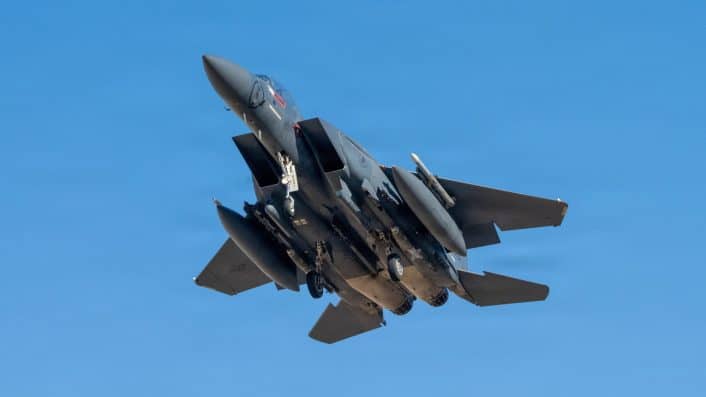
US officials said: NBC News It is possible that China’s shoulder-fired MANPADS missiles were the weapon used to shoot down the US F-15E Strike Eagle over Iran.
U.S. officials are investigating the possibility that the F-15E Strike Eagle shot down over Iran was hit by a Chinese-made shoulder-mounted man-portable air defense system (MANPADS). NBC News Reported on May 30, 2026. However, the unidentified official did not make a definitive claim and did not provide details about the manufacturer of the MANPADS or when they were transferred to Iran.
This follows U.S. President Donald Trump’s insinuation last April that an F-15 was hit by Chinese MANPADS, and the Chinese embassy in Washington at the time immediately denied the “unfounded claim.” The embassy responded, “China has never provided weapons to any party to the conflict,” and “the information in question is untrue.” CNN It has been reported.
Confirmed U.S. losses due to Iranian attacks include the problematic F-15E Strike Eagle and A-10C Thunderbolt II. Additionally, extreme close-quarters attack attempts against F-35s and F/A-18 Super Hornets were recorded, an E-3 Sentry Airborne Warning and Control System (AWACS) was destroyed on the ground, and a KC-135 Stratotanker was minimally damaged by debris from Iranian surface fire, two of which were photographed.
Spokesperson for Iran’s Khatam al-Anbiya headquarters:
🔺 A second American 5th generation F-35 was shot down by a new IRGC Aerospace Force air defense system over central Iran.
🔺 Considering the crash and massive explosion upon impact, it is unlikely that the pilot would have ejected. pic.twitter.com/akrsz1m8Mm
— Press TV 🔻 (@PressTV) April 3, 2026
A large-scale combat search and rescue (CSAR) mission was spurred by the rescue of a weapon system operator (WSO) hiding in the Zagros Mountains while the pilot was rescued hours after an F-15 was shot down in early April. In particular, small-scale hostilities are continuing ahead of the reopening of the Strait of Hormuz, and since a large-scale ceasefire is still in progress, full-scale hostilities are not expected to resume.
Report contents
NBC News It quoted three unidentified officials as saying the F-15s “were probably hit by Chinese shoulder-fired missiles” and may have been supported by “long-range early warning radars that detect stealth aircraft” that Iran received in the “early days” of the war. MANPADS, meanwhile, were about 7 feet long and weighed 40 pounds.
Regarding recent developments, the Chinese embassy’s response has been more cautious. NBC NewsInstead of outright rejection. “China always acts carefully and responsibly on military exports, exercising strict control in accordance with China’s laws and regulations on export control and reasonable international obligations,” the statement said. “China opposes groundless slander and malicious collusion.”

Iran Air Defense Inventory
Iran’s air defenses are relatively sophisticated and include a mix of domestically developed Russian and long-rumored Chinese surface-to-air missile platforms. These include the domestically developed medium- and long-range Servom Khordad, Ra’ad, Bavar-373, the Majid AD-08 optically guided and SUV-mounted short-range/very-short-range air defense (S/VSHORAD), and the unorthodox anti-aircraft loitering munitions Product 378 and Product 379.
As previously described, Products 378 and 379 use passive optical tracking while launched from routine civilian trucks. This allows for a ‘pop-up’ attack that disables the plane’s radar warning receivers and gives the crew little time to react.
🇺🇸🇮🇷🇨🇳 U.S. officials believe the F-15 fighter jet shot down over southwestern Iran was hit by a Chinese shoulder-launched missile.
They also believe China has provided Iran with long-range early warning radars that can detect stealth aircraft to evade detection. pic.twitter.com/RYojN6CkLB
— Shiri_Sabra (@sabra_the) May 30, 2026
The Russian system consists of the S-300PMU2, the most advanced variant of the medium-range SAM, the delivery of which was confirmed by Russian arms exports in October 2016.
Lastly, a Chinese system often touted as having stealth capabilities is the YLC-8B X-band air defense radar, which some recent reports mention as being used by Iran. U.S. intelligence officials claimed in early April that China was “considering whether to provide” the radar to Tehran.
U.S. media reports about imminent arms sales from China to Iran continued in May, citing U.S. security and defense officials. Another Chinese systems think tank claimed that it was the HQ-9B long-range SAM that Iran received after the 12-day war with Israel in July 2025.
🚨 Exclusive Analysis: Made in China — The missile that downed the US F-15 had China’s fingerprints all over it
The missiles came from China. Si-eun looked Trump straight in the eye and lied.
U.S. intelligence now believes that the F-15Es defeated in southern Iran are A… I believe he was killed by https://t.co/rdSsN5f69q. pic.twitter.com/sGAIaHy7ud
— Aric Chen (@arichen) May 30, 2026
China-Iran Relations
Defense cooperation between China and Iran began in the 1980s and mainly involved anti-ship cruise and ballistic missiles. Primarily, the collaboration consists of dual-use civilian components such as electronics, circuits, semiconductors used in drones, and chemicals used in missiles, rocket propellants, and warheads. This is transferred to the exchange of oil for weapons, given Beijing’s enormous energy needs.
Recent claims by U.S. security officials that Chinese weapons ended up in Iranian hands were not accompanied by a formal protest to China from the White House, State Department or War Department, contrary to Beijing’s frequent criticism of U.S. arms sales to Taiwan. The contrast highlights the diplomatic equations currently underway.
Armenia displayed the Iranian-made Majid (AD-08) short-range air defense system at its Republic Day military parade.
The SHORAD system is the same platform Iran recently used against Israeli/American drones and is believed to have played a role in the downing of several manned aircraft. pic.twitter.com/smY3ynlvwp
— Intel Observer in Egypt (@EGYOSINT) May 29, 2026
same NBC The report also quoted another official as saying that China’s long-known weapons oil transfers to Iran dating back to the 1980s were briefly halted in 2006 following a UN arms embargo, but also downplayed recent cases. “It was not critical support and did not have a critical impact on operations,” the official said.
Competence and future
If confirmed, the F-15 would be the second time a Western platform has been shot down by Chinese weapons. The first involved a dogfight between India and Pakistan in May 2025, in which beyond-visual-range PL-15 missiles were reportedly used against Indian fighter jets, including the Rafale, MiG-29UPG and Su-30MKI. However, Iran’s air defense lacks the integration needed to create an integrated air defense system on two fronts.
Components of the “3rd Khordad” battalion (Iranian air defense missile system):
– 4 looms
– 8 phone
– 1 Bashir phased array radar
– 1st Battalion Command Post
– Transporters#AirDefenceSystem #ADS #Iran #IRGC #Khordad pic.twitter.com/s5vJrk4zg3— 𝔗𝔥𝔢 𝕯𝔢𝔞𝔡 𝕯𝔦𝔰𝔱𝔯𝔦𝔠𝔱Δ 🇬🇪🇺🇦🇺🇲🇬🇷 (@TheDeadDistrict) May 2020 26th
One is that we have very few air forces comprised of at least 4th generation fighters (if not 4.5th and 5th generation), aerial tankers, airborne radars, and ISR/SIGINT jets. It coordinates with a variety of ground-based air defense and point defense aircraft that defend strategic air bases.
Second, lack of fusion between Iranian radars and Russian and Chinese air defense sensors cannot be expected due to differences in hardware, circuitry, and communication protocols, and lack of time and space for Iranian commanders to conduct training.
#Iran#Iranian weapons
long range SAM
The Sayyad missile is a copy of the #US SM-1 and is undergoing continuous modernization. The range is a guess.
Talash 3- Sayyad 3- 120km
Babar 373- Sayad 4- 200km pic.twitter.com/6o0fOi7Pg0
— Sankalan Chattopadhyay (@VinodDX9) January 4, 2020
But the Iranian military has relied extensively on secondary support from Russia and China in terms of targeting intelligence from satellites, particularly the latter’s privately owned MizarVision optical space-based surveillance network and near-real-time image updates for U.S. military bases in the Gulf. like washington post The number of U.S. targets attacked by Iran across the Gulf was much more extensive than initially reported, according to new satellite images reported earlier this month.


