



Alex Scott, the latest call-up to Thomas Tuchel’s squad, says his favorite position is number eight. But he’s likely fighting for a different role this week.
The real battle for the England midfielder at the moment is in the more defensive No. 6 position, so Scott’s World Cup hopes will likely depend on how well the Bournemouth man can prove himself in that position if given the chance against Serbia and Albania.
Scott has played in a deeper role at Bournemouth and previously at Bristol City and his statistics show he is very good at Bournemouth. However, Nottingham Forest’s Elliot Anderson, who has dominated England’s number 6 position since his debut last September, ranks first in England’s midfield defensive statistics in the Premier League.
Let’s compare the four defensive midfielders currently in Tuchel’s squad: Anderson, Scott, Jordan Henderson and Adam Wharton. Declan Rice, who the England manager has said he would like to use more of in the future, is ignored.
Most statistics clearly show that Anderson is clearly in the lead, especially on the defensive side of things. He is ahead of the rest in terms of total touches, forward passes, duels won, tackles and recoveries.
But Anderson’s closest rival is Scott for duels won and tackles, while Scott is ahead of Anderson for wins in possession and interceptions in the final third.

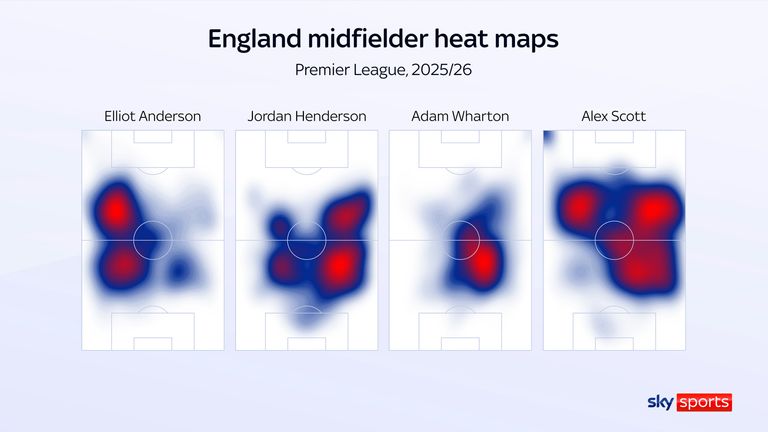
Heat map comparison of England’s deep midfield options
The heatmap shows that of the four options, naturally the deepest of Tuchel’s midfield options are Henderson and Wharton. In fact, Wharton is probably the most natural No. 6 and rarely goes deep into the opposition’s half.
Scott is clearly the most dynamic and loves to roam all over the pitch, but he will certainly need to be much more disciplined defensively if he makes his debut in an England shirt. Anderson gravitates more towards the left flank. This could be an issue for England moving forward as this is also something Rice prefers.
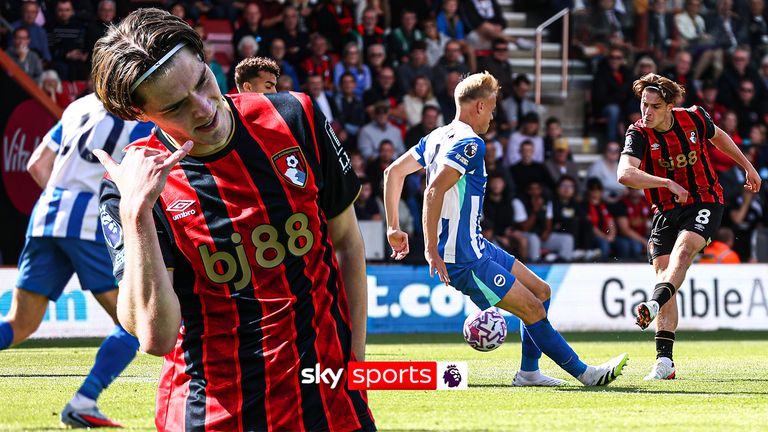
Following his first England call-up, take a look at Scott’s stunning strike against Brighton in Bournemouth’s 2-1 win in September
Henderson is currently leading his rivals in blocking, ranking highly for both long balls and forward passes. Tuchel said this was a top priority for all players to avoid a drop in tempo during international matches.
When it comes to more offensive areas, looking at the stats shows that Wharton’s biggest strengths are the way he can unlock defenses and the quality of his passes. He has created 14 chances this season. That’s just one fewer than Anderson, but the Palace man played two fewer Premier League games to reach that total.
It will be interesting to see how Wharton adapts if he ends up playing alongside Rice in this week’s World Cup qualifiers against Serbia and Albania.

Take a look at Wharton’s best beats against Crystal Palace in the Premier League this season
However, if the statistical evidence focuses on defensive ability, it is clear that Elliott Anderson is the best player so far this season.
I expect Tuchel to take four or five central midfield players to next summer’s World Cup, and with Rice joining, Henderson looking safer than ever and Anderson looking more and more of an international midfielder, the shortlist will likely be a choice between Wharton and Scott (although I don’t rule out the possibility of a player like Kobbie Mainoo returning to form and providence later in the season).
Rice is England’s number eight and can influence play both in attack and defence. Whoever Rice’s deeper midfield partner is, they are expected to adapt to him and become an important playmaker, acting as a defensive buffer in front of England’s back four.
Of course, Tuchel will be half-interested in finding out which of Anderson, Wharton and Scott could be the best candidates for the Arsenal player as a box-to-box midfielder this international break. But his priority will be to evaluate which of those three can best play alongside Rice, build a relationship and understanding with him, and have the positional intelligence to fill in whenever Rice is elsewhere.
With that in mind, and with just four games left before Tuchel selects his World Cup squad, it looks like this international break could be key in shaping the form of England’s midfield.


