



Just as France marks the 10th anniversary of the Bataclan massacre, there has been another reminder of the persistence of the jihadist threat.
The ex-girlfriend of the only jihadist to survive the November 2015 attacks has been arrested on suspicion of plotting his acts of violence.
The 27-year-old French convert to Islam, Maëva B, began a letter-writing relationship with Salah Abdeslam, 36, who was convicted in 2022 and is serving a life sentence in a prison near the Belgian border.
Prison guards discovered that Abdeslam was using a USB key containing jihadist propaganda and traced its source to a face-to-face meeting the inmate had with Maëva B.
Detectives then examined Maëva B’s computer and phone and found evidence that suggested she may have been planning jihadist attacks, and on Monday she, along with two associates, faced a judicial inquiry.
As France commemorates 10 years since the worst attack in modern history, the arrests have focused minds on enemies who have never gone away.
Interior Secretary Laurent Nuñez said six plots had been foiled this year and the threat level remained high.
“Unfortunately, no one can guarantee an end to attacks,” President Emmanuel Macron said at the park’s opening ceremony on November 13, 2015.
“But we can assure you that there will be a stern response to those who take up arms against France.”



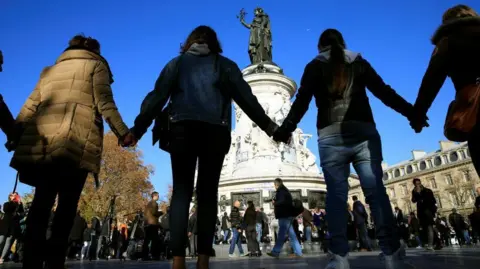
On the evening of November 13, 2015, jihadist militants and suicide bombers launched a series of coordinated attacks that culminated in a bloody assault on the Bataclan concert hall in eastern Paris.
Before that, three suicide bombers detonated themselves outside the Stade de France during a national team match. Then other members of the gang opened fire with Kalashnikovs on people drinking in bars and cafes not far from the Bataclan.
There, the American group The Eagles of Death Metal was about to begin a performance when three jihadists stormed into the audience and opened fire indiscriminately. They took hostages and blew themselves up when the police arrived.

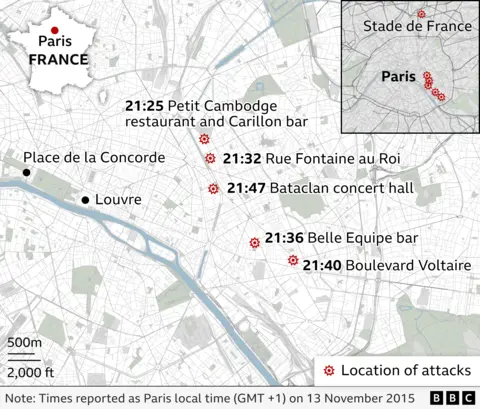
A total of 130 people died, 90 at the Bataclan and more than 400 receiving treatment in hospitals. Millions of people have suffered psychological trauma.
The word Bataclan has become as synonymous with extreme Islamist attacks in France as 9/11 was in the United States.
There have been other attacks since, including the Nice truck massacre in July 2016 and the beheading of teacher Samuel Paty in October 2020, but the scale and organization of November 13, 2015 set this one apart.
Now, 10 years later, a lot has changed. The disappearance of the Islamic State (IS) group as a major force in Syria and Iraq means that the funds available to conceive, plan and carry out complex terrorist projects have been greatly reduced.

The Bataclan attackers were mainly young men from North Africa, recruited in Belgium and France, trained in IS territory in the Middle East, and then returned to Europe hidden among crowds of immigrants.
Everywhere they were able to tap into networks of supporters who provided shelter, transportation and cash.
Intelligence services are also very effective in controlling online radicalization, according to Middle East expert Gilles Kepel.
“They now have access to IT resources, which allows them to detect and stop execution of many individual plans that are not very sophisticated,” he told Le Figaro.
But according to Mr. Keppel, the danger now comes from what he calls “peripheral jihadism.”
“Now the threat is domestic and much younger. It is based on friendships and social networks of like-minded people, without people necessarily giving orders and obeying them,” he said.
He believes the threat is all the more concerning because it is so porous. Because the events taking place in Gaza and Israel have had a “traumatic impact” on the minds of many citizens and are being “exploited by entrepreneurs of anger.”
He argues that France’s current political crisis is also adding to the risks. Because an incompetent president is giving way to a partisan Congress increasingly influenced by extremists on the left and right.
“If what divides us becomes more important than what unites us as French people and shatters our national consensus, a chasm will open under our feet and violence will become increasingly limited,” he said.
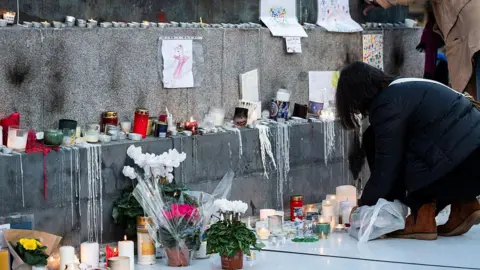
Thursday’s commemorations will take place throughout the day at various attack sites, culminating with the opening of a new garden in central Paris on November 13.
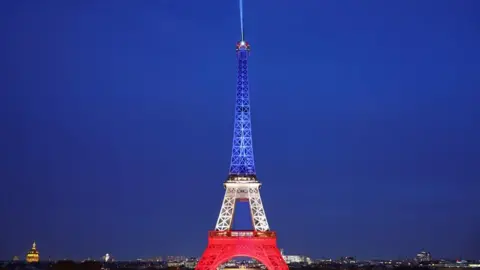
At night, the Eiffel Tower is colored with the red, white, and blue French flag.
French media is filled with stories and memories, with survivors describing how their lives have changed.
In an unexpected development, Salah Abdeslam has announced through his lawyer that he is ready to cooperate with any efforts for “restorative justice,” a process where victims and offenders meet to discuss the impact of the crime.
Some families opposed this idea, while others vehemently opposed it.
According to cartoonist Laurent Sourisseau, Riss, who was shot and wounded in the Charlie Hebdo attack a few months before the Bataclan massacre, Abdeslam’s proposal is “perverse.”
“Restorative justice also exists for other types of crimes, crimes in general,” he said.
“But terrorism is not a common crime. Salah Abdeslam wants to make you think that his crimes are like other crimes. But that was not the case.”


