



An eerie buzzing sound followed by a loud boom as Kenyan villagers were relaxing with family and friends one recent afternoon.
Stephen Mangoka, 75, a farmer from Mukuku village in Makueni County, told the BBC: “I was shocked because it sounded like a bomb. I looked around and wondered if it had been a gunshot.”
“I looked up at the sky to see if there was smoke, but there was nothing.
“I ran down the road to see if there was an accident. And there was nothing. Then someone said something had fallen from the sky.”
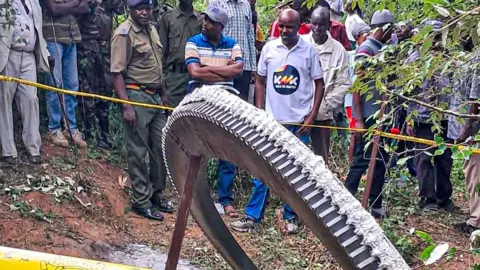
In fact, a huge, round metal object fell on farmland near a dry riverbed, and it was very hot.
“We found a large piece of metal that was very red, so we had to wait for it to cool before anyone could approach it,” said Ann Kanuna, who said she owns the land where the object fell. .
It took about two hours for the giant ring to cool and turn gray, but it has already caused a sensation among those who arrive to see it.
The rest of that Monday afternoon, like New Year’s Eve, few people were working and crowds came to see the giant metal ring.
It was like a selfie hub with people coming up next to it, posing for it and having a big discussion about what it was.
Local authorities in Makueni County, about 115km southeast of the capital Nairobi, were notified.
The Kenya Space Agency (KSA) heard this news and prepared to come and investigate the next day.
However, the reputation of the item was such that the villagers of Mukuku feared that it might be stolen overnight.
Some people took turns standing guard with local police officers and lit fires nearby. They wanted to keep away potential scrap dealers and others who wanted to make money off their curiosity.
It weighs more than 500 kg (1,102 pounds), about the same as an adult horse, and has a diameter of about 2.5 meters (8 feet), about the size of a children’s four-seat carousel.
As the day dawned, more onlookers welcomed the New Year, followed by the KSA team and media.

Mukuku had never seen such activity. Later that day, any concerns the villagers had about what had happened between them were put to rest when the KSA transported the goods.
KSA said a preliminary assessment showed the object was a “separation ring” from a space launch rocket.
“These objects are typically designed to either burn up when they re-enter Earth’s atmosphere or fall over uninhabited areas such as the ocean,” the statement said the following day.
No one was injured in the crash, but some residents in Mukuku began complaining of damage to nearby homes due to the impact of the crash.
Christine Kionga, who lives about 1km from the crash site, showed cracks in the concrete of some of the buildings on her property. She said they showed up after the crash.
Other neighbors have claimed the structural integrity of their homes has been affected, but this has not yet been proven.
Benson Mutuku, a resident of Mukuku, told the BBC: “The government must find the owner of this object and compensate those who have been harmed by it.”
Local media reported that some residents began complaining of discomfort after being exposed to the metal rings. But there was no confirmation from the people we spoke to when we visited, from the authorities or from KSA.
Nonetheless, Mr Mutuku said there were concerns about the long-term effects of cosmic radiation.
“This is a space object and we have heard of other similar incidents where there have been effects of radiation affecting future generations and there is fear in this community.”
However, tests later conducted by the Kenya Nuclear Regulatory Authority showed that the metal rings had higher levels of radiation than the area where they were found, but not at levels harmful to humans.
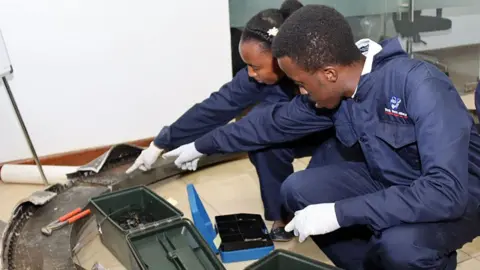
Engineers at KSA, which was established in 2017 to promote, coordinate and regulate space-related activities in the East African country, continue to run other tests to learn more about the object.
The KSA director said it was fortunate that no major damage was caused when the object hit the Earth.
“Ultimate responsibility for any damage or injury caused by that space object lies with the state whose jurisdiction the operator may have launched that object from,” Brigadier General Hillary Kipkosgey told the BBC.
“States shall be liable for damage caused by space objects,” according to the Outer Space Treaty, overseen by the UN Outer Space Secretariat.
“(The ring) is a common item on many rockets and many space objects, so it is difficult to say for sure that it corresponds to a specific rocket or space object, but there are clues, but as I said, our investigation is not conclusive,” Brigadier General Kipkosgei said. said.
The BBC showed photos of the object to the British Space Agency to get experts’ thoughts.
“The most likely object is the upper separation ring of the 2008 Ariane rocket,” said Matt Archer, launch director.
“The satellite is fine, but the actual rocket body passed through and went out of orbit.”
Ariane was Europe’s primary rocket launch vehicle, putting more than 230 satellites into orbit before its retirement in 2023.
The separate ring appears to have been orbiting Earth for 16 years before making an unexpected appearance in Mukuku.
This is not the first time space debris has appeared in East Africa.
Just a year and a half ago, suspected space debris fell on several villages in western Uganda.
And just a few days ago, on January 8th, there were unconfirmed reports of what was believed to be brightly burning space debris over northern Kenya and southern Ethiopia.

Such accidents are predicted to become more frequent as the space industry grows, and African governments may need to invest in better ways to detect space debris that are speeding up the pace.
NASA estimates that there is currently more than 6,000 tons of space junk in orbit.
There are various estimates as to the likelihood of such trash hitting anyone. But most are in the 1 in 10,000 range..
These statistics are of no comfort to Mukuku residents, who cannot help but think of the damage the ring would have caused if it had landed in the center of the village rather than farmland.
“We need assurances from the government that something like this will not happen again,” Mr Mutuku said.
You may also be interested in:




