




Knowing that you may have a disease like lung cancer can be scary. Fortunately, there are surgical options for minimally invasive diagnosis and treatment. This means it involves only a small scar and the recovery is much faster than traditional or open surgery.
Understanding some of the different types of minimally invasive procedures and how they can help people with lung cancer and other conditions can help you feel less anxious about what you’re facing.
Common minimally invasive procedures
One minimally invasive procedure used to diagnose and treat a variety of health problems is endoscopy. During an endoscopy, your healthcare provider (HCP) inserts an endoscope, a long, thin tube, inside your body to get a closer look at the body part that needs to be examined. This tube typically has a light and a camera at the end, and the HCP views a screen that shows what the camera is seeing.
There are many different types of endoscopy, but they all work in the same basic way. A type of endoscope called a laparoscope may be used with surgical tools in a minimally invasive surgery called laparoscopy to check for problems in the stomach or pelvic area.
During a laparoscopy, the laparoscope enters the stomach through a small wound and displays images on a monitor for the doctor to view.
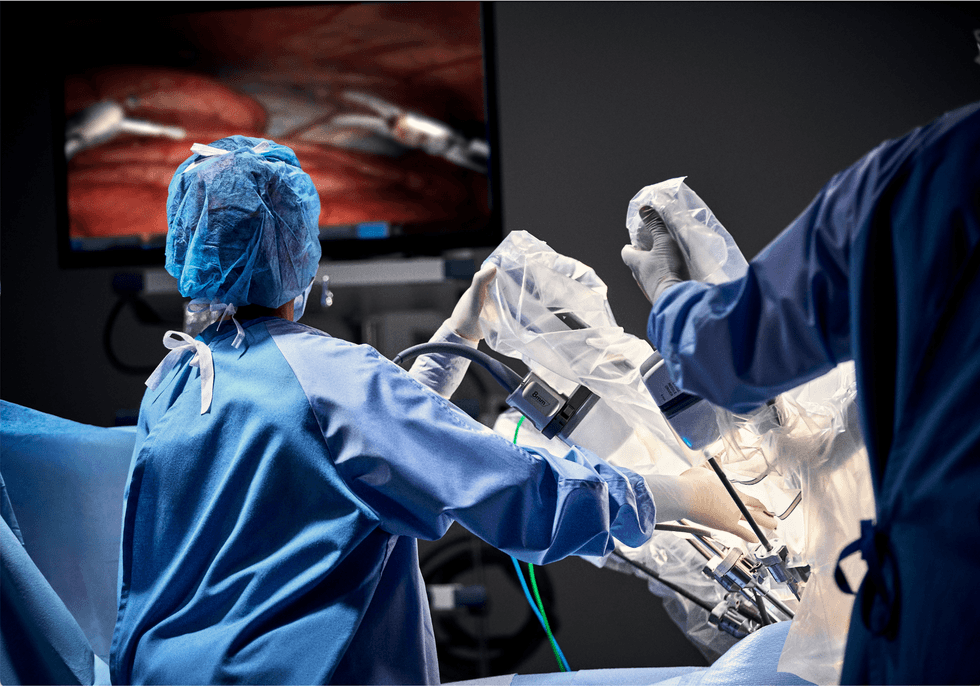
Robot-assisted surgery is another minimally invasive surgery. It includes a high-definition (HD) camera that shows a close-up of the area and a robotic arm with a small surgical tool on the end. There’s also a control panel that looks like a video game joystick. Surgeons perform surgery by manipulating a robotic arm, a type of surgical tool.
When are minimally invasive procedures used?
Although there are times when more traditional procedures are necessary, minimally invasive procedures can be used for a variety of health problems throughout the body, including lung cancer and other health problems that affect the lungs.
For example, an HCP may do an endoscopy called bronchoscopy, which uses a tube to look inside the lungs and airways. This procedure may be used to check for lung cancer and find out how serious it is. Robotic bronchoscopy, as performed on systems such as Ion and Monarch, involves smaller tubes and control panels that HCPs use to move the tube in a precise manner and reach parts of the lung that traditional bronchoscopy cannot reach. Controlling the tube through a 3D map of the lung, HCPs can see exactly where the tube is and where it should go, and can guide the tube to hard-to-reach nodules for biopsy.
Minimally invasive procedures can also be used to treat lung cancer and other lung problems. Instead of the traditional approach, which is an open-heart surgery called a thoracotomy, minimally invasive surgery involves smaller incisions and often has a shorter recovery time. In video-assisted thoracoscopic surgery (VATS), commonly used for small, early-stage lung cancers, your health care provider makes small incisions in the chest and performs the surgery while viewing a video screen using a camera and a special tool with a long handle.
Robotic-assisted surgery, such as the da Vinci Surgical System or the Mako System, uses a robotic arm (fully controlled by the surgeon) in a minimally invasive manner to treat more complex lung problems. Robot-assisted surgery uses video screens with high-definition 3D images.
Advantages of minimally invasive procedures
Minimally invasive procedures require only small cuts, putting a much lighter burden on the body, resulting in less pain for patients, shorter recovery times, and smaller scars. Studies have also shown that robotic surgery is associated with better outcomes during and after surgery than other types of minimally invasive or open surgery. Benefits of robotic surgery include reduced need for blood transfusions, lower complication rates, shorter hospital stays, fewer readmissions, and lower mortality.
Inexpensive surgery can be especially helpful for people undergoing cancer treatment. If your body doesn’t have to work as hard to recover from surgery, it will be better able to handle your next treatment plan.
And these types of minimally invasive cancer treatments are on the rise. A recent study led by Duke University School of Medicine that examined more than 76,000 lung cancer cases found that lung cancer surgery is moving toward becoming less invasive, especially for young, healthy patients.
“This is a very encouraging finding for the entire community of professionals who care for patients with lung cancer,” study author Xiaofei Wang, MD, a professor at Duke School of Medicine, said in a press release.
know your choices
Whether you’re dealing with the scary prospect of a lung cancer diagnosis or dealing with another health issue altogether, minimally invasive procedures may be a potential treatment tool.
Talk to your health care provider to learn more about your options for less invasive treatments. They can walk you through your options and help you choose the one that best suits your unique needs.
This training material was created with support from:m It’s intuitive.
From your site article
Related articles on the web


