



david grittonand
paul adams



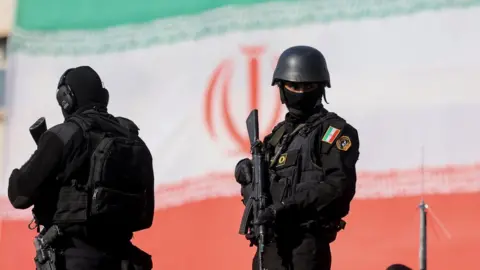
More than 2,000 people have been killed in a violent crackdown by security forces on protests in Iran, a human rights group says, just as President Trump promised aid would soon arrive for Iranians.
The US-based Human Rights Action News Agency (HRANA) reported that despite the internet blackout, it had confirmed the deaths of 1,850 protesters, 135 government officials, nine uninvolved civilians and nine children over the past 17 days.
An Iranian official also told Reuters that 2,000 people were killed but that terrorists were responsible.
President Trump is scheduled to attend a conference on Iran Tuesday evening and has pledged to get an “accurate” death toll.
“It looks like the murder was significant, but we’re not sure yet,” Trump told reporters when he returned to the White House.
“We will act accordingly,” he said after seeing the numbers.
Earlier in the day, President Trump said on his Truth Social platform that Iranian authorities would “pay a heavy price” for the killings and urged people to “continue to protest.”
“I have canceled all meetings with Iranian officials until the senseless killings of protesters stop. HELP IS ON ITS WAY. MIGA!!!,” he added, using an acronym for the U.S.-based Iranian opposition slogan “Make Iran Great Again.”
President Trump has been weighing military and other options in response to the crackdown, having already announced a 25% tariff on all countries doing business with Iran.
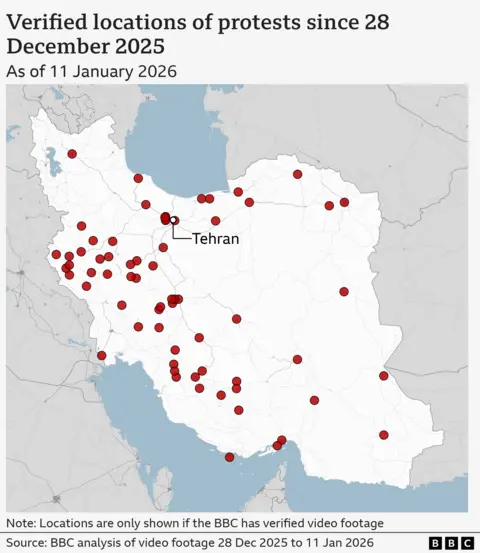
The protests, which are said to have spread to 180 cities and towns across 31 provinces, were sparked by anger over the slumping Iranian currency and rising costs of living.
They quickly escalated into demands for political change and became one of the most serious challenges to the clerical establishment since the 1979 Islamic Revolution.
Protests escalated significantly last Thursday and were met with lethal force by authorities, with internet and telecommunications services almost completely disrupted.
HRANA said Tuesday afternoon that it had not only confirmed that at least 2,003 people had been killed during the unrest, but was also reviewing reports of a further 779 deaths.
“We’re shocked, but we still think those numbers are conservative,” Deputy Director Skylar Thompson told The Associated Press.
Another Norway-based group, Iran Human Rights (IHR), confirmed that at least 734 protesters had been killed.
“These figures are based on information received from less than half of Iran’s provinces and less than 10 percent of Iranian hospitals,” Mahmoud Amiri-Moghadam told AFP, adding that the actual death toll was likely in the thousands.
Reuters said an unnamed Iranian official estimated the death toll at around 2,000 but did not provide details on the figure. But he added that ‘terrorists’ were behind the deaths of both protesters and security personnel.
Like other international media outlets, the BBC is unable to report domestically, making it difficult to estimate the actual scale of bloodshed.
But a video posted online Sunday showed people searching for the bodies of their loved ones at Tehran’s Karizak Forensic Center. The BBC identified at least 180 covered bodies and body bags in the footage.
Another video from the facility shared on Monday showed about 50 bodies.
“My friend went there (Karijak) to look for his brother, but he forgot his grief,” one activist told BBC Persia on Monday.
“They have piled up bodies in every neighborhood – Sadatabad, Naziabad, Satarkan – so go to the piles of addresses and search them. You don’t know what level of violence was used.”
It is also known that the number of casualties in hospitals in the metropolitan area is increasing.
Professor Shahram Kordasti, an Iranian oncologist in London, told the BBC Newsday program on Tuesday about the last message he received from his colleague in Tehran: “Most hospitals are like war zones. We are short on supplies and blood.”
Other doctors from “two or three hospitals” also said they treated hundreds of injured or dead people.
An Iranian living in Rasht, near the Caspian Sea coast, described the city as unrecognizable. “Everywhere is on fire,” they said.

On Monday night, Pentagon officials told the BBC’s US partner CBS News that Trump had been briefed on a wide range of secret and military tools, including long-range missile attacks, cyber operations and countering psychological campaigns.
At the same time, Iranian Foreign Minister Abbas Araghchi told Al Jazeera that Iran was ready to pursue diplomacy as well as other options, including “if the United States wants to test military options that it has tested in the past.” Last June, the United States carried out airstrikes against Iran’s main nuclear facilities during the 12-day war between Iran and Israel.
Araghchi also said the Iranian government held talks with protesters but was forced to take action after a “trained terrorist group” fleeing abroad infiltrated the protesters and targeted security forces.
His comments echoed Supreme Leader Ayatollah Ali Khamenei’s comments Monday, telling supporters at rallies he hosted across the country that “domestic mercenaries have neutralized the plans of foreign enemies that were supposed to be carried out.”

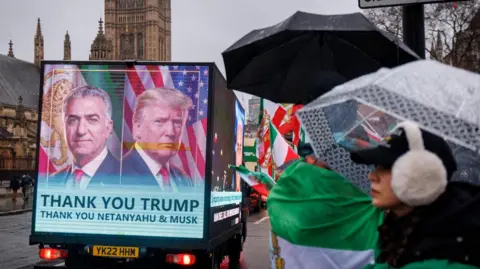
Also on Tuesday, British Foreign Secretary Yvette Cooper summoned Iran’s ambassador to protest against the “appalling and brutal killings of Iranian protesters.”
U.N. High Commissioner for Human Rights Volker Turk called on Iranian authorities to immediately end all forms of violence and repression against peaceful protesters, his office said.
He added that labeling protesters as “terrorists” to justify violence was unacceptable and that it was “very concerning” to see statements from Iranian officials suggesting the death penalty could be applied to protesters through an emergency trial.
Justice Minister Gholamhossein Mohseni Ezei said on Monday that those involved in the unrest “will be dealt with seriously and severely.” And prosecutors said some people would be charged with “enmity against God,” a national security crime punishable by death.
According to HRANA, more than 16,780 protesters were arrested during the unrest.
The 26-year-old man detained last Thursday has already been sentenced to death, according to his family and the Norway-based Kurdish human rights group Hengaw.
A relative of Erfan Soltani’s family told BBC Persia: “It was a very fast process, in just two days the court sentenced him to death and the family was told he was scheduled to be executed (this) Wednesday.”
“I have never seen events move so quickly,” Awyar Shekhi from Hengaw told the BBC. “The government is using every tactic it knows to oppress people and spread fear.”
In an interview with CBS, the BBC’s American news partner, President Trump said the United States would take “very strong action” if Iranian authorities hanged protesters.
“If they hang it, you’ll see something. If they do that, we’ll take very strong action,” he said.

Turkey also demanded that Iranian authorities restore full access to the internet and other telecommunications services.
Some international calls from Iran were made on Tuesday, but the internet blockade has now exceeded 120 hours, according to Monitor NetBlocks.
A person living near Tehran via the Starlink satellite service told BBC Persia that there were “checkpoints on every block” with security forces checking vehicles and passengers’ mobile phones.
New footage of protests has also emerged in recent days, with BBC Persia verifying footage taken in the central city of Arak and the western cities of Tabriz, Urmia and Khorramabad.
Footage from Khorramabad shows gunshots heard during clashes between security forces and protesters, some of whom are throwing stones.
Protesters chanted slogans such as “Death to the dictator”, a reference to Ayatollah Khamenei, and “Reza Shah, may your soul rest in peace”, a reference to the late monarch Mohammad Reza Pahlavi, who was toppled in a 1979 revolution and whose son Reza lives in exile.


