



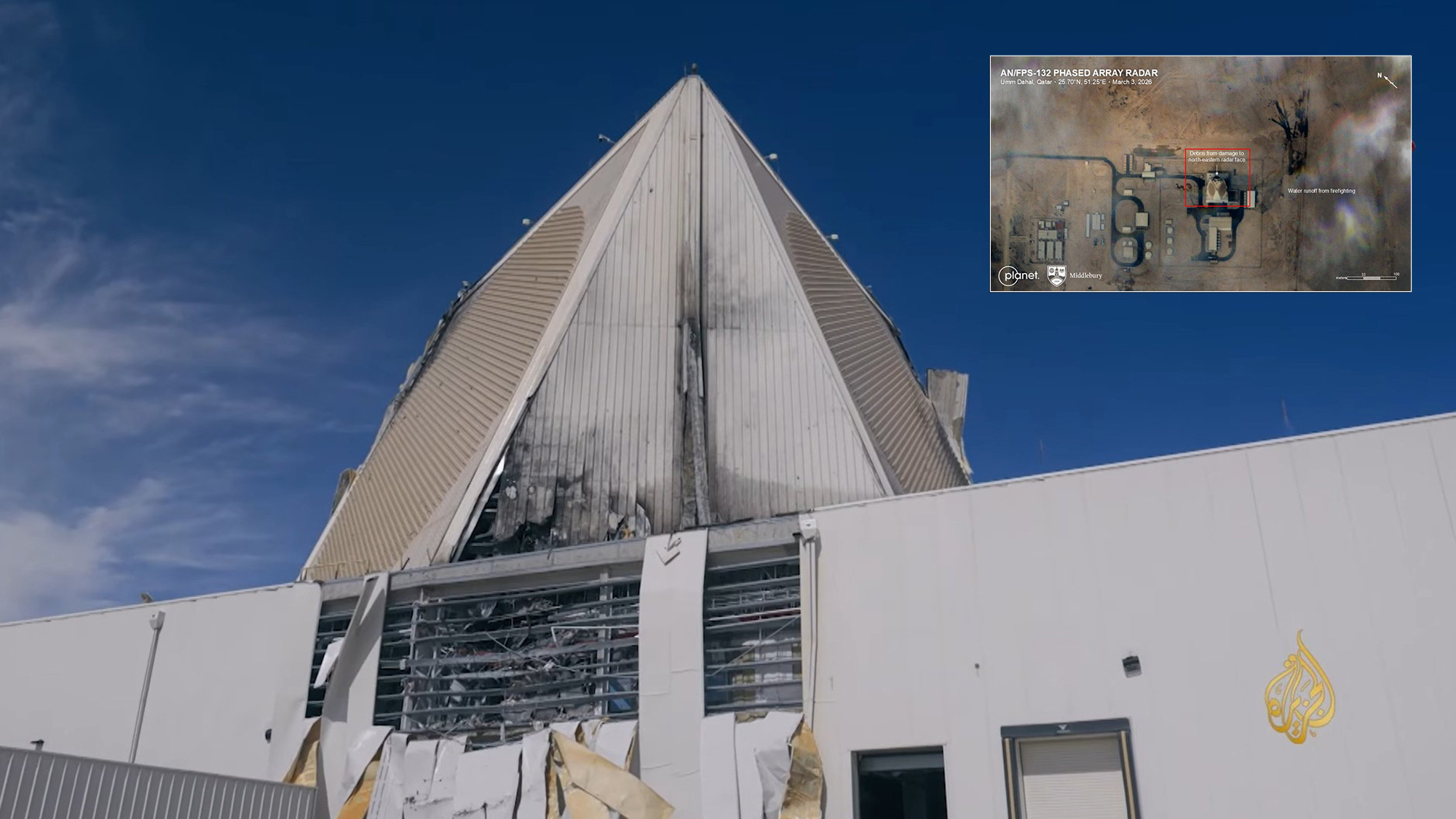
This image details the damage to a giant phased array AN/FPS-132 radar struck during an Iranian attack on Qatar last month.
New photos posted by Al Jazeera Data circulated online provides the clearest view yet on the damage suffered by the US-made AN/FPS-132 Block 5 (SSPARS) ballistic missile early warning radar deployed in Qatar in last month’s retaliatory attack by Iran.
Qatar’s radar complex, a high-value fixed-position phased array system that forms part of the Gulf’s broader missile warning architecture, is located at Al Udeid Air Base, a key U.S. base in the region that has been targeted several times by Tehran missiles during the conflict triggered by U.S. and Israeli airstrikes against Iran.
Photos first published by Al Jazeera revealed damage caused by Iran’s attack on the US-made AN/FPS-132 Block 5 (SSPARS) ballistic missile early warning radar in Qatar.
The scale of damage appears to be wider than seen in satellite images. https://t.co/wQvJh8Eldk pic.twitter.com/tfuxzIna7J
— Intel Observer in Egypt (@EGYOSINT) April 10, 2026
The images themselves do not allow us to assess the full extent of the damage or the current operational status of the radar, but appear consistent with previous reports that at least part of the radar installation had been hit based on satellite imagery. Previous analysis showed one side of the radar was damaged and debris and signs consistent with firefighting activity were identified at the scene.
Satellite images captured by Planet appear to confirm that a US-made AN/FPS-132 Block 5 (SSPARS) ballistic missile early warning radar in Qatar was damaged in a recent Iranian attack.
The system is valued at approximately $1.1 billion. https://t.co/2izKrf1a5f pic.twitter.com/F8Q3G9S9cc
— Intel Observer in Egypt (@EGYOSINT) March 3, 2026
Again, the photos show burnt parts and wiring, and although the damage is clear, it is impossible to determine whether the radar can be repaired or how long it will take, so caution is required. There has been no official statement about the damage so far, so it is unknown how badly the radar has been hit or whether it continues to operate in some degraded mode.
However, it is worth emphasizing that even partially damaged such radars can be problematic. This does not necessarily mean that the entire network is unnoticed, especially in areas of significant redundancy, but it can still degrade warning coverage, degrade tracking quality, and complicate response to subsequent missile or drone attacks.
The AN/FPS-132 Block 5 is not only the radar of regional air defense, but also the main fixed-site ballistic missile early warning system, one of the largest and most strategically important sensors deployed in the region.
According to the U.S. Defense Security Cooperation Agency, the radar was sold to Qatar to provide a “permanent defense capability” on the Korean Peninsula, protect economic infrastructure, and help counter current and future threats in the region. The package included not only the radar itself, but also communications equipment, cryptography devices, support and test equipment, training, and U.S. government and contractor engineering and logistics support. Raytheon was the main contractor.
Although some media outlets describe the radar complex as being operated by the United States, the radar was purchased by Qatar through a foreign military sale, so it is technically owned by Qatar and made in the United States. However, it is reasonable to assume that both Qatari and American personnel will work on the system. At the same time, the radar is said to be part of a broader missile warning architecture in the Gulf region supported by the United States and its allies, meaning it is tightly integrated into regional air and missile defense networks.
The United States also operates the A/N FPS-132 Block 5 SSPARS radar complex with a range of 5,000 km in Qatar (25°42’24″N 51°15’16″E). This provides early warning of ballistic missiles to both the United States and the IDF, providing critical lead time to intercept most Iranian and Houthi missiles. https://t.co/2ukgyvXtjw pic.twitter.com/w30YzuG08R
— Intel Observer in Egypt (@EGYOSINT) June 15, 2025
According to published details, the system uses three electronically steered phased array planes that provide 360-degree azimuth coverage and can detect ballistic missiles at a range of up to 5,000 km. The same source said the radar would support missile warning, missile defense and space situational awareness, placing it in a broader area air and missile defense architecture rather than a narrow point defense role.
In any case, what makes the strike particularly important is the type of function involved – a function worth $1.1 billion in 2013 – that cannot be more easily relocated or replaced. So there is something symbolic about the huge Qatari radar.
But the attack on this radar station was not an isolated act.
destruction:
US soldiers film an Iranian ballistic missile hitting the ground very close to their location.
The Patriot air defense system at Al Udeid Air Base in Qatar failed to intercept an Iranian missile. pic.twitter.com/XAtAY6HKDB
— Visegrad 24 (@visegrad24) February 28, 2026
🚨 BREAKING NEWS: Iranian ballistic missiles hit Al Udeid Air Base in Qatar, the largest US military base in the Middle East.
It is currently unknown if there have been any casualties.
In development… pic.twitter.com/EV2Cp6zFIH
— Nick Sorter (@nicksortor) March 4, 2026
Since the beginning of Operation Epic Fury, Iran has continued to target multiple radar systems in the Middle East, including several AN/TPY-2 sites, with the goal of degrading the warning and tracking architecture that supports the region’s integrated air and missile defense posture.
Photos show the destruction of a US military-operated AN/TPY-2 forward-based X-band mobile radar following an Iranian drone strike targeting Muwaffaq Salti Air Base in Jordan earlier this week. AN/TPY-2 is the primary ground-based airborne surveillance device. pic.twitter.com/54QyQCxNVW
— OSINTdefender (@sentdefender) March 7, 2026







