



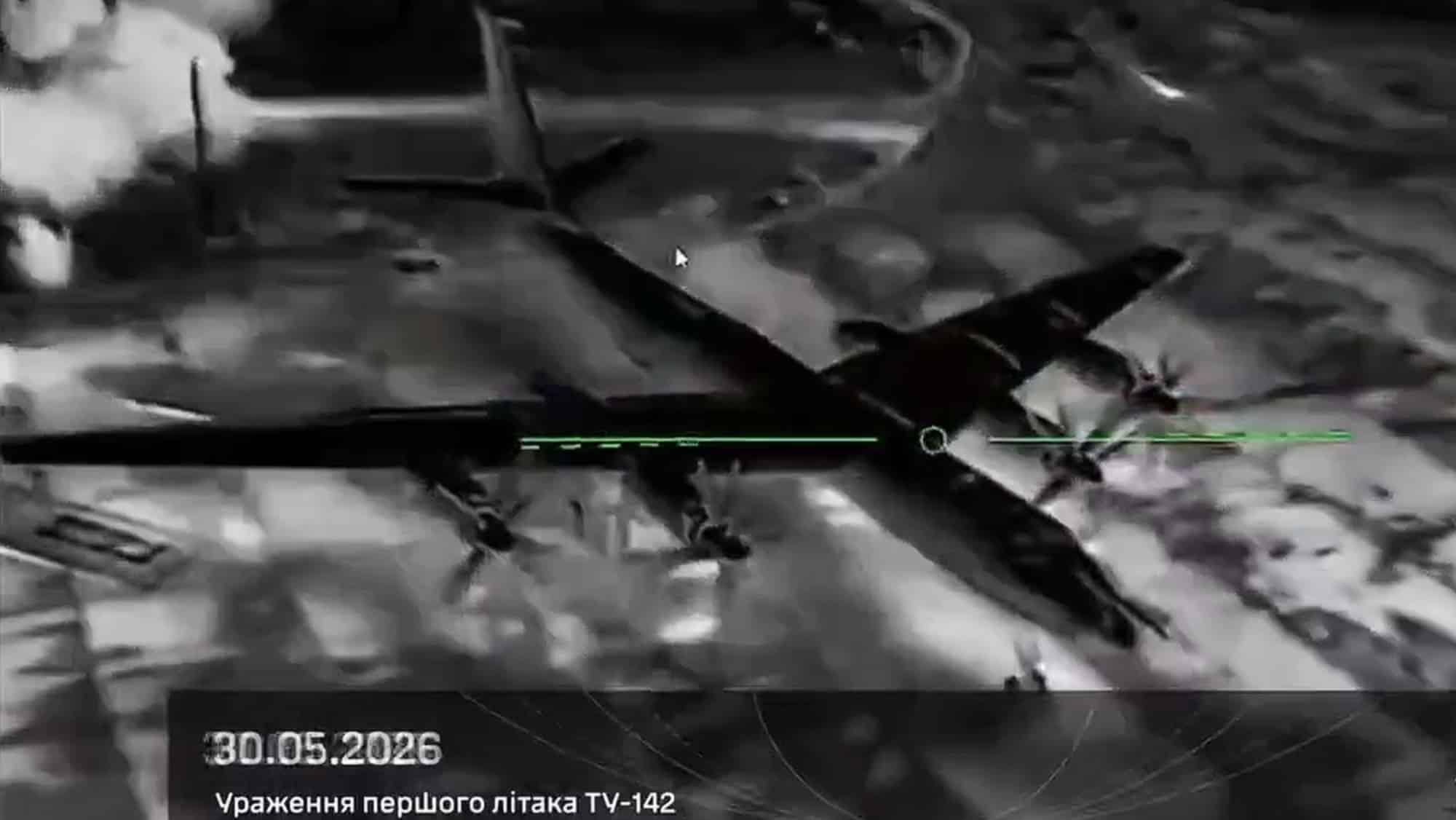
An overnight attack on Russia’s Taganrog airfield reportedly destroyed two Tu-142s, including a rare “MR” radio relay variant used to communicate with ballistic missile submarines.
Ukraine launched coordinated drone strikes against Russian energy infrastructure and military facilities across multiple regions overnight.
The attack on Taganrog, located in the Rostov region on the coast of the Sea of Azov, also targeted the Taganrog Aviation Plant, along with oil tankers, fuel tanks and administrative buildings in the port area. Taganrog is home to one of Russia’s important aviation industry hubs. The site includes the Beriev Aircraft Company, known for its work on large military platforms such as the Tu-95MS, Tu-142 and A-50, as well as amphibious aircraft, and the 325 aircraft repair plant supporting transport aircraft including the Il-76, An-12 and An-72. The wider region also has aviation-related facilities such as Atlant Aero, which is known to be involved in the development and production of unmanned aerial vehicles.
Drone footage released by the Ukrainian military after the attack showed that the drones destroyed two Russian Tu-142 aircraft undergoing repairs in Taganrog and also hit an Iskander ballistic missile launcher.
Ukrainian drones destroyed two Russian Tu-142 strategic anti-submarine aircraft undergoing repairs in Taganrog and also attacked an Iskander ballistic missile launcher. pic.twitter.com/HP1FniPdPA
— Yaroslav Trofimov (@yarotrof) May 30, 2026
Although it cannot be ruled out that one or more aircraft at Taganrog are undergoing maintenance or are not immediately mission-ready, the site is one of the key facilities used to repair and modernize the Tu-142 family. For this reason, the presence of two Tu-142s represents more operational aircraft working in the factory rather than retired aircraft.
Interestingly, according to Piotr Butowski, aviation journalist, author and recognized Russian aviation expert, one of the two Tu-142s destroyed in the attack was not “just” an anti-submarine aircraft, but a rare and important Tu-142MR strategic radio repeater.
One of the two Russian Tu-142s destroyed in Taganrog by Ukrainian drones today was an important Tu-142MR strategic radio repeater.
The Beriev plant in Taganrog is responsible for overhauling these aircraft.
This is the Tu-142MR page from my book Russian Air Power, Key Publishing. pic.twitter.com/TdU33mbTJh— Piotr Butowski (@piotr_butowski) May 30, 2026
Tu-142MR “Bear J” is a VLF band radio communications relay platform whose mission is similar in concept to the US E-6A TACAMO. That is, it provides communication relay capabilities to underwater SSBNs, SSGNs and SSNs. The Bear J is based on the Bear F airframe but features a ventral fairing with VLF antenna cable reels and a unique nose radome and antenna in the vertical tail.
According to Piotr Butowski russian air forceThe Beriev Tu-142MR, published by Key Publishing, is a strategic radio relay aircraft developed in Taganrog and derived from the Tu-142 maritime patrol aircraft. Unlike other naval aircraft, its significance comes not from the weapons it carries, but from its role in Russia’s nuclear command and control architecture. The aircraft is built on the Oryol communications relay system, which performs a broadly similar role to the American TACAMO concept, allowing national command authorities to transmit launch orders to submerged ballistic missile submarines.
Butowski points out that the Tu-142MR can be externally distinguished from other Tu-142 variants by the forward pods on the tailplane, which replace the rear magnetometers found on the anti-submarine version. Another key feature is the very long aft wire antenna used for VLF communications with underwater submarines, deployed from a ventral pod connected to equipment installed in the forward bomb bay.
The same source said an upgrade program, codenamed Kipelovo, has been launched to replace aging equipment and support operations. Butowski also notes that six Tu-142MR aircraft are assigned to each of the two Tu-142 units, one to the Northern Fleet in Kipelovo and the other to the Pacific Fleet in Mongokhto.
Therefore, only small numbers of Tu-142MR were produced. Depending on the source, the total number of aircraft appears to be between about 7 and 12 to 14, with Butowski’s unit allocations indicating at least 12 in service across the Northern and Pacific Fleets. Anyway, that type is pretty rare and valuable. In fact, while the Tu-142MR does not directly support the tactical air war over Ukraine, it plays a strategic role in Russia’s nuclear command and control architecture, acting as an airborne communications relay used to relay commands to submerged ballistic missile submarines. For this reason, the loss or damage of one aircraft would be a huge blow to Russia. This is not because of its direct impact on battlefield operations, but because of the niche and strategic mission it performs in the field of nuclear deterrence.


