



Guy HazzicoIn Adamuz, southern Spain



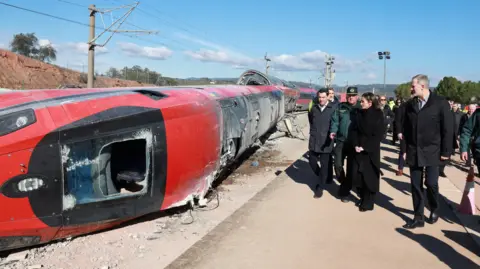
In a huge tragedy for Spain, the worst high-speed train crash in a decade has taken the lives of at least 42 people in southern Spain.
And even in their grief, many are asking what led to such a failure in one of Europe’s most revered rail systems.
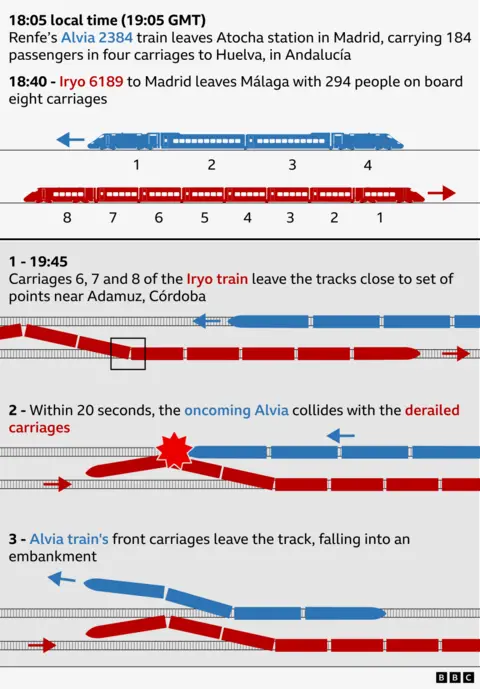
The CIAF Railway Investigation Commission began analyzing why a train traveling north from Malaga derailed on a straight section and collided with an oncoming train.
The Spanish government described the accident as “very strange.”
Three bodies were already recovered from the rubble on Tuesday afternoon, and a 42nd victim was discovered at the crash site near Adamuz.
The confusion of the sudden failure of a long-running and efficient railway line added to the shock felt in this sleepy town.
Since its opening in 1992, Spain’s high-speed rail (AVE) network has been seen as a symbol of the country’s modernization. Built with EU funding, the railway provided a state-of-the-art transport system that was fast, efficient and safe.
The 2013 derailment that killed 80 people near Santiago de Compostela was not part of the AVE network, even though the train was traveling at high speeds. But Sunday’s crash occurred on the oldest AVE route linking Madrid and Andalusia.
Several officials, including Álvaro Fernández Heredia, president of state-owned rail operator Renfe, said human error was almost certainly not the cause of the accident, given that neither train was operating at excessive speeds. Interior Minister Fernando Grande-Marlaska insisted vandalism was not a probable cause.
Inevitably, investigators are watching the derailed train closely.
Owned by Italian company Iryo, the train was manufactured in 2022. Transport Minister Óscar Puente said carriage 6 of the train was the first to derail and would be examined closely as it presented “many pieces of the puzzle”.

However, investigators are also examining the section of track where the derailment occurred and plan to analyze part of it in a laboratory.
It was discovered that some of the tracks at the crash site were damaged, leading to speculation that this could be the culprit.
The government was keen to discount this conclusion, noting that the force of the collision may have damaged the track.
Some observers have noted possible primitives of the network.
Adif, a railway infrastructure manager, was found to have drawn attention to eight technical problems on the line near the accident site through social media last year. Most of these issues relate to signaling, and one was discussed in the Senate last summer.

Adif reduced the AVE’s speed limit along a 150km (93 miles) section between Madrid and Barcelona due to concerns about the condition of the route. The new limit for that section is 160 km/h, almost half the previous limit.
Following the crash, many social media users flagged posts in the past complaining about uncomfortable movements while traveling on AVE trains.
One user said he felt “fearful for my and my daughter’s safety” while filming the violently vibrating interior of the train in December.
In August 2025, the train drivers’ union Semaf issued a statement warning that the condition of many AVE lines led to a “lack of comfort and reliability” for those traveling.
It called for a reduction in speed limits to prevent further degradation of infrastructure and “ensure the safety of workers and travellers”.
These complaints could suggest that Spain’s high-speed rail network is in desperate need of an overhaul. But the government countered that the section of track where the accident occurred was renovated at a cost of €49m (£42m) as part of a €700m investment to update the Madrid-Andalusia network in recent years.
Prime Minister Pedro Sánchez declared three days of mourning during a visit to Adamuz, saying: “Once we find the answer, we will let the Spanish people know with absolute transparency.”
The answer could have enormous implications for the future of Spain’s famous rail system.


