



The CERP program’s Critical Design Review paves the way for two B-52 bombers to be retrofitted with the new engine, with work on the first bomber set to begin later this year.
The U.S. Air Force announced that the Commercial Engine Replacement Program (CERP) for the B-52 Stratofortress bomber has passed Critical Design Review (CDR). Following this milestone, the Air Force said it can begin retrofitting the two bombers to replace their existing TF33 engines with the new F130 engines.
CERP’s CDR comes just over a year after the F130 completed its own CDR in December 2024. The final design was verified through analysis, simulation, schematics, software code, and review of test results. Rolls-Royce recently completed altitude and operability testing for its F130 engines at the U.S. Air Force’s Arnold Engineering Development Complex (AEDC) in Tullahoma, Tennessee.
The B-52 Commercial Engine Replacement Program has held a critical design review. This milestone brings the program closer to modernization. #B52 By the 2050s, aircraft will be equipped with fuel-efficient engines and advanced systems.
Learn more: https://t.co/VdjdDLZXI1 pic.twitter.com/xHwp0OtuG7
— Boeing Defense (@BoeingDefense) May 4, 2026
“This CERP critical design review is the culmination of a tremendous amount of engineering and integration work from Boeing, Rolls-Royce and the Air Force to ensure the B-52J remains in the fight for future generations,” said Lt. Col. Tim Cleaver, Bombers Directorate CERP program manager.
During CDR’s comprehensive technical evaluation, experts from the Air Force, Boeing and Rolls-Royce scrutinized the overall system design to ensure it met all requirements before major modifications began. Cleaver described the CDR as a pivotal moment. This is because the program can now move quickly in the direction of aircraft modifications.

Work on the first bomber is scheduled to begin later this year. The Air Force said Boeing will convert the first two B-52H aircraft to the B-52J configuration with the new engines at its facility in San Antonio, Texas.
Two modified B-52J aircraft will undergo extensive testing at Edwards AFB, California to validate new engines and related systems. Once testing is complete, the program will move forward with modifications to the remainder of the B-52H fleet.
B-52J and CERP
As we often report here aeronautical scientistThe current Pratt & Whitney TF33-PW-103 bomber, which has been in service since the 1960s, will no longer be supported after 2030. This led to the launch of the B-52 Commercial Engine Replacement Program (CERP) in 2018, with GE Aviation, Pratt & Whitney, and Rolls-Royce competing for the contract.
Rolls-Royce’s successful offering is the F130, a military version of the BR725 engine used by the Gulfstream G650 business jet and which powers the C-37 and E-11 BACN already in service with the U.S. Air Force. In 2023, two years after the 2021 selection, Rolls-Royce announced that it would begin testing the F130 engine.
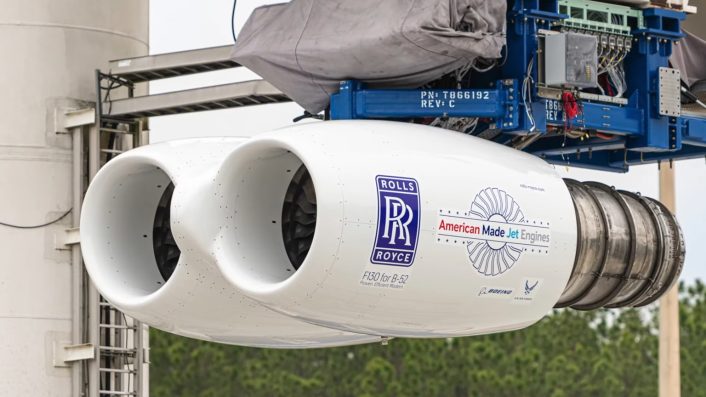
As was the case with the B-52G, when the new engine was the main reason the B-52G was redesignated the B-52H in 1962, the use of the new F130 engine also gave the Stratofortress the designation B-52J. Another important component of the B-52J upgrade is the radar modernization program, with the first modified aircraft currently being tested at Edwards AFB.
The Air Force plans to finalize integration activities and deliver the first lot of B-52Js in 2026-2027. Initial operational capability was initially expected in 2030, but was later delayed to 2033. The new engine will increase the bomber’s fuel efficiency, increase its range, reduce emissions of unburned hydrocarbons and significantly reduce maintenance costs.
Although the overall shape is still the same, the new nacelles on the F130 engines are larger than those on the original engines, and the new struts are shorter, bringing the nacelles closer to the wings. Wind tunnel testing for this was completed in 2022.
The new nacelles will be supplied by Spirit AeroSystems, which signed a contract with Boeing in 2023 to provide both struts and nacelles for the CERP program. The company, one of the world’s largest suppliers of struts and nacelles, was meanwhile acquired by Boeing.
In December 2025, Boeing received a $2.04 billion task order for the Post-Critical Design Review (CDR) phase of CERP. With this, Boeing will complete system integration work, modifications and testing for two B-52 aircraft with new engines and associated subsystems by May 2033.







