



The U.S. Air Force has announced testing of a family of low-cost mass munition payloads, with photos showing the weapons in question are Rusty Dagger low-cost cruise missiles.
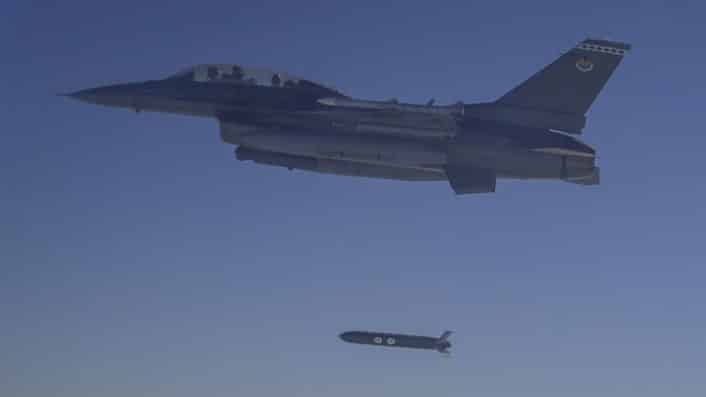
The U.S. Air Force announced in March 2026 that it has completed a series of integrated tests of the Rusty Dagger low-cost air-launched surface-strike cruise missile, one of the Extended Range Attack Munition (ERAM) weapons developed by Zone 5 Technologies. The weapon was launched from an F-16 Fighting Falcon fighter jet at Eglin AFB, Florida.
An April 13 press release said the test campaign included a series of captive transport and release tests, including “fit and functionality checks, verification of loading procedures, and ensuring flight compatibility with the FAMM-L and F-16.” “These efforts culminated in the weapons loading and release of the F-16,” the release added.
The statement did not identify Rusty Dagger, developer Zone 5, or the ERAM program designation, but instead used the Family of Affordable Mass Munitions-Lugged (FAMM-L) designation, as the program was subsequently named. However, the ERAM designation can be seen stenciled on the inactive weapon along with the serial number beginning with “RD”, Rusty Dagger’s initials.
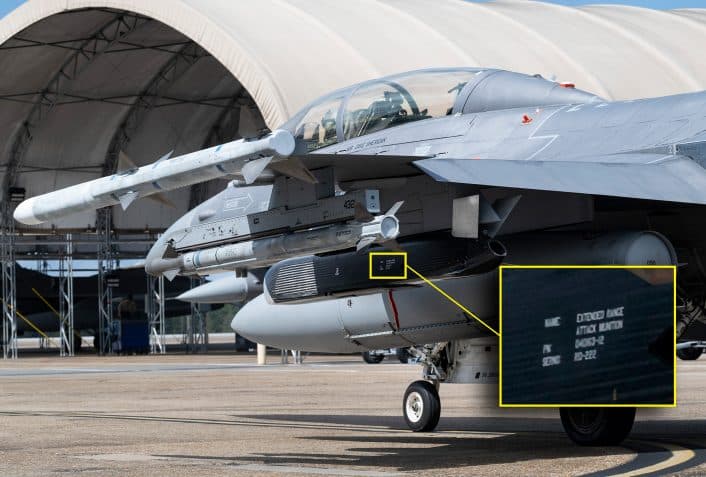
Zone 5 itself re-shared Eglin AFB’s LinkedIn post, saying, “We are proud to have supported Team Eglin’s rapid Rusty Dagger integration on the F-16.” The company added, “Together, we are making ‘Affordable Mass’ a reality with precision strike capabilities at scale!”
I firmly believe that dozens, if not hundreds, of these weapons cost ~$250,000 (decrease with scale) and are used across multiple platform changes, although they often match the cost of their removal through secondary effects, if not directly. pic.twitter.com/E1wkqwOSSQ
— Abd (@blocksixtynine) April 17, 2026
This new test campaign follows a live warhead test of a standoff cruise missile conducted by the 96th Test Wing at Eglin Test and Training Range (ETTR) on January 21, 2026. In that case, the military specifically identified the weapon as an ERAM.
The ERAM program was initially launched to equip Ukrainian jets with simple, scalable, anti-jamming cruise missiles. The goal was to throw an inexpensive air-launched mass against Russia at a lower cost compared to current cruise missiles.
Rusty Dagger Test
The March test shows Team Eglin Test Enterprise’s F-16D Block 50 equipped with two Rusty Daggers, two CATM-120 AMRAAMs, a CATM-9 Sidewinder short-range AAM and an AN/AAQ-28 Litening pod. The 96th Test Wing and the 58th Test Wing were responsible for integrated and operational tests, respectively.
Lt. Col. Brett Tillman, 780th Test Squadron commander, called it “a perfect demonstration of our test readiness to meet the needs of the warfighter.” “By unifying our entire test team, we were able to safely test and deliver critical functionality at incredible speed,” Tillman added.
Lt. Col. Taylor Wilson, 40th Flight Test Squadron commander, emphasized how the team is “accelerating testing” to get the weapon operational quickly. “The team was able to quickly create and execute sorties to provide critical data to evaluate new and innovative warfighting capabilities,” Wilson said.
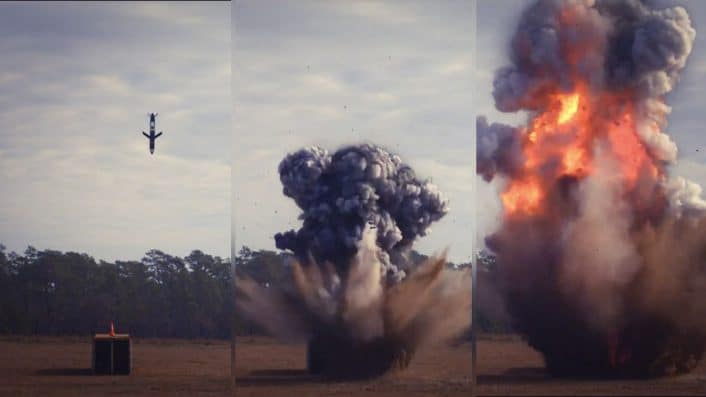
The initial live warhead test conducted at ETTR on January 21 “achieved all primary objectives, including full warhead detonation, and collected critical data to mature a new, cost-effective long-range strike capability.” The release emphasized that the testing took place “less than 16 months after the initial contract award for the program.”
It is unclear which platform was used to launch the Rusty Dagger, but in a series of officially released photos the weapon can be clearly identified by capturing the missile heading straight towards a static target before the actual warhead explodes.
The release called ERAM “a next-generation air-launched cruise missile designed to provide affordable mass for combat.” The service also explains that it “provides a cost-effective, precision-guided standoff capability against high-value fixed targets while being capable of rapid production in large quantities.”
This should indeed result in the AGM-188A Rusty Dagger being certified/integrated into the Extended Range Attack Munition (ERAM) effort and the expanded FAMM umbrella. The requirement threshold was 250 nm, but the AGM-188A pushes this to almost 500 nm (930 km). https://t.co/hK52flCgi7 pic.twitter.com/IdWi9g1G1N
— Abd (@blocksixtynine) April 17, 2026
“Going from contract to live-fire demonstration in less than two years demonstrates that we can deliver a lethal, cost-effective capability at a relevant pace,” said Brig. Gen. Robert Lyons III, Weapons Portfolio Acquisition Officer.
rapid progress
The Air Force Life Cycle Management Center (AFLCMC) first explored air-launched tactical, scalable, and affordable air-to-ground weapons in June 2024. By August 2025, US President Donald Trump’s administration had approved 3,350 units for sale to Ukraine, proving that things had moved reasonably quickly in the meantime.
Two weapons were not selected, the first weapon being the Rusty Dagger. Another low-cost cruise missile that is part of the ERAM program is CoAspire’s Rapidly Adaptable Affordable Cruise Missile (RAACM), which the company tested aboard the A-4 Skyhawk in August 2025.
The U.S. military is also envisioning cheap air-launched munitions, like Project Artemis, that would blur the line between long-range one-way attack (OWA) drones and cruise missiles. The ERAM project progressed independently and quickly from conception (July 2024) to production (September 2025) in just 14 months.
From ERAM to FAMM-L
Air Force and Space Force Magazine More information comes from a March 24, 2026, report to Air Force Acquisition Director Brig. General Robert P. Lyons III appears before the Senate Armed Services Committee (SASC). The service has contracts with Zone 5 Technologies and CoAspire for ERAM “in late 2024,” according to the publication.
Therefore, the ERAM program went from concept to contract in just four months, had a flight prototype fielded in four to seven months, and went into production in just 14 months.
Under the name ERAM, 🇺🇦 plans to purchase missiles from two manufacturers at once, with the first batch expected by the end of 2026.
According to AviationWeek 🇺🇦 plans to procure two types 🚀 that will be launched from both F-16 and MiG-29 jets: Zone 5’s Rusty Dagger and CoAspire’s RAACM. pic.twitter.com/en42OMMr9h— 𝔗𝔥𝔢 𝕯𝔢𝔞𝔡 𝕯𝔦𝔰𝔱𝔯𝔦𝔠𝔱Δ 🇬🇪🇺🇦🇺🇲🇬🇷 (@TheDeadDistrict) September 6, 2025
ERAM was then considered a Family of Affordable Mass Munitions (FAMM) program in the missile procurement section of the Air Force’s fiscal year 2026 budget request, seeking $656,333 for 3,010 units. In the research, development, test and evaluation section of the FY2026 budget document, FAMM even included the Rapid Dragon palletized launch program.
The budget document highlighted the low cost and mass production capabilities of FAMM weapons.
“The Family of Affordable Mass Missiles (FAMM) will be the Modular Weapon Series (M-Series), an open-architecture munition for long-range, economical, high-productivity, and palletized use. FAMM life cycle prototyping activities will include integration and flight demonstrations of inexpensive, highly manufacturable compact turbine engines, seekers/sensors, networked data links, joint autonomous operations, and weapons (warheads/fuzes). It will also include testing and certification of a palletized mass employment munitions flying vehicle. “It will be.”
The origins of ERAM/FAMM date back to the Air Force’s Enterprise Test Vehicle (ETV) program, which aimed to develop low-cost, palletized air-to-ground munitions. Traditional defense industry heavyweights have also developed their own cost-effective, scalable palletized launch surface strike munitions.
Two of them are Leidos’ Black Arrow and Lockheed Martin’s Common Multi-Mission Truck (CMMT), which the Air Force designated as AGM-190A last February. There are two versions of the CMMT, including a non-powered glide vehicle called CMMT-D and a smaller powered variant called CMMT-X.
#Czechia/#USA 🇨🇿🇺🇸: PBS Aerospace, Czech PBS Group (@PBS_GRP), a jet engine manufacturer, today announced that it has signed a significant subcontract with Zone 5 Technologies, Inc. The contract is worth tens of millions of dollars.
The contract is as follows… pic.twitter.com/qRuiC8HtA5
— 𝕻𝖗𝖆𝖎𝖘𝖊 𝕿𝖍𝖊 𝕾𝖙𝖊𝖕𝖍 (@praisethesteph) February 25, 2026







