



A cloud rests over the summit of Nevis Peak. Stone sugar mills emerge from tropical gardens. Wooden houses and Georgian buildings line the compact streets of Charlestown, where church bells, fruit stalls and centuries of Caribbean history occupy the same few blocks.
Down by the sea, the mood changes. The water off Pinney’s Beach is calm, the sand stretches beneath coconut palms and a famous rum punch waits at Sunshine’s Beach Bar and Grill. A few minutes away, the broad lawns of the Four Seasons Resort Nevis meet one of the island’s finest beaches.
You come here for an island where history remains visible, where former sugar estates have become intimate hotels and where the Caribbean’s grand-resort tradition shares space with family-run restaurants, quiet beaches and a festival created to celebrate Nevisian culture.
The Power of the Peak
You also come because Nevis is genuinely fun. You can spend one day tracing the early life of Alexander Hamilton, another beneath the palms at Sunshine’s and another dining by candlelight inside a centuries-old sugar mill. During Culturama, the island trades its customary reserve for parades, pageants, calypso and elaborate costumes.
Nevis feels deeply Caribbean, proudly individual and remarkably comfortable in its own identity.
Nevis Peak rises 3,232 feet above the island, its upper slopes frequently covered by clouds. The mountain dominates nearly every view, creating a green backdrop for beaches, villages and old plantation estates.
The island’s circular shape makes it easy to explore. A drive around Nevis carries you through small communities, past churches and stone ruins, beneath flamboyant trees and alongside stretches of golden and dark volcanic sand. Green vervet monkeys appear near the road or dart through hotel gardens. Goats wander near old estate walls. On the western side, St. Kitts seems close enough to touch across the Narrows.
Charlestown, the capital, gives you an immediate sense of Nevisian history. Its streets hold Georgian buildings, traditional wooden homes and landmarks connected to some of the most consequential figures of the 18th century.
Nevis was once among the wealthiest sugar-producing islands in the Caribbean. The industry relied on the labor of enslaved African people, and its economic legacy cannot be separated from the suffering upon which it was built. Ruined mills and estate buildings now provide a physical record of a difficult era as well as the communities and culture formed after emancipation.
The island later became part of the independent federation of St. Kitts and Nevis in 1983.
The Caribbean Birthplace of Alexander Hamilton
Alexander Hamilton was born in Charlestown in 1757, making him the only United States Founding Father born in the Caribbean.
His birthplace stood near the Charlestown waterfront. A Georgian-style building now occupies the site and houses the Museum of Nevis History, where you can learn about Hamilton’s childhood and the broader story of the island.
Hamilton left Nevis as a child, but his Caribbean beginnings remain central to the way the island presents its past. The tropical port, mercantile economy and social divisions of the Caribbean shaped the world he encountered long before he reached the North American colonies.
A Hamilton tour can take you through Charlestown and St. Paul’s Anglican Church, adding geographic context to a life more frequently associated with New York, Philadelphia and Washington. The Four Seasons Resort Nevis also offers a guided Hamilton experience that visits places connected to the island during his lifetime.
Hamilton is only part of the story. British naval officer Horatio Nelson married Frances “Fanny” Nisbet on Nevis in 1787. Their marriage is traditionally associated with the Montpelier estate, adding another layer of international history to an island filled with unexpected connections.
Nevis also lays claim to one of the Caribbean’s earliest chapters in resort travel. The Bath Hotel, built in 1778 beside natural hot springs, is regarded as the first hotel in the Caribbean. Visitors came for the therapeutic waters at a point when leisure travel in the region was still a rarity. You can still visit the Bath Spring area near Charlestown and enter its warm mineral water.
The Four Seasons Is the Island’s Grande Dame
The Four Seasons Resort Nevis is the island’s grande dame, a beachfront resort large enough to create its own world while remaining closely connected to Nevis.
The resort occupies a prime stretch of Pinney’s Beach, with Nevis Peak rising behind its gardens and St. Kitts visible across the water. Its arrival helped introduce Nevis to a wider luxury audience, and the property remains the island’s best-known hotel.
You can spend an entire vacation here and never feel confined. Three infinity-edge pools serve different styles of stay, while four gingerbread-trimmed beach cottages offer extra privacy near the sand. The resort also has an 18-hole Robert Trent Jones II golf course, tennis and pickleball facilities, water sports, a children’s program and a 12,000-square-foot spa with nine indoor and outdoor treatment rooms.
Rooms and suites occupy low-rise buildings spread across the property. Larger families and multigenerational groups can choose private residences and estate homes, some with several bedrooms, pools and views across the golf course or sea.
The Four Seasons works particularly well when different members of your group want different vacations. One person can play golf, another can spend the afternoon at the spa and children can alternate between the beach and the pool. Couples can retreat to a private cabana or reserve dinner beside the water.
Dining has become an increasingly important part of the resort. Mango serves Caribbean cuisine in an open-air setting overlooking the sea toward St. Kitts. On the Dune focuses on locally sourced seafood and produce. EsQuilina brings Italian cooking together with island herbs and fresh-caught fish, while The Crowned Monkey is an intimate cocktail and rum bar.
The resort has the breadth of a major Caribbean hotel, yet Nevis is always nearby. Green monkeys cross the golf course. Fishermen work along the water. Charlestown is a brief drive away. Sunshine’s is close enough for an easy lunch or rum punch.
Its real advantage is how naturally it can serve as both a resort vacation and a base for seeing the island.
And the golf course is spectacular, too.
Sunshine’s and the Art of the Nevis Beach Bar
Every Caribbean island needs a beach bar capable of becoming part of its mythology. On Nevis, the place is Sunshine’s Beach Bar and Grill, a legend of the region.
Sunshine’s stands on Pinney’s Beach, a casual collection of brightly painted wood, shaded tables, photographs and memorabilia. The menu centers on grilled seafood, ribs and jerk chicken. The signature drink is the Killer Bee, a rum punch famous enough to have become one of Nevis’s unofficial attractions. We’ve called it the best rum punch in the Caribbean, and we stand by it.
The recipe is closely guarded. The experience is less mysterious: you sit near the beach, order food from the grill and watch the room gradually fill with island residents, hotel visitors, sailors and people who have been returning for years.
Sunshine, the owner behind the name, is a Nevis personality in his own right. The bar has grown from a local beach stop into an essential island address, but it has retained its informality. Nobody arrives expecting ceremony.
The Killer Bee is deceptively strong, so one deserves respect and two deserve a free afternoon.
Sunshine’s also reveals why this island works so well as a destination. A resort and an easygoing beach bar can occupy the same vacation. You are never required to choose between refinement and personality.
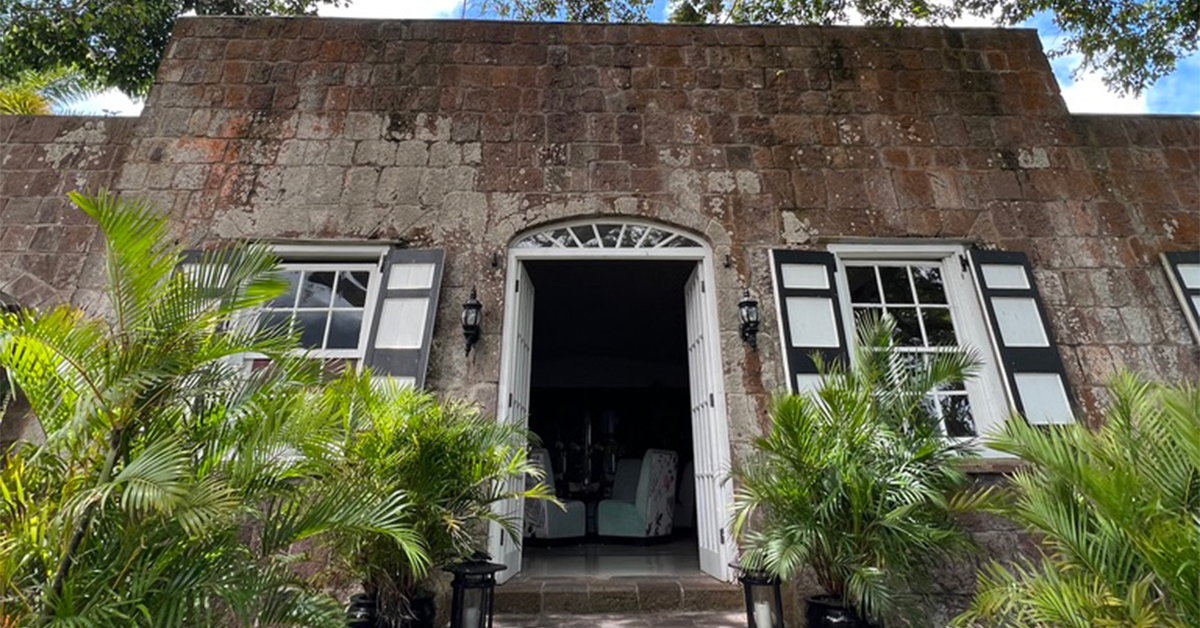
Montpelier Nevis, Where History Becomes the Hotel
High in the foothills of Nevis Peak, Montpelier Nevis offers a very different interpretation of island luxury.
The hotel occupies an 18th-century sugar estate surrounded by 60 acres of tropical gardens, 750 feet above the sea. Its 18 individually styled rooms and villas give the property the feeling of a private country retreat. Bougainvillea climbs across stone walls, green monkeys pass through the trees and the old mill remains at the center of the estate’s identity.
Montpelier is personal, quiet and deliberately intimate. You spend your stay among gardens rather than directly beside the water, with the mountain air and elevation providing a different side of Nevis.
The pool is one of the social centers of the hotel. Indigo, beside the pool, serves relaxed lunches and dinners, while The Terrace offers open-air dining and views toward St. Kitts.
The most memorable meal is at Mill Privée, a candlelit restaurant inside the property’s roughly 300-year-old sugar mill. Thick stone walls enclose an intimate dining room used for tasting menus and special dinners. Reservations are essential, in part because the room itself can accommodate only a small number of diners. I did this on my last trip to the island, and it remains one of my signature travel memories — it’s really that good. It feels ethereal.
Montpelier also has a private, three-acre beach about 15 minutes from the main hotel. Transportation runs between the estate and the beach, where you find cabanas and picnic lunches delivered near the sand. The beach pavilion hosts barbecue lunches and occasional dinners under the stars.
The arrangement gives you two distinct environments in a single stay: a historic mountain estate and a private beach club.
The Hotel Princess Diana Chose
Montpelier’s privacy has long attracted public figures, but its best-known visitor was Diana, Princess of Wales.
Diana came to Nevis with Princes William and Harry following her separation from Prince Charles, staying at Montpelier during a highly scrutinized period of her life. The secluded hotel and discreet island gave the family a degree of privacy difficult to find in larger Caribbean destinations.
The association still adds to Montpelier’s mystique, although the hotel does not trade heavily on royal history. Its appeal is readily apparent when you arrive. Rooms are dispersed through gardens, public spaces feel residential and the entire estate encourages you to disappear into your own routine.
You can read on your veranda, walk through the grounds, take the shuttle to the beach club and return for drinks before dinner. Staff members learn your name quickly. Resident Labradors Cosmo and Marley may appear on a veranda or in the gardens.
Montpelier suits couples, solo travelers and anyone drawn to boutique hotels with a strong identity. Families seeking extensive activities may find the Four Seasons more suitable. Travelers who prefer gardens, history and an intimate atmosphere are likely to find Montpelier difficult to leave.
Culturama Changes the Island’s Tempo
Nevis may be known for quiet hotels and uncrowded beaches, but Culturama shows you its exuberant side.
Created in 1974, the annual celebration runs from late July into early August. The festival brings calypso, soca, pageants, food fairs, cultural exhibitions, concerts and street parades to communities around the island.
Culturama is rooted in Nevisian heritage. Traditional performances share the calendar with contemporary music. Elaborate costumes fill the streets. Families gather for events that have been part of island life for generations.
The 2026 festival begins July 23. The calendar typically builds toward major parade days and competitions in Charlestown, turning the capital into the center of the island’s cultural life.
Visiting during Culturama provides a fuller picture of Nevis. The island remains friendly and approachable, but the energy rises. Hotels fill, relatives return from abroad and local food becomes as central to the experience as the music.
You should reserve your room well ahead of the festival, particularly at smaller properties such as Montpelier. Culturama also rewards flexibility. Events may run on an island cadence, crowds gather quickly and the best experience often comes from following the music rather than adhering to a rigid plan.
How to Reach Nevis
Many visitors fly into Robert L. Bradshaw International Airport on St. Kitts, followed by a water taxi or ferry to Nevis. The boat ride across the Narrows is brief and scenic, with Nevis Peak growing larger throughout the crossing.
Private and shared water taxis depart from the St. Kitts side, and the Four Seasons can coordinate transfers directly to its pier. Public ferries connect Basseterre with Charlestown.
You can also fly into Vance W. Amory International Airport on Nevis. Regional service includes connections through St. Maarten, creating one-stop itineraries with airlines serving the Dutch Caribbean hub.
Once you arrive, renting a car or hiring a driver lets you explore beyond your hotel. Driving is on the left. Distances are modest, but roads curve around villages and the lower slopes of Nevis Peak, so journeys often take longer than the map suggests.
A visit of four or five nights gives you enough room for Charlestown, a plantation inn lunch, the hot springs, Sunshine’s and a full beach day. A week allows Nevis to work more gradually, with space for a rainforest hike, a boat trip, dinner at Mill Privée and several afternoons devoted to very little.
By the end, the island’s size seems less important than everything held within it.







