


Every day, millions of Americans turn on their taps and fill glasses, rinse produce, boil pasta, and bathe their children, rarely thinking twice about what’s in the water. But for millions of households, especially those near farms, factories, or relying on groundwater, that water may carry chemicals that have been linked to an increased risk of cancer with long-term exposure.
Despite decades of research on these contaminants, the way drinking water is regulated in the U.S. still hasn’t caught up. Most contaminants are reviewed one by one, with years between updates, and limits are based as much on economic feasibility as on public health, which, the Environmental Working Group (EWG) argues, can leave many people exposed without knowing it.
These outdated standards have prompted EWG researchers to examine just how much cancer risk might be reduced if the problem were approached differently. Their findings suggest that a more realistic and protective approach is both possible and overdue.1,2
Which 3 Tap Water Contaminants Did the EWG Study Examine?
EWG’s study, which was published in the journal Environmental Research, focused on three contaminants that frequently occur in U.S. tap water, often together, and that have been linked to increased cancer risk. The researchers calculated cancer cases for chromium-6 and arsenic; nitrate was included in the co-occurrence analysis because no comparable cancer-risk value has been developed for it:3,4
1. Chromium-6 — Also known as hexavalent chromium, this chemical gained national attention when it was linked to a cluster of illnesses, including cancer, in the town of Hinkley, California,5 where the chemical had leached into the local water supply. Chronic exposure to chromium-6 in drinking water has been associated with an elevated risk of stomach cancer,6 and the EPA notes that chronic high-level exposure may affect the liver, while animal studies have reported reproductive effects.7
In a 2008 National Toxicology Program (NTP) study, mice given chromium-6 in drinking water for two years developed more small-intestine tumors, and rats developed more tumors of the oral cavity.
In people, workplace inhalation of chromium-6 has long been linked to lung cancer, although the NTP report notes that evidence from drinking water exposure in humans is more limited.8 As of the study’s 2025 publication, chromium-6 was not regulated as a standalone compound under federal law, despite being classified as a human carcinogen.
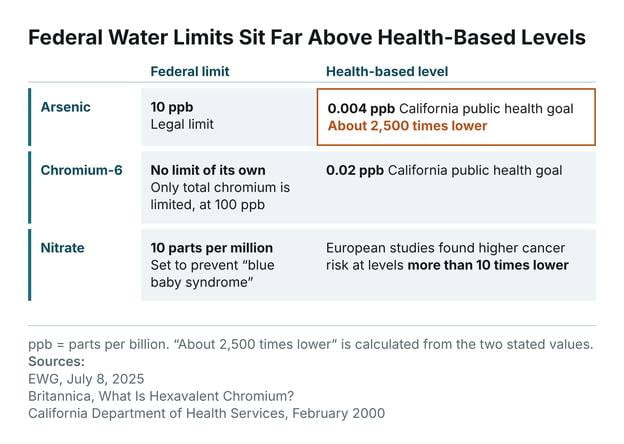
The U.S. Environmental Protection Agency (EPA) sets a limit only for total chromium of 100 parts per billion (ppb), which includes both toxic hexavalent and safer trivalent forms. As a result, water supplies can meet federal standards while still containing chromium-6 well above health-based benchmarks — California’s public health goal for chromium-6, for example, is 0.02 ppb.9
2. Arsenic — This chemical enters water supplies from underground sources and human activities like agriculture and mining. EWG reports that it has been found in drinking water in all 50 states,10 and long-term exposure is associated with cancers of the skin, lungs, and bladder, as well as cardiovascular disease and developmental problems.11
A 2024 study published in PLOS Water,12 which analyzed consumer test-kit samples from California’s San Francisco Bay Area, detected arsenic in 8% of household-treated tap water samples (9 of 111) and 3% of untreated tap water samples (16 of 603).
The EPA’s legal limit of 10 ppb was set in 2001 and, according to EWG, was based on outdated treatment-cost estimates rather than on what’s safest for health.13 By contrast, California has set a much lower public health goal of 0.004 ppb, the level that, according to EWG, scientists say would pose no significant cancer risk over a lifetime.
3. Nitrate — Nitrate contamination comes mainly from fertilizer runoff, livestock waste, and failing septic systems. It’s widespread in both groundwater and surface water, especially in farming regions. Drinking water with nitrate has been linked to serious health risks, including colorectal and ovarian cancer, very preterm birth, low birth weight, and neural tube defects.14
The current federal nitrate limit of 10 parts per million was set to prevent “blue baby syndrome,” where excess nitrate in drinking water disrupts oxygen transport in the blood, which can cause an infant’s skin to turn bluish.15 However, EWG notes that European studies have found increased cancer risk at levels more than 10 times lower than that threshold.16
Unfortunately, these aren’t the only contaminants lurking in your drinking water. To learn what else could be in your glass, read “Nearly 100 Million Americans Exposed to Contaminated Drinking Water.”
A National Cancer Burden — and How Much of It Could Be Prevented
To estimate how many cancer cases could be avoided with better water treatment, the researchers analyzed more than 10 years of testing data from U.S. community water systems, focusing on cancer cases from chromium-6 and arsenic, with nitrate included in the co-occurrence analysis.
The dataset combined chromium-6 results from the EPA’s Unregulated Contaminant Monitoring Rule (testing conducted from 2013 to 2015) with state compliance records spanning 2011 to 2023. Together, these reflect average contaminant levels measured in community water systems, which the researchers used to model theoretical lifetime cancer risk.17,18
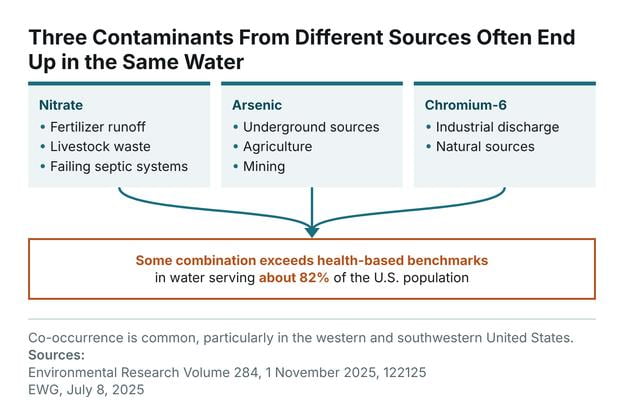
• Nearly 100 million Americans are served by systems where all three exceed health-based benchmarks — Using data from more than 17,000 community water systems (6,831 with direct chromium-6 testing, plus 10,893 groundwater systems where chromium-6 was estimated from total chromium), the researchers found that some combination of arsenic, chromium-6, and nitrate exceeded health-based benchmarks in water serving about 82% of the U.S. population.
California, Arizona, and Texas had the most potentially avoidable cancer cases associated with chromium-6, and EWG says these states also bear the highest burden of arsenic pollution. In California, nearly 79% of the potentially avoidable cancer cases were attributed to arsenic.
• These contaminants frequently appear together — While not every water system contains all three carcinogens at once, co-occurrence is common, particularly in the western and southwestern United States. For instance, nitrate from agricultural runoff can occur alongside naturally occurring arsenic and chromium-6 from industrial discharge or natural sources.
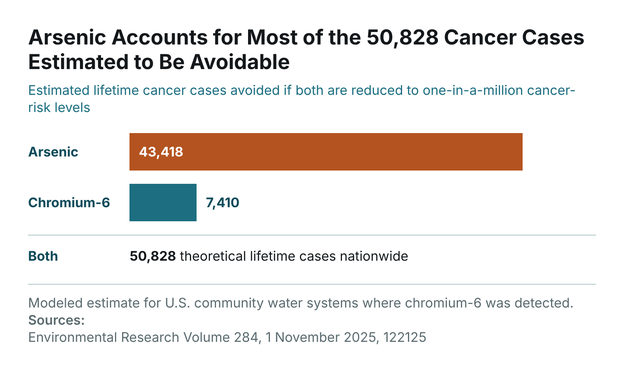
• Reducing multiple contaminants at once may yield greater benefits — The analysis showed that addressing several pollutants together produces substantially greater estimated benefits rather than tackling them one at a time. In systems where chromium-6 was detected, reducing both chromium-6 and arsenic to their one-in-a-million cancer-risk levels could avoid an estimated 50,828 theoretical lifetime cancer cases nationwide — 7,410 from chromium-6 and 43,418 from arsenic.
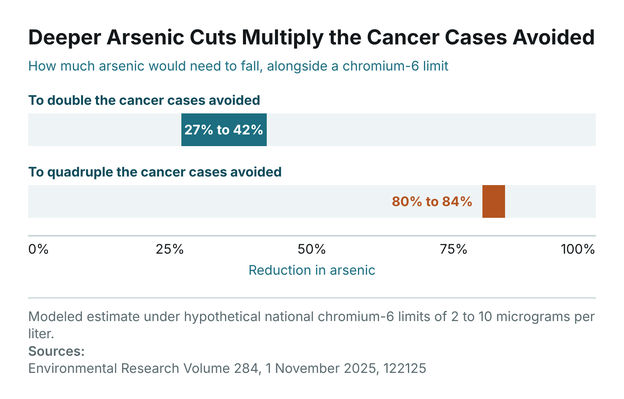
Under hypothetical national chromium-6 limits of 2 to 10 micrograms per liter, simultaneously reducing arsenic by roughly 27% to 42% would double the estimated number of lifetime cancer cases avoided, and quadrupling them would require arsenic reductions of about 80% to 84%.
In a separate Wisconsin case study cited by the researchers, a modeled 20% statewide reduction in nitrate was estimated to avert about 130 cancer cases a year, corresponding to roughly $35 million in annual direct medical costs.19
• Federal regulation lags behind both science and state action — National standards still largely evaluate drinking water contaminants one at a time, even though people are exposed to complex mixtures. Arsenic’s federal limit hasn’t changed since 2001. Nitrate’s hasn’t changed since 1992.
• Meanwhile, as of the study’s publication, there was still no federal limit for hexavalent chromium, only for total chromium, which doesn’t distinguish between the toxic hexavalent form and the far less harmful trivalent form. According to Tasha Stoiber, Ph.D., a senior scientist at EWG and lead author of the study:
“Drinking water is contaminated mostly in mixtures, but our regulatory system still acts like they appear one at a time. This research shows that treating multiple contaminants together could prevent tens of thousands of cancer cases.”20
• A call for better water regulations — Many rural water systems serve just a few hundred or a few thousand people. For these communities, installing and maintaining effective treatment infrastructure comes at a high cost per household. Even when the threat is clear and the solution exists, they often lack technical support and funding to make changes. David Andrews, Ph.D., acting chief science officer at the EWG, stated:
“This is about more than clean water — it’s about protecting health and advancing equity. We have the engineering solutions to fix the broken drinking water system in the U.S., but we need state and federal policies to reflect the reality people face when they turn on the tap.”21
For a deeper look at other harmful contaminants found not just in tap water but also in bottled water, check out “Cancer-Causing Chemicals Found in Tap and Bottled Water.”
Consider a High-Quality Filtration System to Reduce Your Exposure to Water Contaminants
The study’s estimates apply to treatment by community water systems; it didn’t evaluate home filters or measure whether filtering water at home changes cancer risk. Still, if testing shows these contaminants in your water, a home system certified to reduce them is a practical way to lower your exposure. While there is no single solution that works for everyone, whole-house filtration is generally the most comprehensive option.
• Use a combination of point-of-entry and point-of-use filtration — Ideally, water needs to be filtered at both the main supply line entering your home (point of entry) and again at key locations where it’s consumed or used, such as the kitchen sink and showers (points of use). This dual approach can provide broader protection against a range of contaminants.
• Choose a system certified for your specific contaminants — Not every filter reduces arsenic, nitrate, or chromium-6, so look for a system that is independently certified to reduce the contaminants actually found in your water.
Ion exchange is another option. These systems use specialized resins to remove charged contaminants; the researchers note that, at the water-system level, anion exchange can remove chromium-6, arsenic, and nitrate together.22
• Some households may benefit from combining filtration technologies — For example, use activated carbon for chlorine and volatile organic compounds, along with a technology such as ion exchange for charged contaminants like arsenic, nitrate, and chromium-6.
• Filter performance depends on maintenance — Regardless of system type, performance depends on proper installation, periodic testing, and routine maintenance. Filters degrade over time, and when they’re overdue for replacement, they may allow contaminants to pass through unnoticed.
• Know what you’re dealing with before you choose a system — To understand what’s in your tap water, EWG’s Tap Water Database23 is a valuable starting point. By entering your ZIP code, you can view the latest testing data from your local water utility and compare contaminant levels against both federal legal limits and stricter health-based benchmarks.
Once you know your specific exposures, choose a filtration system that directly targets them. For detailed comparisons and product guidance, visit EWG’s Water Filter Guide.24
More Ways to Protect Your Water
Filtration is an important step, but it’s not the only one you can take. There are additional ways to help reduce hidden exposures and give you more control over water quality from the source to the tap.
• Flush stagnant water from your pipes — If the tap hasn’t been used for several hours, such as overnight or after returning from travel, let the water run for a minute or two before using it. This helps clear out water that may have absorbed metals or chemicals while sitting in the pipes.
• Test private wells regularly — If your household relies on a private well, periodic testing is essential. Unlike municipal systems, private wells are not routinely monitored by public agencies. Testing at least once a year can help catch emerging problems early.
• Stay informed about your local water utility — Public water systems are required to publish Consumer Confidence Reports each year. These documents list detected contaminants, explain any violations, and, where applicable, describe steps being taken to address them. Reading these reports helps you understand whether your community is meeting safety benchmarks and where gaps still exist.
• Engage with local and state decision-makers — Infrastructure upgrades and water treatment projects depend on funding and policy support. Contacting your state representatives, attending water board meetings, or submitting public comments on proposed rules helps ensure your concerns are heard. When residents get involved, it becomes harder for decision-makers to overlook the public health cost of delay.
Frequently Asked Questions (FAQs) About Water Contaminants and Filtration
Q: Which cancer-linked tap water contaminants did the EWG study focus on?
A: The study focused on hexavalent chromium (chromium-6) and arsenic, two carcinogenic contaminants that frequently co-occur in groundwater, and also mapped nitrate. These pollutants often appear together, especially in agricultural or industrial areas, and long-term exposure has been associated with higher risks of several cancers, including stomach, bladder, lung, and ovarian cancers.
Q: Which states had the greatest estimated burden in the study?
A: California, Arizona, and Texas had the most potentially avoidable cancer cases associated with chromium-6, and EWG says they also bear the highest burden of arsenic pollution. Higher chromium-6 levels have been detected in groundwater in these states, where chromium-6 and arsenic frequently co-occur.
Q: How can I find out what contaminants are in my tap water?
A: Use the EWG Tap Water Database. By entering your ZIP code, you can view testing results from your local utility and see how contaminant levels compare to both federal legal limits and stricter health-based guidelines.
Q: What kind of home water filter can reduce arsenic, nitrate, and chromium-6?
A: Look for a system that is independently certified to reduce the specific contaminants found in your water. Ion exchange systems use specialized resins to target charged contaminants such as nitrate, arsenic, and chromium-6. For broad protection, many households combine point-of-entry and point-of-use filters.
Q: What can I do to improve water quality in my community?
A: Beyond filtration, flush stagnant water after long periods of disuse, test private wells yearly, read your utility’s Consumer Confidence Report, and advocate for local infrastructure upgrades and stricter standards. Public involvement can accelerate change where policy lags.
This article is for informational purposes only and does not constitute medical advice. Consult a qualified health care provider before making changes to your health regimen.