



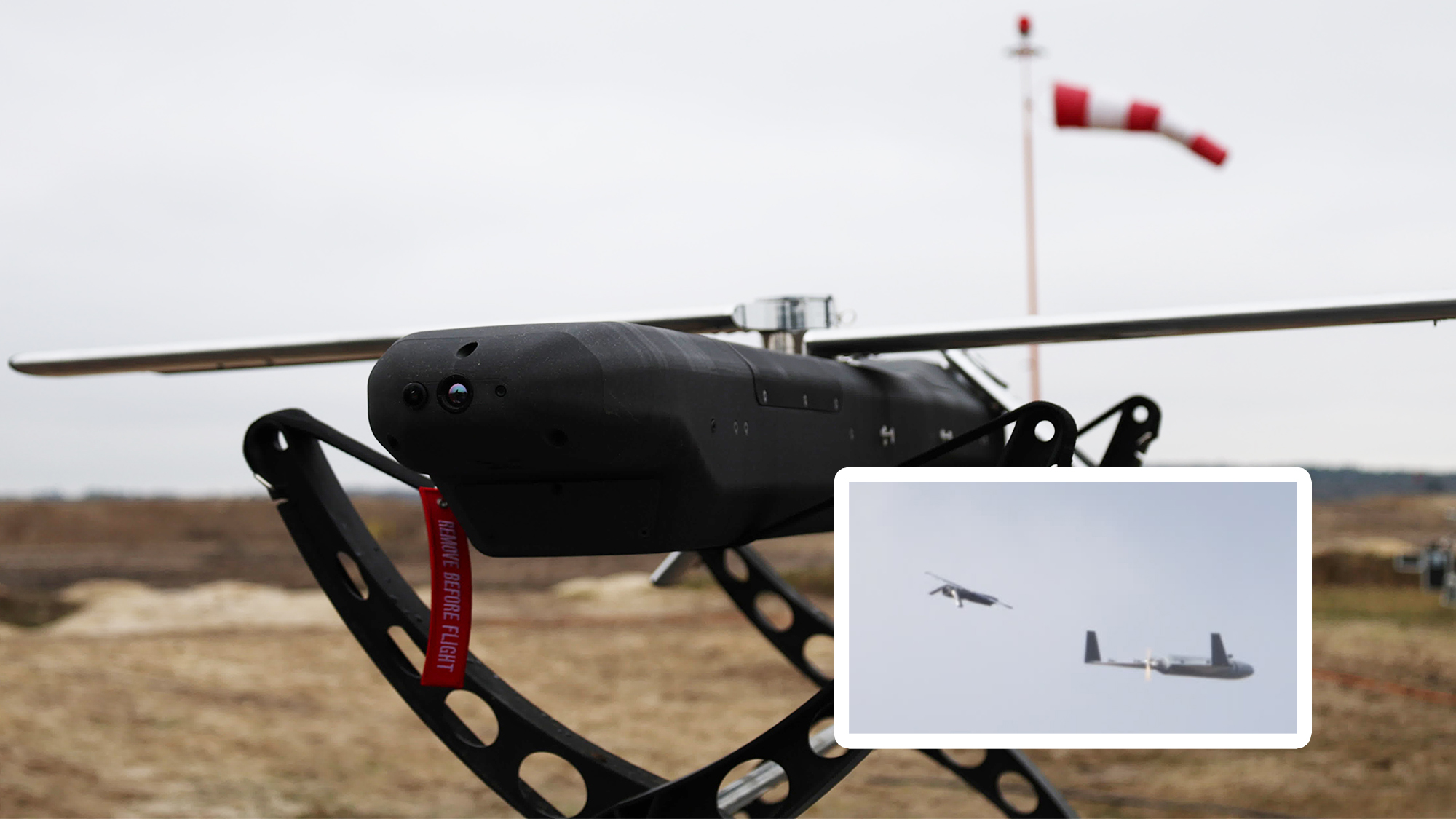
Emerging British manufacturer Cambridge Aerospace will deliver ‘a significant number’ of low-cost Skyhammer air defense systems designed to counter attack drones such as the Shahed 136 at ranges of more than 30km.
The announcement was made by UK Defense Secretary John Healey MP on the opening day of the London Defense Conference, which will be held every spring at King’s College London from 2022. Pending contract confirmation, the first units are expected to be delivered to the UK Armed Forces in May 2026, with all deliveries expected to be completed within six months. Although exact figures have not yet been officially confirmed, Cambridge Aerospace said the deal includes a ‘significant number’ of systems.
The Skyhammer was unveiled by Cambridge Aerospace at last year’s Defense and Security Equipment International (DSEI) exhibition. At the show, the company said the design went from design stage to sky in just six weeks. Powered by a jet engine to a maximum speed of 700 kilometers per hour, ground-launched from a tube, it features a custom radar for terminal guidance. The first flight of this system took place in the first half of 2025.
Britain’s Cambridge Aerospace has said it will supply a ‘significant number’ of low-cost Skyhammer air defense systems to the UK Ministry of Defense from May. Skyhammer, optimized for the counter Shahed role, boasts a range of 30km and a top speed of 700km/h. #avgeek pic.twitter.com/0VXxw8WU9S
— Tim Robinson (@RAeSTimR) April 10, 2026
The Skyhammer’s exact per-unit cost is not known, but company representatives have suggested it is very much the same as the cost of a Shahed 136-style drone ($20,000-$50,000). This appears to be slightly cheaper per round than the Martlet missiles (also known as Light Multi-Role Missiles, or LMMs) that Wildcat helicopters are currently using to counter attack drones in the Eastern Mediterranean.
I just spoke with Rocket Scientist CEO and Founder Steven Barrett. He said: “Shahed drones cost from £20k to £30k…
“Skyhammer is similar. It’s similar.”
— Jerome Starkey (@jeromestarkey) April 10, 2026
It’s also similar to the single Advanced Precision Kill Weapon System II (APKWS II) round being tested for Typhoon delivery in an anti-drone capability, one of the first we reported on last month. Importantly, Skyhammer surpasses both the APKWS II and Martlet’s at-range performance, despite being designed to be launched from the ground. The air-to-air weapon currently used by Typhoon and F-35B to shoot down drones is the Short-Range Air-to-Air Missile (ASRAAM), a world-class air-to-air missile with a unit price of 200,000 pounds.
A Typhoon equipped with a rocket pod has been spotted for the first time.
An RAF Typhoon was pictured carrying two seven-gun LAU-131 rocket pods from BAE Systems Warton. These rocket pods can be used to launch APKWS against surface and, importantly, airborne targets.
Story: https://t.co/9ZJtVJ4wjz
— The Aviation Expert (@TheAviationist) March 6, 2026
Secretary of Defense Healey said: “Our government’s support of Cambridge Aerospace is a key example of a veteran-founded British defense start-up scaling up to deliver new interceptor missiles within weeks for our armed forces and Gulf partners, as well as delivering good jobs and security here in the UK.”
Steven Barrett, CEO of Cambridge Aerospace, added: “With aerial threats to the UK and its allies increasing every day, it is vital that we are able to defend ourselves effectively. Skyhammer is designed to do exactly that – providing affordable mass to protect our skies. We welcome the Government’s commitment to supporting UK air defense with a scalable sovereign solution.”
As Healey mentioned, Skyhammer ‘drone killers’ will also be supplied to unspecified partners in the Gulf region. The UK has been working closely with several Gulf states to coordinate defenses against drone and missile attacks by Iran and Iranian-backed forces, which has seen RAF Typhoon FGR4 aircraft deployed to Qatar and Rapid Sentry systems (launching Martlet missiles) deployed to Iraq, Jordan and Kuwait. The Stormer HVM armored vehicle, capable of firing Martlet missiles or the related anti-aircraft-only Starstreak missiles, has been deployed in Saudi Arabia since 2022.
Cambridge Aerospace includes:
Skyhammer (left) – tube-launched subsonic turbojet drone interceptor, Mach 0.7, 30 km)
Starhammer (right) – solid rocket, advanced drone/cruise missile interceptor, Mach 2, 10 km). A longer BM supported version is in development. https://t.co/UuwN6F0E0q pic.twitter.com/z1SjRyiTzT
— Britsky (@TBrit90) April 10, 2026
Cambridge Aerospace also has Starhammer in its development pipeline. This Starhammer is designed as a more traditional point-defense surface-to-air missile for higher tier threats and boasts a top speed of Mach 2. Anti-ballistic missile (ABM) capabilities are envisioned in future evolutions. The company currently supports 125 jobs in the UK and the deal is expected to create up to 50 more jobs.
Big hit due to delay in defense investment plan
The Pentagon’s announcement of the acquisition comes as the Defense Investment Plan (DIP) promised in last fall’s Strategic Defense Review has yet to be announced. Now that they are long overdue, many defense investment and procurement decisions have been put on hold until they are finalized. Special exceptions had to be made to place orders for Leonardo and its New Medium Helicopter (NMH) after the company made it very clear and direct that delays in awarding the contract were threatening the future of its UK operations.
Facing questions at the London Defense Conference, Healey did not give a date when the DIP was expected to be published, but said: sky news “This is a 10-year plan. It’s important to get it right.” The unnamed official said the plan could be announced in June, but that date is not guaranteed. The complications are said to largely arise from complex negotiations between the Department of Defense and the Treasury over the significant funds needed to make the necessary investments.
BREAKING NEWS: Finalizing the UK’s much-delayed defense investment plan – which should have been announced last autumn but remains shrouded in secrecy – is the Prime Minister’s “top priority”, the Defense Secretary has said.
— Deborah Haynes (@haynesdeborah) April 10, 2026
Key capabilities covered by the DIP are expected to include the Global Combat Air Program (GCAP) fighter aircraft, the UK’s F-35 fleet, the Royal Navy’s planned Type 83 air defense destroyer, air-to-ground weapons, air defense systems, and various drone and counter-drone platforms.
Both large and small defense companies are being hit by delays, and many companies have suspended transactions during difficult times. Andrew Kinniburgh, Director General of Make UK Defense, said: guardian Small companies are “desperately trying to hold on to their people and keep their factories going. The problem for them is they’re just bleeding cash. Cash goes out every day to feed the baby birds and they just stand still.”







