



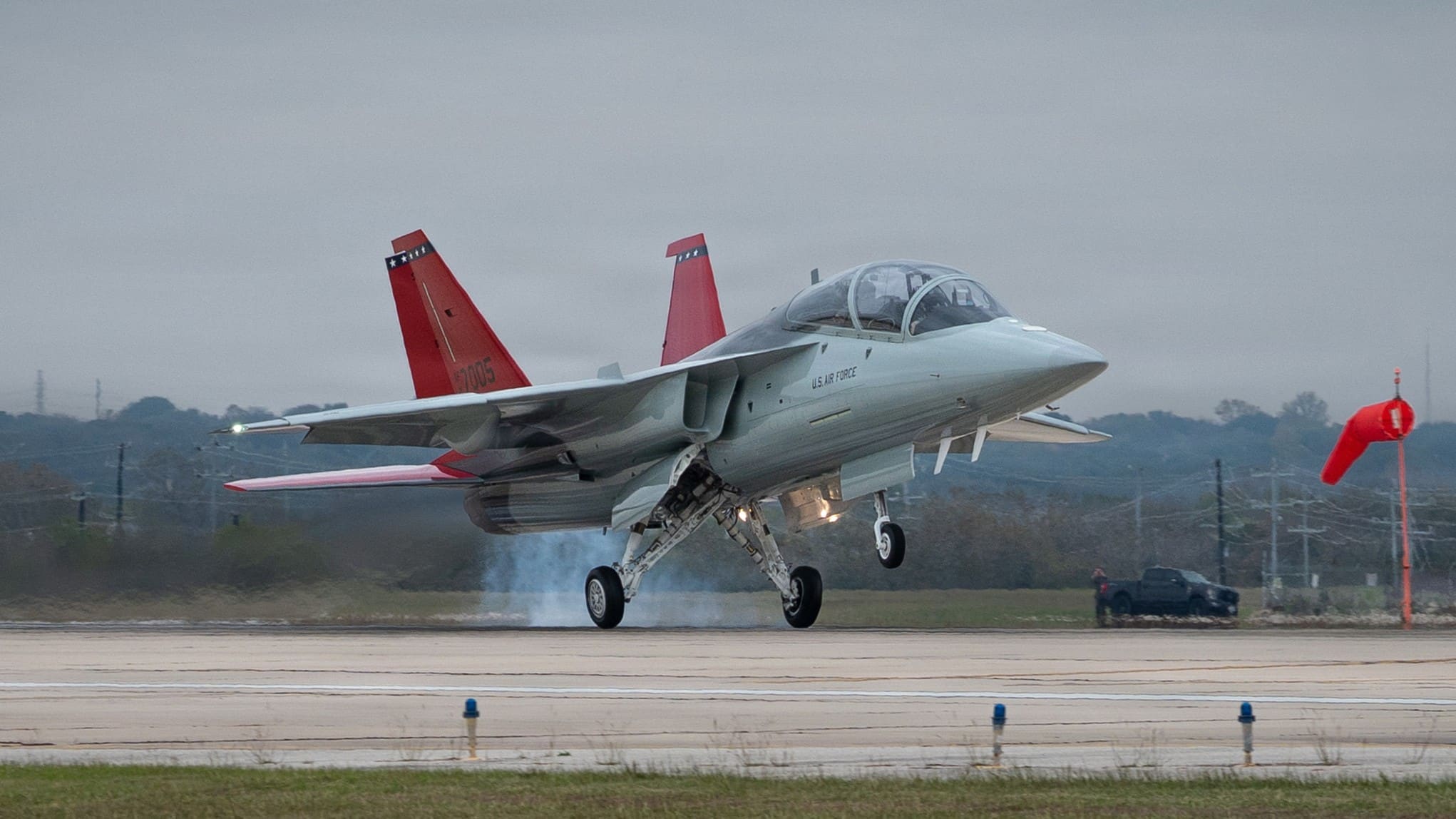
Following the Milestone C decision last April, the U.S. Air Force authorized serial production of the T-7A Red Hawk and ordered the first 14 trainer aircraft.
The U.S. Air Force and Boeing Defense announced on May 4, 2026 that the T-7A Red Hawk reached Milestone C on April 23 and confirmed the start of mass production. Accordingly, Boeing was awarded a $219 million contract for the first 14 advanced trainer aircraft, as well as associated spare parts, support equipment and training, as part of Low Rate Initial Production (LRIP).
The broader program of record includes 351 T-7As and 46 ground-based training simulators to be delivered to five Air Education and Training Command (AETC) bases over the next 10 years. The first T-7A Red Hawk trainer aircraft was delivered to Joint Base San Antonio, Texas (Randolph, Texas) on December 5, 2025.
Ready and capable.
thank you, @USAirForceFor trust and partnership in the T-7A #Red Hawk. Milestone C paves the way for low-rate initial production. It is our mission and commitment to quickly provide these trainers to the fighter and bomber pilots of the future. Let’s fly! pic.twitter.com/RcWtjv58Wy
— Boeing Defense (@BoeingDefense) May 4, 2026
It was originally delayed, but is now back on track.
A recent Air Force statement confirmed that initial operational capability (IOC) for the T-7A is scheduled for 2027, with a focus on beginning to replace the aging T-38 Talon and finalizing the Engineering and Manufacturing Development (EMD) phase. The original IOC target of 2024 was missed, and the previous White House administration also postponed the Milestone C decision to 2026.
The Milestone C decision is the first of an “innovative, phased approach” in which the T-7A Program Office will seek individual approval for each of the first three low-rate initial production lots. This will help manage “concurrency risk by incorporating insights from ongoing development testing and other program progress prior to embarking on subsequent production.”
The aircraft has suffered numerous delays since the program’s launch due to problems discovered during the early development and testing stages. Among these were the aircraft’s behavior at high angles of attack and problems with its escape system.
✅ Production hot clear!!!
Once you reach Milestone C, you’ll be on your way to the next generation of equipment. @usairforce A pilot with cutting-edge training capabilities. #T7ARRedHawk #TheFirstCommand https://t.co/McZsdeXz6o
— AETC – First Command (@AETCommand) May 4, 2026
The Air Force says the T-7A Red Hawk will revolutionize undergraduate pilot training and education for fourth-, fifth- and sixth-generation fighter aircraft by replacing the older T-38 Talon. The Air Force highlighted the T-7A Red Hawk’s distinction as the Air Force’s first platform designed and built using all-digital methods “to streamline development, production and sustainment,” and the execution of a joint roadmap that continues to advance the aircraft’s development, test operations and introduction.
Milestone C and Production Decisions
An Air Force statement called the Milestone C request a “pivotal moment” for the T-7 Advanced Pilot Training Program, following a year of intensive “active management” between the Air Force, Air Education and Training Command and Boeing. The three’s close collaboration was effective in “delivering capabilities to the warfighter as quickly and safely as possible.”
“Reaching Milestone C is a testament to the dedicated government and industry teams who worked diligently to overcome complex technological obstacles,” said William Bailey, acting Assistant Secretary of the Air Force for Acquisition, Technology and Logistics. “The T-7A is a pivotal program for the future of our combat air force, and entering production brings us one step closer to putting this essential capability in the hands of instructor pilots and students.”
It’s historic and symbolic.
A second T-7A Red Hawk lands. @jbsa_official -Randolph towering with the Taj Mahal in the background – Setting another milestone #AETC We will guide you @usairforceIt’s the next era of pilot training modernization.
📸 U.S. Air Force photo by Ben Faske pic.twitter.com/6W1sXHZl2p
— AETC – First Command (@AETCommand) January 16, 2026
Describing the Milestone C approval as “landmark,” Rodney Stevens, training program executive officer and director of training at the Air Force Life Cycle Management Center (AFLCMC), said it represents “confidence in the aircraft design” to support early series production. “There is still work to be done, but we have strong partnerships and a clear path to delivering the most advanced pilot training system in the world,” Stevens added.
“Our mission is to train the next generation of combat aviators, and the T-7A Red Hawk is the tool we need to do that,” said Brig. Gen. Matthew Leard, AETC’s director of plans, programs, requirements and international affairs. “Replacing the T-38, which is more than 60 years old, is a top priority. The T-7A’s advanced systems provide students with a much more realistic training environment, ensuring they are prepared for the cockpits of the future.”
T-7A milestone before serial production
As reported by the Air Education and Training Command (AETC), the T-7A program has seen a series of steady developments since late last year. High-speed ejection seat testing took place on April 16, 2025, resolving safety concerns about the escape system.
In May 2025, Lt. Gen. Brian Robinson became the first non-test pilot to fly the T-7A at Edwards Air Force Base, California. The service currently flies five Production Representative Test Vehicle (PRTV) test aircraft, with the last aircraft delivered in December 2024.
‘I’m just resting.’ ❄️
that #T7A Red Hawk has just completed anti-fog, frost and ice ground testing. @Team Eglin From the McKinley Climate Institute. Advanced trainers are exposed to radical environmental conditions to validate their systems in a variety of climates. pic.twitter.com/G7JTzshG1k
— Boeing Defense (@BoeingDefense) June 23, 2025
Between May and July 2025, the aircraft underwent a second extreme weather test at Eglin AFB, Florida. The aircraft then joined the 12th Flight Training Group at Joint Base San Antonio-Randolph (JBSA), Texas, in December 2025, ahead of an official arrival ceremony on January 9, 2026.
AETC and Boeing reported the arrival of a second T-7A Red Hawk (Tail 21-7003) at JBSA on January 16. This aircraft will help establish Type 1 maintenance training and initial pilot training and train first instructors.
Ahead of the Milestone C decision, AETC Director Lt. Gen. Clark Quinn visited the Air Force Test Center (AFTC) at Edwards AFB on Jan. 31 to “see updates on the T-7A Red Hawk program and complete the first flight with the aircraft.” By March 10, AETC said JBSA’s first batch of maintainers had completed Phase 1 qualification training on the T-7A Red Hawk.
@usairforce COMAETC’s Lt. Gen. Clark Quinn visited @airforcetestcenter at @edwardsairforcebase for an update on the T-7A Red Hawk program and completed his first flight in the aircraft. pic.twitter.com/p2B2W3xWRP
— AETC – First Command (@AETCommand) January 31, 2026
Maintainers from the 12th Aircraft Maintenance Squadron (12 AMXS) completed crew chief mission, propulsion, integrated avionics, escape, fuel and maintenance instructor courses. AETC said that with theoretical and practical training in the operation, removal, installation and testing of all major systems, maintenance personnel were given “a written exam measuring knowledge-based learning and an instructor checklist used to evaluate hands-on maintenance tasks.”
Prepare maintenance personnel to keep the next generation of pilots trained.
air force soldier @JBSA_Official We are completing Phase 1 qualification training for the T-7A Red Hawk and building the technical expertise needed to support it. @usairforceFuture Training Aircraft. https://t.co/926c24LOm4 pic.twitter.com/EQHYbkAOiE— AETC – First Command (@AETCommand) March 12, 2026
The training was divided into an Initial Training, Operations and Evaluation (ITO&E) phase and an Initial Sustainment Support (ISS) phase. “ITO&E represents the initial qualification phase where mechanics receive formal training and on-the-job training to build a foundational knowledge of aircraft systems and maintenance procedures. ISS follows a sustainment phase where qualified personnel apply their training while continuing to improve procedures and gain experience as aircraft are integrated into the training enterprise,” the statement explained.
The T-7A Red Hawk’s ground-based simulator features high-resolution visual effects and integrated avionics, providing pilots with a realistic environment to train in complex mission-relevant conditions.
Check it out!
🔗 https://t.co/gGs1R9UURF📸 @jbsa_official #T7A #Redhawk #pilot training pic.twitter.com/7gWg4hYV6T
— AETC – First Command (@AETCommand) April 24, 2026







