



The Copperhead family of autonomous underwater vehicles (AUVs) can be equipped with ISR for external detection, communications and acoustic payloads, or warheads for kinetic purposes.
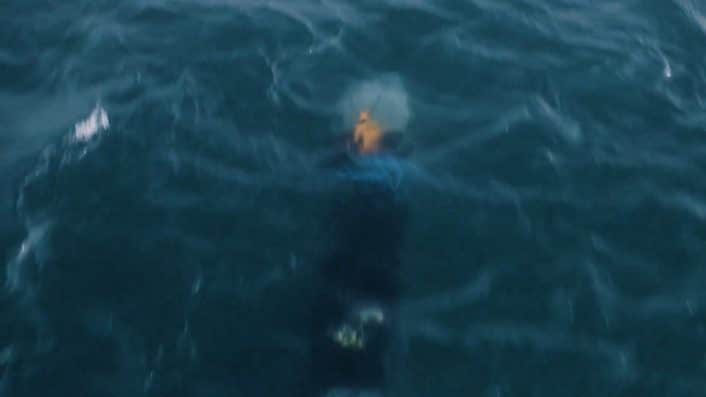
Anduril released the first look video of the Copperhead-500M underwater weapon, part of the Copperhead autonomous underwater vehicle (AUV) series, on April 25, 2026, in a short 16-second clip. Footage shows the weapon moving just below the surface of the water during a test that is believed to have taken place recently.
“This is the first public video of the Copperhead-500M swim,” the company said in the post. “During testing, the 21-inch heavy AUV successfully broke internal speed records while demonstrating extreme agility maneuvers in open seas.”
The company did not say when or where the tests were conducted. The Copperhead 100 and 500 are the two main products in this family of naval weapons, with variants for both kinetic and non-kinetic missions.
If you see a Copperhead approaching,
It’s already too late.Shown: First public footage of the Copperhead-500M swim. During testing, the 21-inch heavy AUV successfully broke internal speed records while demonstrating extreme agility maneuvers in open seas. pic.twitter.com/oCgvkQ5FIP
— Anduril Industries (@anduriltech) April 24, 2026
As shown on the product page on the company’s website, the ‘M’ designation and yellow bands around the side body indicate a torpedo-shaped vehicle. Vehicles without these markers are instead underground detection AUVs.
The video does not show the Copperhead-500M hitting the target, but the blue band indicates it is an inert AUV with no explosives. Additionally, the video does not show the control room or operator console that operates the system.
Anduril’s underwater system
The company unveiled the Copperhead family a year ago in early April, emphasizing its mass productivity and ability to launch from other land, air, and the company’s own large subsea platforms, such as the Ghost Shark very large unmanned underwater vehicle (XLUUV), Dive-LD, and Dive-XL. Anduril also pointed out that the vehicle could be used for civilian and humanitarian purposes.
The marine vehicle adds to Anduril’s diverse portfolio of modular and scalable systems, including the YFQ-44A Fury Collaborative Combat Aircraft (CCA), the Barracuda family of autonomous aircraft, the Roadrunner reusable anti-aircraft interceptor drone, and the Ghost Shark extremely large unmanned underwater vehicle (XLUUV).
Australia has announced a $1.12 billion contract for its fleet of Ghost Shark XLUUVs, which will be manufactured within Australia in September 2025. The company also announced that it was selected as a participant in the Combat Autonomous Maritime Platform Project (CAMP) of the Defense Innovation Unit (DIU) on March 12, 2026.
“Anduril will complete a long-term, operationally representative demonstration of the Dive-XL within four months of contract award,” the company said. Dive-XL also performed successfully in Australia before Sydney chose Ghost Shark.
Anduril has secured a US$1.7 billion (US$1.2 billion) contract to deliver its Ghost Shark XL-AUV fleet. @Australian_Navy.
This is our first international program of record. Production is already underway. pic.twitter.com/VZDnU9TyxR
— Anduril Industries (@anduriltech) September 10, 2025
Copperhead family of detection and strike AUVs
The Copperhead-100M is a lightweight torpedo measuring 12.75 inches in diameter and 9 feet long, while the larger Copperhead-500M is a heavy torpedo measuring 21 inches thick and just over 13 feet long. Copperhead-100 and 500 are classic ISR AUVs capable of carrying interchangeable payloads for extended communications, magnetometers and side-scan sonar for anti-submarine warfare and chemical detection devices.
The maximum speed of all Copperheads is 30 knots. Roughly speaking, the Copperhead-500 can be considered roughly equivalent to the Mk 48 heavy torpedo, and the Copperhead-100 can be considered roughly equivalent to the Mk 54 light torpedo.
Anduril said in an April 7, 2025 release: “With Dive-LD and Dive-XL, Copperhead supports comprehensive, intelligent maritime capabilities that enable operators to rapidly respond to threats in the undersea battlespace at a fraction of the cost of legacy options.”
More firepower.
The United States and its allies need scalable, autonomous undersea weapons that can be rapidly deployed to meet the requirements of modern naval operations.
Meet Copperhead. Anduril’s family of high-speed, software-defined AUVs. pic.twitter.com/uxRMHOlXIH
— Anduril Industries (@anduriltech) April 7, 2025
The company called Copperhead-M a “munitions variant” for autonomous vehicles with “affordable, mass-producible torpedo-like capabilities.” “Copperhead-M enhances Naval operations by enabling commanders to use autonomous vehicles for high-risk missions and responding more accurately and effectively to maritime threats while protecting more valuable assets and personnel,” the company said.
For example, Anduril’s Dive-XL can carry dozens of Copperhead-100Ms or multiple Copperhead-500Ms, “providing underwater firepower as needed to neutralize or destroy maritime threats.” Both can also be repurposed for “rapid response commercial missions” such as “search and rescue, critical infrastructure inspection, and environmental monitoring.”
future
The Copperhead system has not been tested by the U.S. Navy’s existing surface combatants or the P-8A Poseidon, its primary maritime patrol and anti-submarine warfare platform. However, all of these platforms are expected to work in conjunction with Anduril’s Seabed Sentry Undersea Sensor Network, which the company unveiled just days before it unveiled Copperheads.
According to a 2022 Government Accountability Office (GAO) report, the U.S. Navy’s Orca The Defense Advanced Research Projects Agency (DARPA) is also testing Northrop Grumman’s very large glider, the Manta Ray UUV. The glider is “capable of long-duration, long-range, and payload-capable underwater missions without the need for field personnel.”







