



Succession planning for food and beverage companies is becoming increasingly difficult as retirements accelerate and leaders change companies more frequently. Common challenges include thin staffing, limited time for leadership development, and a lack of structured processes to prepare employees for broader roles. Without a succession plan, leadership transitions lead to confusion in decision-making, gaps in technical expertise, and added pressure on already-stretched teams to take on additional responsibilities.
Recent research from specialist search firm 3P Partners highlights just how serious the succession planning gap is in the food and beverage industry. A survey of 89 food and beverage industry executives found that 82% were worried about losing their institutional knowledge through retirement or unplanned career changes. 45% have lost a key leader in the past year without a successor being identified. Despite this, only 16% of food and beverage companies surveyed reported having a formal succession plan.
These gaps risk operational disruption, loss of institutional knowledge, and cultural instability during leadership transitions.
“Succession planning impacts every stage of business growth and every market situation, yet it remains a low priority for most food and beverage companies,” said Rachel Quinn, Managing Partner at 3P Partners. “The talent mistake leaders fear most is making the wrong hire. A bigger and often overlooked risk is the lack of a clear succession plan. We often see powerful operators without a prepared bench. When change comes unexpectedly, the costs are timeless. It can unsettle customers, lenders and investors.”
Not surprisingly, the survey results showed that operations and manufacturing roles within the food and beverage industry were among the most difficult roles to assess for advancement readiness.
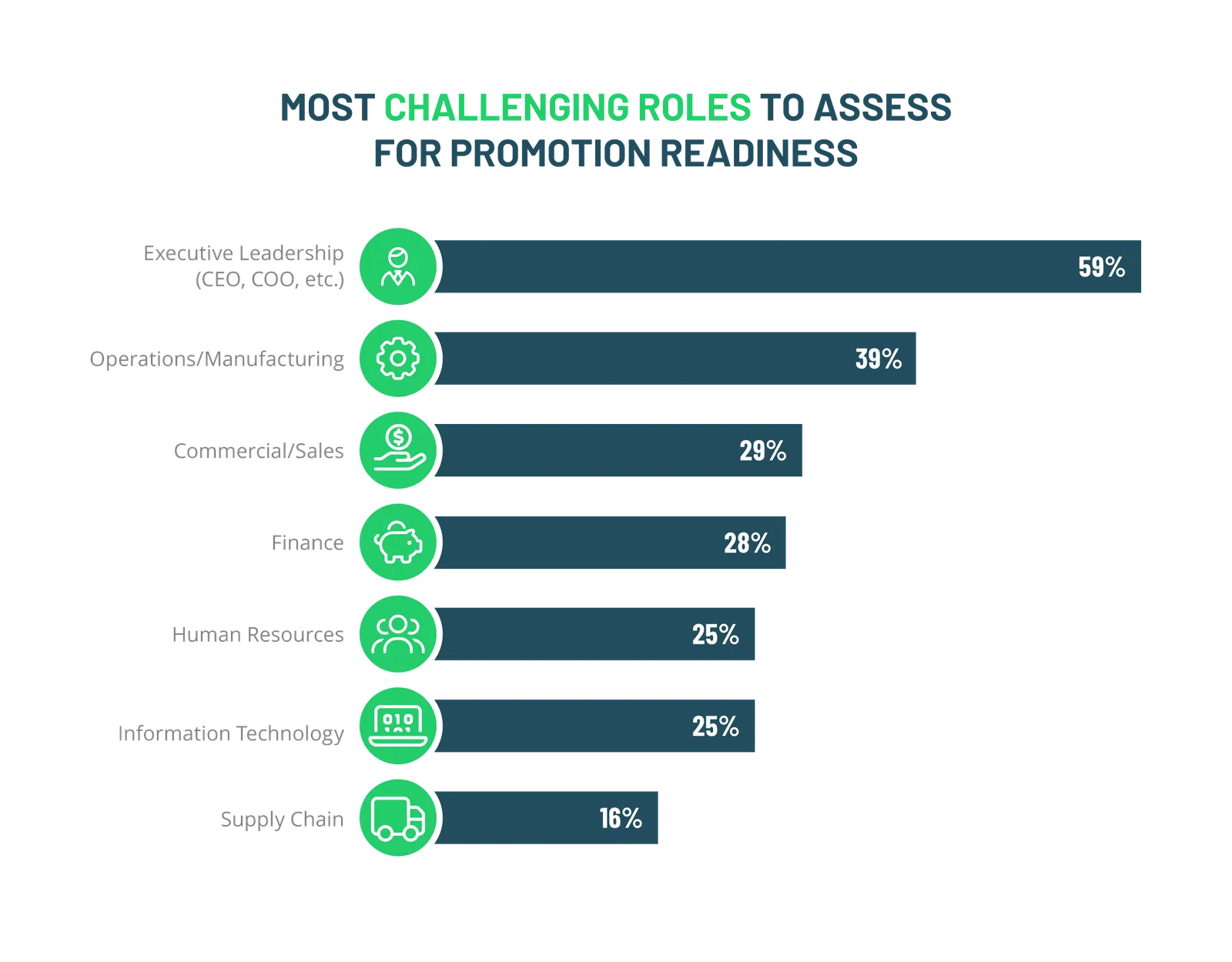
Source: 2025 Food and Beverage Executive Survey, 3P Partners
These functions often rely on leaders with deep technical expertise, but few are coached to translate that knowledge into strategic leadership or cross-functional influence.
Despite these challenges, companies that take a systematic approach to succession planning are finding practical ways to strengthen leadership continuity. The study points to several practices that companies across industries are using to strengthen leadership continuity.
- Start early and review often. The best programs identify successors two to three years in advance.
- Use structured tools. Frameworks like Nine Box Grid help executives make objective, data-driven promotional decisions.
- Invest in mentoring. Matching high-potential employees with experienced leaders transfers important operational and cultural knowledge.
- Encourage cross-departmental exposure. Future leaders who understand supply chain, finance, and operations will adapt faster.
- We place culture and communication as our top priorities. Employees invest in the companies they invest in.
The full study results can be found in 3P Partners’ newly released 2026 Salary Guide. This guide provides compensation data for more than 75 key roles, categorized by company size and function, along with insights into succession risk, talent availability and promotion readiness across the food and beverage sector.
This guide expands on the survey results summarized here and provides additional insights from leaders at Latitude Wines, Adams Group, and A. Duda & Sons, Inc. They shared how their organizations approach succession planning, leadership development, and talent preparation. You can download it for free here.








